Probability · Lecture 14 · cp-probability
📺 Course materials — Lecture 14:
lecture video · handout PDF (Lecture 14) · board notes (14.jpg) · homework answer key (Chapter 14)
— all in the
amc8/video folder.
·
🖨 Printable PDF (answers & solutions at the back)
🔑 Key facts
For equally likely outcomes: $P = \dfrac{\text{favorable outcomes}}{\text{total outcomes}}$.
Always $0 \le P \le 1$, and the probabilities of all possible outcomes add up to $1$ ($100\%$) — that last fact powers the
complement trick: $P(\text{at least one}\ldots) = 1 - P(\text{none})$.
Most AMC 8 probability problems are really the counting problems of Lecture 12 run twice: count the total, count the favorable.
🧰 Instructor's toolbox (from the lecture video & board notes)
3 · Count both layers with combinations. When a hand of items is drawn, both counts are $C$'s:
$3$ cards from $5$: total $C_5^3 = 10$. "$4$ is the largest" means the $4$ is in the hand and the other two come from $\{1,2,3\}$: $C_3^2 = 3$.
The board flags the classic slip: $C_4^3$ counts hands from $\{1,2,3,4\}$ — hands that may not even contain the $4$.
4 · Two roads, same answer. Every finite probability can be computed by counting outcomes or by multiplying step probabilities — the instructor does the jelly-bean example both ways:
counting: $2\times4 = 8$ pairs, $3$ match → $\frac38$; steps: $\frac12\cdot\frac14 + \frac12\cdot\frac24 = \frac38$.
Solve with the easier road, check with the other.
5 · Casework by type (parity is the favorite).
"Sum is even" splits into odd$+$odd or even$+$even. Dice with faces $1,2,3,5,7,8$: $P(\text{odd}) = \frac46$, so
$P(\text{even sum}) = \left(\frac46\right)^2 + \left(\frac26\right)^2 = \frac{16+4}{36} = \frac59$.
Cases must not overlap and must cover everything.
6 · Complement & symmetry.
"At least one…" → $1 - P(\text{none})$: the octagon triangle (Example 5) is $1 - \frac{16}{56} = \frac57$.
Symmetry: two identical dice → $P(\text{first} > \text{second}) = P(\text{second} > \text{first})$, so
$P(\text{first} \ge \text{second}) = \frac16 + \frac{1 - \frac16}{2} = \frac{7}{12}$ — ties first, split the rest evenly.
7 · Geometric probability — compare areas. When the choice is continuous (a dart, a random point), probability $=$ favorable area $\div$ total area (or lengths).
The dartboard (Practice 12): a region's probability is its area share, not its "$\frac13$ of a circle" label.
Even discrete boards work this way: a random unit square not touching the edge of an $8\times8$ board → $\frac{36}{64} = \frac{9}{16}$.
8 · Recursion for repeated random moves. "After $n$ hops…" with too many paths to list → define $f(n)$, relate it to $f(n-1)$, and iterate from a known start.
The cricket (Practice 13): to be home after $n$ hops you must be away after $n-1$ hops, then hop home ($1$ of $3$ ways):
$f(n) = \dfrac{1 - f(n-1)}{3}$, $f(1) = 0$ → $f(2) = \frac13$, $f(3) = \frac29$, $f(4) = \frac{7}{27}$.
The same idea counts Jo's stair climbs: $f(n) = f(n-1) + f(n-2) + f(n-3)$.
📖 Worked examples
2019 AMC 8 #6 · favorable/total
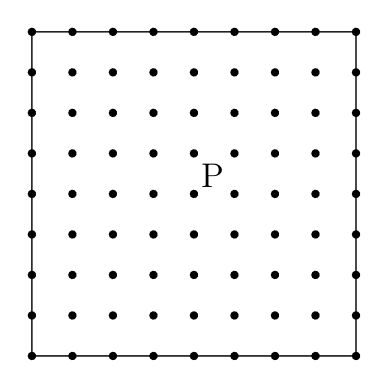
Example 1. There are $81$ grid points (uniformly spaced) in the square shown in the diagram below, including the points on the edges. Point $P$ is in the center of the square. Given that point $Q$ is randomly chosen among the other $80$ points, what is the probability that the line $PQ$ is a line of symmetry for the square?
(A) $\frac{1}{5}$(B) $\frac{1}{4}$(C) $\frac{2}{5}$(D) $\frac{9}{20}$(E) $\frac{1}{2}$
Key idea: the square has exactly $4$ symmetry lines (two diagonals, horizontal and vertical midlines) — all passing through $P$.
Along each line sit $8$ grid points besides $P$ ($4$ on each side). So $4\cdot8 = 32$ favorable positions for $Q$ out of $80$:
$P = \dfrac{32}{80} = \dfrac{2}{5}$.
Answer: C
2017 AMC 8 #10 · combinations
Example 2. A box contains five cards, numbered $1, 2, 3, 4,$ and $5$. Three cards are selected randomly without replacement from the box. What is the probability that $4$ is the largest value selected?
(A) $\frac{1}{10}$(B) $\frac{1}{5}$(C) $\frac{3}{10}$(D) $\frac{2}{5}$(E) $\frac{1}{2}$
Key idea: "4 is the largest" = the hand contains the $4$, skips the $5$, and fills up from $\{1,2,3\}$.
Total hands: $C_5^3 = 10$. Favorable: $C_3^2 = 3$ (choose the two companions of the $4$).
$P = \dfrac{3}{10}$.
Answer: C Not $C_4^3$ — that would allow hands without the $4$.
2013 AMC 8 #14 · two roads
Example 3. Abe holds $1$ green and $1$ red jelly bean in his hand. Bob holds $1$ green, $1$ yellow, and $2$ red jelly beans in his hand. Each randomly picks a jelly bean to show the other. What is the probability that the colors match?
(A) $\frac{1}{4}$(B) $\frac{1}{3}$(C) $\frac{3}{8}$(D) $\frac{1}{2}$(E) $\frac{2}{3}$
Road 1 — count: $2\times4 = 8$ equally likely pairs; matches: green-green ($1$) and red-red ($1\times2 = 2$) → $\frac38$.
Road 2 — steps: both green: $\frac12\cdot\frac14 = \frac18$; both red: $\frac12\cdot\frac24 = \frac28$; add: $\frac18 + \frac28 = \frac38$.
Answer: C
2011 AMC 8 #18 · symmetry
Example 4. A fair $6$-sided die is rolled twice. What is the probability that the first number that comes up is greater than or equal to the second number?
(A) $\frac{1}{6}$(B) $\frac{5}{12}$(C) $\frac{1}{2}$(D) $\frac{7}{12}$(E) $\frac{5}{6}$
Key idea: ties first, then symmetry. $P(\text{equal}) = \frac{6}{36} = \frac16$.
The rest, $1 - \frac16 = \frac56$, splits
evenly between "first bigger" and "second bigger", so
$P(\text{first} \ge \text{second}) = \frac16 + \frac12\cdot\frac56 = \frac{7}{12}$.
Check by counting: $1+2+\cdots+6 = 21$ favorable pairs out of $36$ → $\frac{21}{36} = \frac{7}{12}$ ✓
Answer: D
2018 AMC 8 #23 · complement
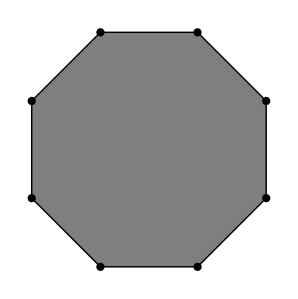
Example 5. From a regular octagon, a triangle is formed by connecting three randomly chosen vertices of the octagon. What is the probability that at least one of the sides of the triangle is also a side of the octagon?
(A) $\frac{2}{7}$(B) $\frac{5}{42}$(C) $\frac{11}{14}$(D) $\frac{5}{7}$(E) $\frac{6}{7}$
Key idea: "at least one side" → count triangles with
no octagon side.
Total: $C_8^3 = 56$. All-diagonal triangles: fix a vertex $A$ — the other two must skip $A$'s neighbors and each other: $6$ triangles per vertex, $8$ vertices, each triangle counted at all $3$ vertices: $\frac{6\cdot8}{3} = 16$.
$P = 1 - \frac{16}{56} = \frac{40}{56} = \frac57$.
Answer: D
✏️ Practice
Try each one before opening the solution. Figures are from the official exams.
2018 AMC 8 #11
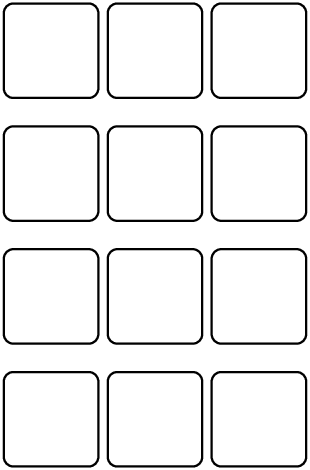
1. Abby, Bridget, and four of their classmates will be seated in two rows of three for a group picture, as shown.
\[\begin{matrix}\text{X}&\text{X}&\text{X}\\ \text{X}&\text{X}&\text{X}\end{matrix}\]
If the seating positions are assigned randomly, what is the probability that Abby and Bridget are adjacent to each other in the same row or the same column?
(A) $\frac{1}{3}$(B) $\frac{2}{5}$(C) $\frac{7}{15}$(D) $\frac{1}{2}$(E) $\frac{2}{3}$
Solution
Only Abby & Bridget's
pair of seats matters: $C_6^2 = 15$ equally likely pairs.
Adjacent pairs: $2$ per row $\times\,2$ rows $= 4$ horizontal, plus $3$ vertical → $7$.
$P = \frac{7}{15}$.
Answer: C
2022 AMC 8 #12
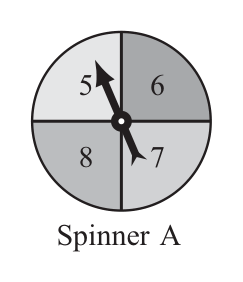
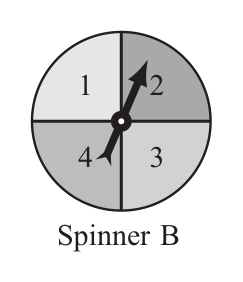
2. The arrows on the two spinners shown below are spun. Let the number $N$ equal $10$ times the number on Spinner A, added to the number on Spinner B. What is the probability that $N$ is a perfect square number?
(A) $\frac{1}{16}$(B) $\frac{1}{8}$(C) $\frac{1}{4}$(D) $\frac{3}{8}$(E) $\frac{1}{2}$
Solution
Spinner A is the tens digit, Spinner B the units: $N$ runs over $16$ equally likely values $51$–$54$, $61$–$64$, $71$–$74$, $81$–$84$.
Perfect squares in range: $64$ and $81$ — that's it. $P = \frac{2}{16} = \frac18$.
Answer: B
2011 AMC 8 #12
3. Angie, Bridget, Carlos, and Diego are seated at random around a square table, one person to a side. What is the probability that Angie and Carlos are seated opposite each other?
(A) $\frac{1}{4}$(B) $\frac{1}{3}$(C) $\frac{1}{2}$(D) $\frac{2}{3}$(E) $\frac{3}{4}$
Solution
Seat Angie anywhere. Of the $3$ remaining seats, exactly $1$ is opposite her, and Carlos lands in each with equal chance:
$P = \frac13$. (Full count: $8$ favorable of $4! = 24$ seatings ✓)
Answer: B
2014 AMC 8 #12
4. A magazine printed photos of three celebrities along with three photos of the celebrities as babies. The baby pictures did not identify the celebrities. Readers were asked to match each celebrity with the correct baby picture. What is the probability that a reader guessing at random will match all three correctly?
(A) $\frac{1}{9}$(B) $\frac{1}{6}$(C) $\frac{1}{4}$(D) $\frac{1}{3}$(E) $\frac{1}{2}$
Solution
A random matching is a permutation of $3$ babies: $3! = 6$ equally likely, exactly $1$ all-correct.
$P = \frac16$.
Answer: B
2019 AMC 8 #18
5. The faces of each of two fair dice are numbered $1, 2, 3, 5, 7,$ and $8$. When the two dice are tossed, what is the probability that their sum will be an even number?
(A) $\frac{4}{9}$(B) $\frac{1}{2}$(C) $\frac{5}{9}$(D) $\frac{3}{5}$(E) $\frac{2}{3}$
Solution
Even sum = both odd
or both even. Each die: $P(\text{odd}) = \frac46 = \frac23$, $P(\text{even}) = \frac13$.
$P = \left(\frac23\right)^2 + \left(\frac13\right)^2 = \frac49 + \frac19 = \frac59$.
Answer: C
2016 AMC 8 #21
6. A top hat contains $3$ red chips and $2$ green chips. Chips are drawn randomly, one at a time without replacement, until all $3$ of the reds are drawn or until both green chips are drawn. What is the probability that the $3$ reds are drawn?
(A) $\frac{3}{10}$(B) $\frac{2}{5}$(C) $\frac{1}{2}$(D) $\frac{3}{5}$(E) $\frac{7}{10}$
Solution
Slick road: the reds win exactly when, in a full random shuffle of all $5$ chips, the
last chip is green (the third red then shows up before the second green).
$P(\text{last is green}) = \frac25$.
Answer: B
Casework check: reds done on draw 3: $\frac35\cdot\frac24\cdot\frac13 = \frac1{10}$; on draw 4: $\frac{3}{10}$; total $\frac{4}{10} = \frac25$ ✓
2002 AMC 8 #21
7. Harold tosses a nickel four times. What is the probability that he gets at least as many heads as tails?
(A) $\frac{5}{16}$(B) $\frac{3}{8}$(C) $\frac{1}{2}$(D) $\frac{5}{8}$(E) $\frac{11}{16}$
Solution
Need $2, 3,$ or $4$ heads out of $2^4 = 16$ outcomes: $C_4^2 + C_4^3 + C_4^4 = 6 + 4 + 1 = 11$.
$P = \frac{11}{16}$.
Answer: E
2008 AMC 8 #24
8. Ten tiles numbered $1$ through $10$ are turned face down. One tile is turned up at random, and a die is rolled. What is the probability that the product of the numbers on the tile and the die will be a square?
(A) $\frac{1}{10}$(B) $\frac{1}{6}$(C) $\frac{11}{60}$(D) $\frac{1}{5}$(E) $\frac{7}{30}$
Solution
Total: $10\times6 = 60$. Case on the die:
$1$ → tiles $1,4,9$; $2$ → tiles $2,8$; $3$ → tile $3$; $4$ → tiles $1,4,9$; $5$ → tile $5$; $6$ → tile $6$.
That's $3+2+1+3+1+1 = 11$ favorable → $P = \frac{11}{60}$.
Answer: C
2007 AMC 8 #21
9. Two cards are dealt from a deck of four red cards labeled $A, B, C, D$ and four green cards labeled $A, B, C, D$. A winning pair is two of the same color or two of the same letter. What is the probability of drawing a winning pair?
(A) $\frac{2}{7}$(B) $\frac{3}{8}$(C) $\frac{1}{2}$(D) $\frac{4}{7}$(E) $\frac{5}{8}$
Solution
Total: $C_8^2 = 28$ pairs. Same color: $2\cdot C_4^2 = 12$; same letter: $4$. The two cases can't overlap (same letter → different colors), so add: $16$.
$P = \frac{16}{28} = \frac47$.
Answer: D
2009 AMC 8 #10
10. On a checkerboard composed of $64$ unit squares, what is the probability that a randomly chosen unit square does not touch the outer edge of the board?
(A) $\frac{1}{16}$(B) $\frac{7}{16}$(C) $\frac{1}{2}$(D) $\frac{9}{16}$(E) $\frac{49}{64}$
Solution
The inner squares form a $6\times6$ block: $36$ of $64$.
$P = \frac{36}{64} = \frac{9}{16}$. (Border count check: $4\cdot8 - 4 = 28$, and $64 - 28 = 36$ ✓)
Answer: D
2009 AMC 8 #12
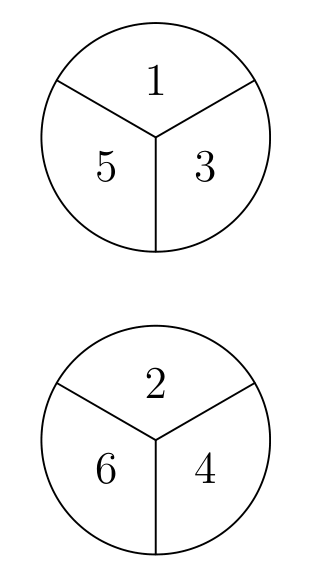
11. The two spinners shown are spun once and each lands on one of the numbered sectors. What is the probability that the sum of the numbers in the two sectors is prime?
(A) $\frac{1}{2}$(B) $\frac{2}{3}$(C) $\frac{3}{4}$(D) $\frac{7}{9}$(E) $\frac{5}{6}$
Solution
$3\times3 = 9$ equally likely sums: $1{+}2, 1{+}4, 1{+}6, 3{+}2, 3{+}4, 3{+}6, 5{+}2, 5{+}4, 5{+}6$ → $3,5,7,5,7,9,7,9,11$.
Only the two $9$'s are not prime: $P = \frac79$.
Answer: D
2007 AMC 8 #25
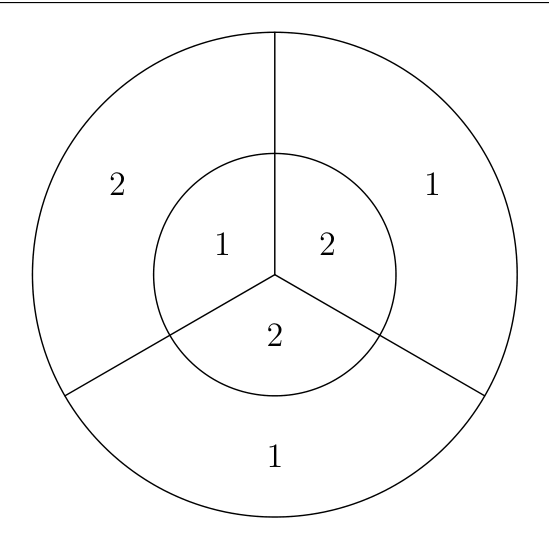
12. On the dart board shown in the figure, the outer circle has radius $6$ and the inner circle has radius $3$. Three radii divide each circle into three congruent regions, with point values shown. The probability that a dart will hit a given region is proportional to the area of the region. When two darts hit this board, the score is the sum of the point values in the regions hit. What is the probability that the score is odd?
(A) $\frac{17}{36}$(B) $\frac{35}{72}$(C) $\frac{1}{2}$(D) $\frac{37}{72}$(E) $\frac{19}{36}$
Solution
Areas: each inner region $3\pi$, each outer region $\frac{36\pi - 9\pi}{3} = 9\pi$; board $36\pi$.
Odd regions: one inner "1" ($3\pi$) and two outer "1"s ($18\pi$) → $P(\text{odd throw}) = \frac{21\pi}{36\pi} = \frac{7}{12}$, so $P(\text{even}) = \frac{5}{12}$.
Odd sum = odd+even or even+odd: $2\cdot\frac{7}{12}\cdot\frac{5}{12} = \frac{70}{144} = \frac{35}{72}$.
Answer: B
2022 AMC 8 #25
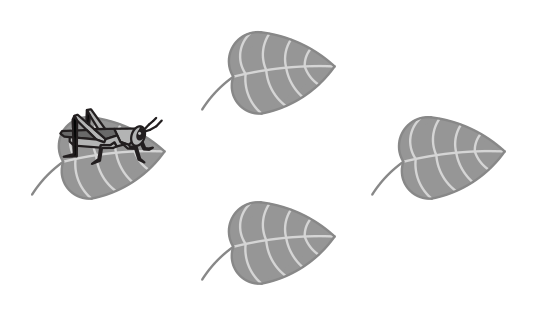
13. A cricket randomly hops between $4$ leaves, on each turn hopping to one of the other $3$ leaves with equal probability. After $4$ hops, what is the probability that the cricket has returned to the leaf where it started?
(A) $\frac{2}{9}$(B) $\frac{19}{80}$(C) $\frac{20}{81}$(D) $\frac{1}{4}$(E) $\frac{7}{27}$
Solution
Let $f(n) = P(\text{home after } n \text{ hops})$. To be home at hop $n$ you must be away at hop $n-1$ (prob $1 - f(n-1)$), then hop home ($\frac13$):
$f(n) = \frac{1 - f(n-1)}{3}$, with $f(1) = 0$.
Iterate: $f(2) = \frac13$, $f(3) = \frac29$, $f(4) = \frac{7}{27}$.
Answer: E
2010 AMC 8 #25
14. Every day at school, Jo climbs a flight of $6$ stairs. Jo can take the stairs $1$, $2$, or $3$ at a time. For example, Jo could climb $3$, then $1$, then $2$. In how many ways can Jo climb the stairs?
(A) 13(B) 18(C) 20(D) 22(E) 24
Solution
Let $f(n)$ count the ways up $n$ stairs. The first move is $1$, $2$, or $3$ steps:
$f(n) = f(n-1) + f(n-2) + f(n-3)$, with $f(1) = 1$, $f(2) = 2$, $f(3) = 4$.
So $f(4) = 7$, $f(5) = 13$, $f(6) = 24$.
Answer: E
🆕 Fresh from the latest exams
The same ideas, exactly as they appeared on the most recent tests.
2024 AMC 8 #5
15. Aaliyah rolls two standard $6$-sided dice. She notices that the product of the two numbers rolled is a multiple of $6$. Which of the following integers cannot be the sum of the two numbers rolled?
(A) 5(B) 6(C) 7(D) 8(E) 9
Solution
Check the sample space of pairs summing to $6$: $(1,5), (2,4), (3,3)$ — products $5, 8, 9$: none is a multiple of $6$.
(The other sums all work: $5 = 2{+}3$, $7 = 1{+}6$, $8 = 2{+}6$, $9 = 3{+}6$.)
Answer: B
2024 AMC 8 #25
16. An airplane has $4$ rows of seats with $3$ seats in each row. Eight passengers have boarded the plane and are distributed randomly among the seats. A married couple is next to board. What is the probability there will be $2$ adjacent seats in the same row for the couple?
(A) $\frac{8}{15}$(B) $\frac{32}{55}$(C) $\frac{20}{33}$(D) $\frac{34}{55}$(E) $\frac{8}{11}$
Solution
Track the $4$
empty seats: $C_{12}^4 = 495$ ways. Complement: no two empties adjacent in a row.
Per row of $3$, non-adjacent empty sets: none ($1$ way), one seat ($3$), or the two ends ($1$). Splitting $4$ empties over $4$ rows:
$2{+}2$: $C_4^2\cdot1\cdot1 = 6$; $\ 2{+}1{+}1$: $12\cdot1\cdot3\cdot3 = 108$; $\ 1{+}1{+}1{+}1$: $3^4 = 81$. Total $195$.
$P = 1 - \frac{195}{495} = \frac{300}{495} = \frac{20}{33}$.
Answer: C
2026 AMC 8 #21
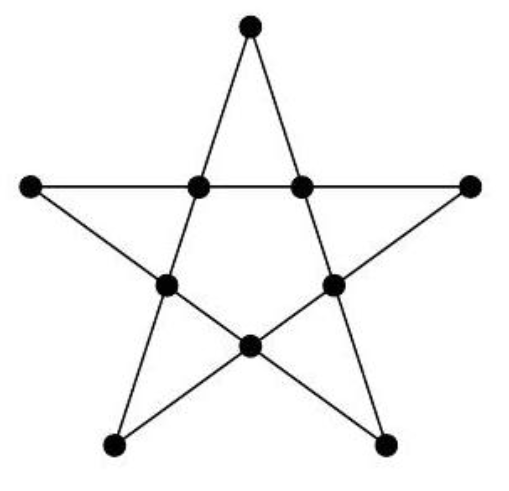
17. Charlotte the spider is walking along a web shaped like a $5$-pointed star, shown in the figure below. The web has $5$ outer points and $5$ inner points. Each time Charlotte reaches a point, she randomly chooses a neighboring point and moves to that point. Charlotte starts at one of the outer points and makes $3$ moves (re-visiting points is allowed). What is the probability she is now at one of the outer points of the star?
(A) $\frac{1}{5}$(B) $\frac{1}{4}$(C) $\frac{2}{5}$(D) $\frac{1}{2}$(E) $\frac{3}{5}$
Solution
Outer points touch $2$ inner points; inner points touch $2$ outer $+$ $2$ inner. Track "outer or inner" move by move:
Move 1: outer → inner (forced). Move 2: from inner, $P(\text{outer}) = \frac24 = \frac12$.
Move 3: to end
outer she must be inner after move 2 (an outer position moves back to inner, never outer): $P = \frac12\cdot\frac12 = \frac14$.
Answer: B
⭐ Challenge (AMC 10 level)
2017 AMC 10A #15 · geometric
C1. Chloe chooses a real number uniformly at random from the interval $[0, 2017]$. Independently, Laurent chooses a real number uniformly at random from the interval $[0, 4034]$. What is the probability that Laurent's number is greater than Chloe's number?
(A) $\frac{1}{2}$(B) $\frac{2}{3}$(C) $\frac{3}{4}$(D) $\frac{5}{6}$(E) $\frac{7}{8}$
Solution
Plot the pair $(x, y)$, $x$ = Chloe $\in [0,2017]$, $y$ = Laurent $\in [0,4034]$: a $2017\times4034$ rectangle of equally likely points.
"$y \le x$" is a right triangle of area $\frac{2017^2}{2}$, which is $\frac{2017^2/2}{2017\cdot4034} = \frac14$ of the rectangle.
$P(y > x) = 1 - \frac14 = \frac34$.
Answer: C
2015 AMC 10B #16 · counting
C2. Al, Bill, and Cal will each randomly be assigned a whole number from $1$ to $10$, inclusive, with no two of them getting the same number. What is the probability that Al's number will be a whole number multiple of Bill's and Bill's number will be a whole number multiple of Cal's?
(A) $\frac{9}{1000}$(B) $\frac{1}{90}$(C) $\frac{1}{80}$(D) $\frac{1}{72}$(E) $\frac{2}{121}$
Solution
Total ordered triples: $10\cdot9\cdot8 = 720$. List the chains Cal $\mid$ Bill $\mid$ Al with distinct values:
$(10,5,1), (10,2,1), (9,3,1), (8,4,2), (8,4,1), (8,2,1), (6,3,1), (6,2,1), (4,2,1)$ — $9$ of them.
$P = \frac{9}{720} = \frac{1}{80}$.
Answer: C
🗝 Answer key
| Example | 1 | 2 | 3 | 4 | 5 |
|---|
| C | C | C | D | D |
|---|
| Practice | 1 | 2 | 3 | 4 | 5 | 6 | 7 | 8 | 9 | 10 | 11 | 12 | 13 | 14 | 15 | 16 | 17 |
|---|
| C | B | B | B | C | B | E | C | D | D | D | B | E | E | B | C | B |
|---|
| Challenge | C1 | C2 |
|---|
| C | C |
|---|
Sources: prep-course Lecture 14 (video + board notes + 25 worked examples, translated to English) and official AMC 8 problems from the local bank
(kb/content/banks/). Answers verified against official AoPS answer keys where available.