Inequalities · Lecture 11 · alg-inequalities
📺 Course materials — Lecture 11 (93 min):
lecture video · handout PDF (Lecture 11) · board notes (11.jpg) · homework answer key (Chapter 11)
— all in the
amc8/video folder.
·
🖨 Printable PDF (answers & solutions at the back)
🔑 Key facts
An inequality behaves like an equation with one exception: you may add or subtract anything on both sides,
and multiply or divide both sides by any positive number — but multiplying or dividing by a negative number
flips the sign ($5 > 1$ becomes $-5 < -1$), and multiplying by $0$ is never allowed.
On the AMC 8 an inequality is usually the last step: translate the story into a range like $77.5 < x < 82$,
then count the integers inside — watching whether the endpoints are included ($1 \le x \le 5$) or not ($1 < x < 5$).
🧰 Instructor's toolbox (from the lecture video & board notes)
1 · Balance moves — and multiply EVERY term.
Equations and inequalities allow the same moves: same add, same subtract, same multiply, same divide (never by $0$).
The instructor's clearing-fractions drill: $\frac{2x}{3} + 5 = 50$, multiply the whole line by $3$: $2x + 15 = 150$.
Trap version: $\frac{2x}{3}\cdot 5 + 6 = 50$ — times $3$ gives $10x + 18 = 150$, because every term gets the $\times 3$, not just the fraction. Treat a bracketed block as one unit.
3 · Endpoints in or out? Read twice, then count.
$(1,5)$ means $1 < x < 5$ — ends excluded; $[1,5]$ means $1 \le x \le 5$ — ends included.
When the answer is "how many integers", solve to a range first, then count carefully:
$77.5 < x < 82$ holds the integers $78, 79, 80, 81$ — four of them, and neither endpoint question can be shrugged off.
4 · Averages: think "distance from the average".
The instructor's picture for Example 1: put all five scores at the average $82$.
If the last test rises by $4k$, the four equal tests must drop by $k$ each to keep the balance —
so the last score can only be $82 + 4k$: that is $86, 90, 94, 98$ (and $k=0$ is banned because the last score must be higher). No equations needed.
5 · "Which is impossible?" — attack with extreme numbers.
To show an option is possible, one concrete example is enough — so try wild values: something tiny like $a = \frac{1}{1000}$, something huge like $c = 100$.
To show an option is impossible, find the one-line reason (in Practice 2: $c$ is already bigger than $b$, so adding positive $a$ keeps $a + c > b$ forever).
Check the easy-to-kill options with examples first; what survives is the answer.
6 · Triangle inequality + integers = a counting problem.
In an isosceles triangle with legs $a$ and base $b$, the only inequality that matters is $2a > b$ (the two legs must reach around the base).
Combine with the perimeter equation and let integrality do the rest — in Practice 3, $2a + b = 23$ forces $b$ odd and $b < 11.5$, so $b \in \{1,3,5,7,9,11\}$: six triangles.
7 · "$x$ is the largest" is an inequality in disguise.
Name the missing cells with letters, write the row/column equations, then translate the size condition.
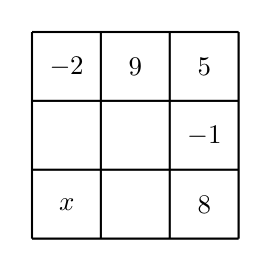
In Example 2: the equations give $A = 14 - x$, and "$x$ is larger than $A$" becomes $x > 14 - x$, i.e. $x > 7$ — so the smallest integer is $x = 8$. Always finish by checking the winner really beats all the others.
8 · Winning both halves ≠ winning overall — weights matter.
The board's shocker: A shoots better than B on three-pointers ($\frac{13}{20} > \frac{3}{5}$) and on two-pointers ($\frac{4}{5} > \frac{15}{20}$), yet B's overall rate wins, $\frac{18}{25} > \frac{17}{25}$ — because the two categories carry different numbers of attempts.
So never average percentages — go back to raw totals (Example 3: $x + y = 25$) and keep the per-half comparisons as inequalities.
9 · Bounding $B = (A+B) - A$: pair opposite extremes.
Board drill: $10 \le A \le 30$ and $20 \le A+B \le 50$. Then $B$ is largest when $A+B$ is largest and $A$ smallest ($50 - 10 = 40$), and smallest when $A+B$ is smallest and $A$ largest ($20 - 30 = -10$; if $B$ can't be negative, that floor becomes $0$).
The classic error is subtracting same-side ends to get $10 \le B \le 20$ — the board lists it as the wrong option.
10 · Let divisibility shrink the search.
With integer unknowns, look at remainders before brute force. In Example 4, $3N + 4M = 76$: both $4M$ and $76$ are multiples of $4$, so $3N$ — hence $N$ — must be a multiple of $4$.
Together with $N > 2M$ and $M > 4$ only a couple of candidates survive ($N=12, M=10$ ✗ fails $N>2M$; $N=16, M=7$ ✓).
📖 Worked examples
2018 AMC 8 #13 · average + range
Example 1. Laila took five math tests, each worth a maximum of $100$ points. Laila's score on each test was an integer between $0$ and $100$, inclusive. Laila received the same score on the first four tests, and she received a higher score on the last test. Her average score on the five tests was $82$. How many values are possible for Laila's score on the last test?
(A) 4(B) 5(C) 9(D) 10(E) 18
Key idea: four tests at $x$, last test $y > x$, and $4x + y = 5 \cdot 82 = 410$.
From $y = 410 - 4x \le 100$: $x \ge 77.5$; from $y > x$: $410 - 4x > x$, so $x < 82$.
The integers are $x = 78, 79, 80, 81$, each giving one $y$ ($98, 94, 90, 86$) — four values.
Answer: A
Average view: raise the last test $4k$ above $82$ and the four equal tests drop $k$ each: $y = 82 + 4k$, $k = 1..4$.
2022 AMC 8 #20 · largest missing number
Example 2. The grid below is to be filled with integers in such a way that the sum of the numbers in each row and the sum of the numbers in each column are the same. Four numbers are missing. The number $x$ in the lower left corner is larger than the other three missing numbers. What is the smallest possible value of $x$?
(A) $-1$(B) 5(C) 6(D) 8(E) 9
Key idea: the full column $5, -1, 8$ fixes every sum at $12$.
Call the other missing numbers $A$ (directly above $x$), $B$ (center), $C$ (right of $x$): column 1 is $-2 + A + x = 12$ so $x + A = 14$; row 3 gives $x + C = 4$; row 2 gives $A + B = 13$.
"$x$ is largest" against $A$: $x > 14 - x \Rightarrow x > 7$, so try $x = 8$: then $A = 6$, $B = 7$, $C = -4$ — all smaller than $8$ ✓.
Answer: D
2022 AMC 8 #21 · weighted percentages
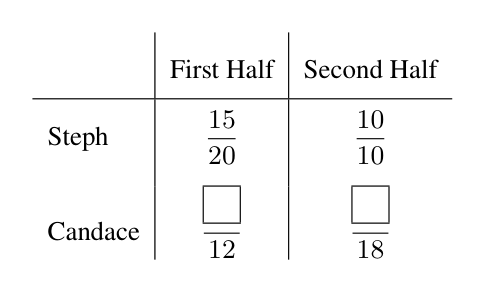
Example 3. Steph scored $15$ baskets out of $20$ attempts in the first half of a game, and $10$ baskets out of $10$ attempts in the second half. Candace took $12$ attempts in the first half and $18$ attempts in the second. In each half, Steph scored a higher percentage of baskets than Candace. Surprisingly they ended with the same overall percentage of baskets scored. How many more baskets did Candace score in the second half than in the first?
(A) 7(B) 8(C) 9(D) 10(E) 11
Key idea: work with totals, keep the halves as inequalities. Steph overall: $\frac{25}{30}$.
Candace made $x$ then $y$ baskets: $\frac{x+y}{30} = \frac{25}{30} \Rightarrow x + y = 25$.
Per half: $\frac{x}{12} < \frac{15}{20} \Rightarrow x < 9$, and $\frac{y}{18} < \frac{10}{10} \Rightarrow y < 18$.
But $x \le 8$ and $y \le 17$ already add to at most $25$ — so both must hit their maximum: $x = 8$, $y = 17$, and $y - x = 9$.
Answer: C
2015 AMC 8 #24 · integer solutions
Example 4. A baseball league consists of two four-team divisions. Each team plays every other team in its division $N$ games. Each team plays every team in the other division $M$ games with $N > 2M$ and $M > 4$. Each team plays a $76$ game schedule. How many games does a team play within its own division?
(A) 36(B) 48(C) 54(D) 60(E) 72
Key idea: a team plays $3$ division rivals $N$ times and $4$ outside teams $M$ times: $3N + 4M = 76$.
Substitute $N = \frac{76-4M}{3}$ into $N > 2M$: $76 - 4M > 6M \Rightarrow M < 7.6$; with $M > 4$, $M \in \{5, 6, 7\}$.
Only $M = 7$ makes $N = \frac{48}{3} = 16$ an integer (and $16 > 14$ ✓). In-division games: $3N = 48$.
Answer: B
✏️ Practice
Try each one before opening the solution.
2005 AMC 8 #6
1. Suppose $d$ is a digit. For how many values of $d$ is $2.00d5 > 2.005$?
(A) 0(B) 4(C) 5(D) 6(E) 10
Solution
Write $2.005$ as $2.0050$ and compare place by place: the numbers agree until the thousandths digit, $d$ vs $5$.
If $d > 5$ we win; if $d = 5$, then $2.0055 > 2.0050$ still wins; if $d < 5$ we lose.
So $d \in \{5,6,7,8,9\}$ — five values.
Answer: C
2007 AMC 8 #15
2. Let $a$, $b$ and $c$ be numbers with $0 < a < b < c$. Which of the following is impossible?
(A) $a+c(B) $a\cdot b(C) $a+b(D) $a\cdot c(E) $\frac{b}{c}=a$
Solution
Since $c > b$ and $a > 0$, adding $a$ to $c$ only grows it: $a + c > c > b$ — always. So (A) is impossible.
The rest all happen: $a=1, b=2, c=10$ kills (B) and (C); $a=\frac{1}{1000}, b=1, c=2$ kills (D); $a=\frac12, b=4, c=8$ kills (E).
Answer: A
2005 AMC 8 #15
3. How many different isosceles triangles have integer side lengths and perimeter $23$?
(A) 2(B) 4(C) 6(D) 9(E) 11
Solution
Legs $a$, base $b$: $2a + b = 23$ and the triangle inequality $2a > b$ give $23 - b > b$, so $b < 11.5$.
Also $a = \frac{23-b}{2}$ must be an integer, forcing $b$ odd. Odd values $1 \le b \le 11$: that's $b \in \{1,3,5,7,9,11\}$ — six triangles.
Answer: C
2018 AMC 10A #4
4. Alice, Bob, and Charlie were on a hike and were wondering how far away the nearest town was. When Alice said, "We are at least $6$ miles away," Bob replied, "We are at most $5$ miles away." Charlie then remarked, "Actually the nearest town is at most $4$ miles away." It turned out that none of the three statements were true. Let $d$ be the distance in miles to the nearest town. Which of the following intervals is the set of all possible values of $d$?
(A) $(0,4)$(B) $(4,5)$(C) $(4,6)$(D) $(5,6)$(E) $(5,\infty)$
Solution
Negate each claim: Alice false $\Rightarrow d < 6$; Bob false $\Rightarrow d > 5$; Charlie false $\Rightarrow d > 4$.
Intersect: $5 < d < 6$, the open interval $(5,6)$.
Answer: D
🆕 Fresh from the latest exams
The same ideas, exactly as they appeared on the most recent tests.
2025 AMC 8 #7
5. On the most recent exam in Prof. Xochi's class, $5$ students earned a score of at least $95\%$, $13$ students earned a score of at least $90\%$, $27$ students earned a score of at least $85\%$, and $50$ students earned a score of at least $80\%$. How many students earned a score of at least $80\%$ and less than $90\%$?
(A) 8(B) 14(C) 22(D) 37(E) 45
Solution
"At least $80$ and less than $90$" is everyone at $\ge 80$ minus everyone at $\ge 90$ — the "at least" groups nest inside each other.
$50 - 13 = 37$.
Answer: D
2026 AMC 8 #8
6. A poll asked a number of people if they liked solving mathematics problems. Exactly $74\%$ answered "yes." What is the fewest possible number of people who could have been asked the question?
(A) 10(B) 20(C) 25(D) 50(E) 100
Solution
With $n$ people, the "yes" count is $\frac{74}{100}n = \frac{37}{50}n$, and it must be a whole number.
Since $37$ and $50$ share no factor, $n$ must be a multiple of $50$ — fewest is $50$ (then $37$ people said yes).
Answer: D
2024 AMC 8 #15
7. Let the letters $F, L, Y, B, U, G$ represent distinct digits. Suppose $\underline{F}~\underline{L}~\underline{Y}~\underline{F}~\underline{L}~\underline{Y}$ is the greatest number that satisfies the equation
\[8\cdot\underline{F}~\underline{L}~\underline{Y}~\underline{F}~\underline{L}~\underline{Y}=\underline{B}~\underline{U}~\underline{G}~\underline{B}~\underline{U}~\underline{G}.\]
What is the value of $\underline{F}~\underline{L}~\underline{Y}+\underline{B}~\underline{U}~\underline{G}$?
(A) 1089(B) 1098(C) 1107(D) 1116(E) 1125
Solution
$\underline{F}\,\underline{L}\,\underline{Y}\,\underline{F}\,\underline{L}\,\underline{Y} = \overline{FLY} \times 1001$, so dividing both sides by $1001$ shrinks the equation to $8 \cdot \overline{FLY} = \overline{BUG}$.
Bound it: $\overline{BUG} \le 999 \Rightarrow \overline{FLY} \le 124$. Test from the top: $124 \to 992$ repeats digits; $123 \to 984$ gives six distinct digits $1,2,3,9,8,4$ ✓.
$123 + 984 = 1107$.
Answer: C
🗝 Answer key
| Example | 1 | 2 | 3 | 4 |
|---|
| A | D | C | B |
|---|
| Practice | 1 | 2 | 3 | 4 | 5 | 6 | 7 |
|---|
| C | A | C | D | D | D | C |
|---|
Sources: prep-course Lecture 11 (video + board notes + 8 worked examples, translated to English) and official AMC 8 problems from the local bank
(kb/content/banks/). Answers verified against official AoPS answer keys where available.