Sequences & Series · Lecture 10 · alg-sequences-series
📺 Course materials — Lecture 10 (92 min):
lecture video · handout PDF (Lecture 10) · board notes (10.jpg) · homework answer key (Chapter 10)
— all in the
amc8/video folder.
·
🖨 Printable PDF (answers & solutions at the back)
🔑 Key facts
An arithmetic sequence adds the same number $d$ each step: $a_n = a_1 + (n-1)d$.
A geometric sequence multiplies by the same ratio $q$ each step: $a_n = a_1 \cdot q^{\,n-1}$.
Almost every AMC 8 sequence problem is won with three little formulas:
number of terms $= \dfrac{\text{last}-\text{first}}{d} + 1$,
sum $= \dfrac{(\text{first}+\text{last})\times n}{2}$,
and "each term is the average of its two neighbors" (arithmetic).
🧰 Instructor's toolbox (from the lecture video & board notes)
2 · The difference must be the same at EVERY gap.
$d = \text{later term} - \text{earlier term}$: for $1,3,5,7,9,\ldots$ $d = 3-1 = 2$; for $99,97,95,\ldots$ $d = 97-99 = -2$ (counting down is allowed).
The instructor's trap: $1,2,1,2,1,2,\ldots$ is not arithmetic — the gaps alternate $+1,-1$. Constant sequences like $1,1,1,1,\ldots$ are arithmetic ($d=0$).
3 · Jump between distant terms in one hop.
$a_n = a_m + (n-m)\,d$ — from $a_2$ to $a_{10}$ is $8$ jumps, not $9$.
Board examples: $a_2 = 4,\ a_{10} = 44 \Rightarrow d = \frac{44-4}{10-2} = 5$; and $a_5 = 12,\ a_{10} = 47 \Rightarrow d = \frac{47-12}{5} = 7$.
Bonus: each term is the average of its neighbors, $b = \frac{a+c}{2}$ — that one line cracks Example 3 and Fresh 7.
4 · Count terms like fence posts.
$n = \dfrac{\text{last}-\text{first}}{d} + 1$ — the "$+1$" is the tree-planting fence-post correction, the instructor's most-repeated warning.
Board example: $2,5,8,\ldots,47$ has $\frac{47-2}{3}+1 = 16$ terms. Cross-check by shifting: add $1$ to every term ($3,6,\ldots,48$), divide by $3$ ($1,2,\ldots,16$) — sixteen terms, no formula needed.
7 · Geometric jumps: multiply by $q$ once per step.
$a_n = a_m \cdot q^{\,n-m}$. Board examples: $a_2 = 4,\ a_5 = 108 \Rightarrow q^3 = 27 \Rightarrow q = 3$;
and $a_1 = 5,\ q = 5 \Rightarrow a_{10} = 5\cdot 5^9 = 5^{10}$ (leave it as a power — don't multiply it out).
Spot a geometric sequence by dividing neighbors: $\frac{a_{n+1}}{a_n}$ must be the same constant every time.
8 · Sum a geometric series: multiply, shift, subtract.
The instructor's "misaligned subtraction": write $S$, write $qS$ under it shifted one slot, subtract — everything in the middle cancels.
$S = 1+2+4+\cdots+1024$: then $2S = 2+4+\cdots+2048$, so $2S - S = 2048 - 1 = 2047$.
$S = 1+3+9+\cdots+2187$: then $3S - S = 6561 - 1$, so $S = \frac{6560}{2} = 3280$.
(Practice drill from the board: try $4^1+4^2+\cdots+4^{10}$ the same way.)
📖 Worked examples
2015 AMC 8 #9 · arithmetic series
Example 1. On her first day of work, Janabel sold one widget. On day two, she sold three widgets. On day three, she sold five widgets, and on each succeeding day, she sold two more widgets than she had sold on the previous day. How many widgets in total had Janabel sold after working $20$ days?
(A) 39(B) 40(C) 210(D) 400(E) 401
Key idea: daily sales $1,3,5,\ldots$ form an arithmetic sequence with $a_1 = 1$, $d = 2$.
Day 20: $a_{20} = 1 + 19\cdot 2 = 39$. Total: $S_{20} = \frac{(1+39)\times 20}{2} = 400$.
Answer: D
Shortcut: the sum of the first $20$ odd numbers is $20^2 = 400$ — no formula needed.
2022 AMC 8 #11 · count the steps
Example 2. Henry the donkey has a very long piece of pasta. He takes a number of bites of pasta, each time eating $3$ inches of pasta from the middle of one piece. In the end, he has $10$ pieces of pasta whose total length is $17$ inches. How long, in inches, was the piece of pasta he started with?
(A) 34(B) 38(C) 41(D) 44(E) 47
Key idea: every bite from the middle of a piece turns $1$ piece into $2$ — the piece count grows by exactly $1$ per bite.
From $1$ piece to $10$ pieces takes $9$ bites (not $10$ — fence posts!), eating $9 \times 3 = 27$ inches.
Original length $= 27 + 17 = 44$ inches.
Answer: D
2015 AMC 8 #18 · middle term = average
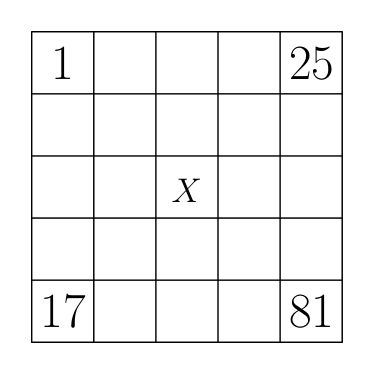
Example 3. An arithmetic sequence is a sequence in which each term after the first is obtained by adding a constant to the previous term. For example, $2, 5, 8, 11, 14$ is an arithmetic sequence with five terms, in which the first term is $2$ and the constant added is $3$. Each row and each column in this $5\times5$ array is an arithmetic sequence with five terms. What is the value of $X$?
(A) 21(B) 31(C) 36(D) 40(E) 42
Key idea: in a 5-term arithmetic sequence the middle term is the average of the two ends.
Top row: middle $A = \frac{1+25}{2} = 13$. Bottom row: middle $B = \frac{17+81}{2} = 49$.
The middle
column is also arithmetic, and $X$ is its center: $X = \frac{A+B}{2} = \frac{13+49}{2} = 31$.
Answer: B
2013 AMC 8 #9 · geometric growth
Example 4. The Incredible Hulk can double the distance he jumps with each succeeding jump. If his first jump is $1$ meter, the second jump is $2$ meters, the third jump is $4$ meters, and so on, then on which jump will he first be able to jump more than $1$ kilometer?
(A) 9th(B) 10th(C) 11th(D) 12th(E) 13th
Key idea: jump lengths are geometric with $a_1 = 1$, $q = 2$: the $n$-th jump is $2^{\,n-1}$ meters.
We need $2^{\,n-1} > 1000$. Since $2^9 = 512 < 1000$ and $2^{10} = 1024 > 1000$, we need $n - 1 = 10$, i.e. the $11$th jump.
(Memorize $2^{10} = 1024 \approx 1000$ — it shows up constantly.)
Answer: C
✏️ Practice
Try each one before opening the solution. Figures are from the official exams.
mock · course problem
1. $90+91+92+93+94+95+96+97+98+99 = $ ?
(A) 845(B) 945(C) 1005(D) 1025(E) 1045
Solution
Ten terms, first $90$, last $99$: $S = \frac{(90+99)\times 10}{2} = \frac{1890}{2} = 945$.
Answer: B
2004 AMC 10B #10
2. A grocer makes a display of cans in which the top row has one can and each lower row has two more cans than the row above it. If the display contains $100$ cans, how many rows does it contain?
(A) 5(B) 8(C) 9(D) 10(E) 11
Solution
Rows hold $1, 3, 5, \ldots$ cans — consecutive odd numbers starting at $1$, so $n$ rows hold $n^2$ cans.
$n^2 = 100 \Rightarrow n = 10$. (Or solve $\frac{(1 + (2n-1))\,n}{2} = 100$.)
Answer: D
2008 AMC 8 #12
3. A ball is dropped from a height of $3$ meters. On its first bounce it rises to a height of $2$ meters. It keeps falling and bouncing to $\frac{2}{3}$ of the height it reached in the previous bounce. On which bounce will it rise to a height less than $0.5$ meters?
(A) 3(B) 4(C) 5(D) 6(E) 7
Solution
Bounce heights are geometric: $a_n = 2\left(\frac23\right)^{n-1}$.
Track them: $2,\ \frac43,\ \frac89,\ \frac{16}{27},\ \frac{32}{81}$. Since $\frac{16}{27} \approx 0.59 > 0.5$ and $\frac{32}{81} \approx 0.40 < 0.5$, the $5$th bounce is the first below half a meter.
Answer: C
2003 AMC 10B #8
4. The second and fourth terms of a geometric sequence are $2$ and $6$. Which of the following is a possible first term?
(A) $-\sqrt{3}$(B) $-\frac{2\sqrt{3}}{3}$(C) $-\frac{\sqrt{3}}{3}$(D) $\sqrt{3}$(E) $3$
Solution
$a_4 = a_2 \cdot q^2$, so $q^2 = \frac{6}{2} = 3$ and $q = \pm\sqrt{3}$.
Then $a_1 = \frac{a_2}{q} = \frac{2}{\pm\sqrt{3}} = \pm\frac{2\sqrt{3}}{3}$ — and the minus version is choice B.
Answer: B
mock · course problem
5. In a geometric sequence $6, \ldots, 768, \ldots, 12288$, the term $768$ is the $n$-th term and $12288$ is the $(2n-4)$-th term. Find the common ratio $q$.
(A) 2(B) 3(C) 4(D) 5(E) 8
Solution
$768 = 6q^{\,n-1}$ and $12288 = 6q^{\,2n-5}$. Divide: $\frac{12288}{768} = 16 = q^{\,n-4}$.
Also $\frac{768}{6} = 128 = q^{\,n-1}$. Try $q = 2$: $2^{\,n-1} = 128 \Rightarrow n = 8$, and then $q^{\,n-4} = 2^4 = 16$ ✓.
Answer: A
🆕 Fresh from the latest exams
The same ideas, exactly as they appeared on the most recent tests.
2024 AMC 8 #13
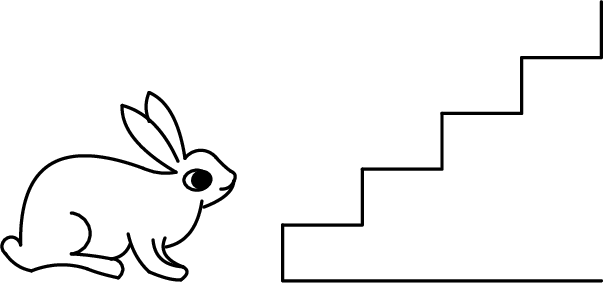
6. Buzz Bunny is hopping up and down a set of stairs, one step at a time. In how many ways can Buzz Bunny start on the ground, make a sequence of $6$ hops, and end up back on the ground? (For example, one sequence of hops is up-up-down-down-up-down.)
(A) 4(B) 5(C) 6(D) 8(E) 12
Solution
List systematically like the lecture's staircase: $3$ hops are U and $3$ are D, and the bunny can never dip below the ground (every prefix needs at least as many U's as D's).
The valid orders are UUUDDD, UUDUDD, UUDDUD, UDUUDD, UDUDUD — $5$ ways.
Answer: B
2026 AMC 8 #14
7. Jami picked three equally spaced integer numbers on the number line. The sum of the first and the second numbers is $40$, while the sum of the second and third numbers is $60$. What is the sum of all three numbers?
(A) 70(B) 75(C) 80(D) 85(E) 90
Solution
Equally spaced means arithmetic: call the numbers $m-d,\ m,\ m+d$.
Then $(m-d)+m = 40$ and $m+(m+d) = 60$; adding the two equations gives $4m = 100$, so $m = 25$.
The total is $3m = 75$ (the middle term is the average, so the sum is $3\times$ the middle).
Answer: B
2026 AMC 8 #18
8. In how many ways can $60$ be written as the sum of two or more consecutive odd positive integers that are arranged in increasing order?
(A) 1(B) 2(C) 3(D) 4(E) 5
Solution
$n$ consecutive odd numbers starting at $a$: the last is $a + 2(n-1)$, so the sum is $\frac{(a + a + 2(n-1))\,n}{2} = n(a+n-1) = 60$.
So $n$ divides $60$ and $a = \frac{60}{n} - n + 1$ must be a
positive odd number.
Check divisors $n \ge 2$: $n=2 \Rightarrow a=29$ ✓ ($29+31$); $n=3,4,5 \Rightarrow a = 18, 12, 8$ — even ✗; $n=6 \Rightarrow a=5$ ✓ ($5+7+9+11+13+15$); $n=10 \Rightarrow a<0$ ✗. Two ways.
Answer: B
⭐ Challenge (AMC 10 level)
2002 AMC 10B #19 · arithmetic series
C1. Suppose that $\{a_n\}$ is an arithmetic sequence with $a_1 + a_2 + \cdots + a_{100} = 100$ and $a_{101} + a_{102} + \cdots + a_{200} = 200$. What is the value of $a_2 - a_1$?
(A) 0.0001(B) 0.001(C) 0.01(D) 0.1(E) 1
Solution
Subtract the two sums term by term: $a_{101}-a_1 = 100d$, $a_{102}-a_2 = 100d$, …, one hundred pairs, each equal to $100d$.
So $100 \cdot 100d = 200 - 100 = 100$, giving $d = 0.01$ — and $a_2 - a_1 = d$.
Answer: C
🗝 Answer key
| Example | 1 | 2 | 3 | 4 |
|---|
| D | D | B | C |
|---|
| Practice | 1 | 2 | 3 | 4 | 5 | 6 | 7 | 8 |
|---|
| B | D | C | B | A | B | B | B |
|---|
| Challenge | C1 |
|---|
| C |
|---|
Sources: prep-course Lecture 10 (video + board notes + 10 worked examples, translated to English) and official AMC 8 problems from the local bank
(kb/content/banks/). Answers verified against official AoPS answer keys where available.