AMC 8 Wiki › Counting & Probability › Permutations & Combinations
Permutations & Combinations · Lecture 12 · cp-permutations-combinations
📺 Course materials — Lecture 12:
lecture video · handout PDF (Lecture 12) · board notes (12.jpg) · homework answer key (Chapter 12)
— all in the
amc8/video folder.
·
🖨 Printable PDF (answers & solutions at the back)
🔑 Key facts
Multiplication rule: a task done in steps → multiply the counts of each step.
Addition rule: a task split into non-overlapping cases → add the counts.
Permutations (order matters): $A_n^k = n(n-1)\cdots(n-k+1)$, and $A_n^n = n!$.
Combinations (order doesn't matter): $C_n^k = \dfrac{A_n^k}{k!}$ — every unordered choice was counted $k!$ times.
The first question to ask on every counting problem: does order matter?
🧰 Instructor's toolbox (from the lecture video & board notes)
1 · Multiplication rule — steps, not choices.
Break the task into steps that all must happen: an outfit = shirt and skirt and shoes → $5\cdot4\cdot3 = 60$.
The instructor's warning: multiply only when every step is required — if any step can be skipped, it isn't one task in steps, it's separate cases (use tip #2).
2 · Addition rule — split into clean cases. When one recipe doesn't cover everything, cut the problem into cases that can't overlap and add.
Classic split: casework on the last digit (Example 2: units digit $0$ or $5$), on parity, or on "how many rows of triangles" (Practice 14).
Always check: no overlaps, nothing missed.
4 · Combination identities — compute the small side.
$C_m^n = C_m^{m-n}$ (choosing who's in = choosing who's out), so $C_{10}^8 = C_{10}^2 = 45$.
Also $C_n^n = C_n^0 = 1$. Never grind out $C_{10}^8$ the long way.
5 · Complement — count the opposite. When the direct count splinters into many cases, count what you don't want and subtract from the total.
Example 1: passwords not starting $9,1,1$ → $10^4 - 10$. The board shows the classic wrong answer $9\cdot9\cdot9\cdot10$ (that forbids each digit separately — not the same thing!).
Same move cracks Practice 13 ($C_6^3$ minus collinear triples).
8 · Repeated items — divide out the copies. Identical items can't be told apart, so divide by $k!$ for each group of $k$ copies:
digits $1,1,2$ → $\dfrac{3!}{2!} = 3$ numbers; INDIANA → $\dfrac{7!}{2!\,2!\,2!} = 630$; six digits $1,1,1,2,2,3$ → $\dfrac{6!}{3!\,2!}$.
Distributing $7$ books, $2$-$2$-$3$, works the same way: $\dfrac{7!}{2!\,2!\,3!} = 210$.
9 · Fix relative order by symmetry. If some items' mutual order is forced, arrange everything then divide by the orderings of that group.
"A left of B" in a row of $5$: $\dfrac{5!}{2!} = 60$. The board's harder one — "A between B and C (not necessarily adjacent)": $\dfrac{5!}{3!}\times 2 = 40$, since of the $3! = 6$ orders of $\{A,B,C\}$ exactly $2$ put A in the middle.
📖 Worked examples
2016 AMC 8 #17 · complement
Example 1. An ATM password at Fred's Bank is composed of four digits from $0$ to $9$, with repeated digits allowable. If no password may begin with the sequence $9,1,1$, then how many passwords are possible?
(A) 30(B) 7290(C) 9000(D) 9990(E) 9999
Key idea: "does NOT begin with $911$" is one clean complement, not four separate digit conditions.
Total passwords: $10\cdot10\cdot10\cdot10 = 10000$. Bad ones: $9,1,1$ fixed, last digit free → $10$.
So $10000 - 10 = 9990$.
Answer: D
The trap: $9\cdot9\cdot9\cdot10 = 7290$ forbids
each of the first three digits separately — that's a different (wrong) condition.
2011 AMC 8 #23 · casework
Example 2. How many $4$-digit positive integers have four different digits, where the leading digit is not zero, the integer is a multiple of $5$, and $5$ is the largest digit?
(A) 24(B) 48(C) 60(D) 84(E) 108
Key idea: a multiple of $5$ ends in $0$ or $5$ — perfect casework.
Units $= 5$: the other three digits come from $\{0,1,2,3,4\}$: leading digit $4$ ways (not $0$), then $4$, then $3$ → $4\cdot4\cdot3 = 48$.
Units $= 0$: digits from $\{1,\dots,5\}$ and $5$
must appear: place the $5$ ($3$ ways), fill the two other spots from the remaining four digits: $4\cdot3 = 12$ → $36$.
Total $48 + 36 = 84$.
Answer: D
2022 AMC 8 #14 · gap method
Example 3. In how many ways can the letters in $\textbf{BEEKEEPER}$ be rearranged so that two or more $\textbf{E}$s do not appear together?
(A) 1(B) 4(C) 12(D) 24(E) 120
Key idea: "no two E's together" → arrange everyone else, then park the E's in the gaps.
$B,K,P,R$ arrange in $4! = 24$ ways. They create exactly $5$ gaps ($\_B\_K\_P\_R\_$), and we have exactly $5$ identical E's — one per gap, $1$ way.
Total $24\cdot1 = 24$.
Answer: D
2018 AMC 8 #16 · bundling
Example 4. Professor Chang has nine different language books lined up on a bookshelf: two Arabic, three German, and four Spanish. How many ways are there to arrange the nine books on the shelf keeping the Arabic books together and keeping the Spanish books together?
(A) 1440(B) 2880(C) 5760(D) 182,440(E) 362,880
Key idea: two bundles.
Tie the $2$ Arabic books into one package ($2!$ inside) and the $4$ Spanish books into another ($4! = 24$ inside).
Now arrange $2$ packages $+$ $3$ German books $= 5$ items: $5! = 120$.
Total $2\cdot24\cdot120 = 5760$.
Answer: C
2014 AMC 8 #16 · combinations
Example 5. The "Middle School Eight" basketball conference has $8$ teams. Every season, each team plays every other conference team twice (home and away), and each team also plays $4$ games against non-conference opponents. What is the total number of games in a season involving the "Middle School Eight" teams?
(A) 60(B) 88(C) 96(D) 144(E) 160
Key idea: a game is an
unordered pair of teams.
Conference games: $C_8^2 = 28$ pairs, each pair plays twice → $56$.
Non-conference: $4$ games $\times\ 8$ teams $= 32$ (each such game involves only one conference team, so no double count).
Total $56 + 32 = 88$.
Answer: B
✏️ Practice
Try each one before opening the solution. Figures are from the official exams.
mock · course problem
1. A girl has $5$ shirts, $4$ skirts, and $3$ pairs of shoes. How many different outfits can she create?
(A) 120(B) 60(C) 15(D) 12(E) 20
Solution
Three required steps: shirt, skirt, shoes → $5\cdot4\cdot3 = 60$.
Answer: B
2015 AMC 8 #12
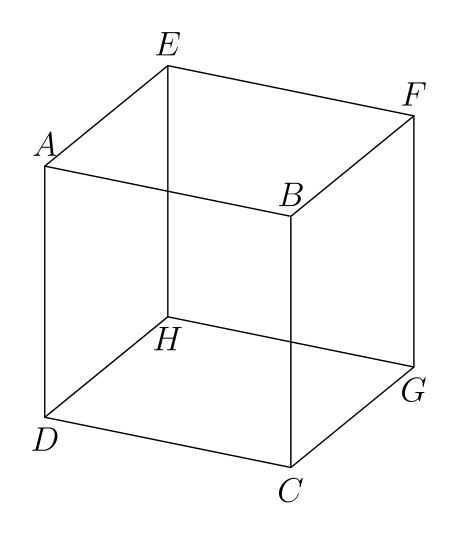
2. How many pairs of parallel edges, such as $\overline{AB}$ and $\overline{GH}$ or $\overline{EH}$ and $\overline{FG}$, does a cube have?
(A) 6(B) 12(C) 18(D) 24(E) 36
Solution
The $12$ edges split into $3$ directions of $4$ parallel edges each.
Within one direction: $C_4^2 = 6$ pairs. Three directions → $3\cdot6 = 18$.
(Or: $12$ edges $\times\,3$ parallel partners $\div\,2$ for double counting $= 18$.)
Answer: C
2008 AMC 8 #14
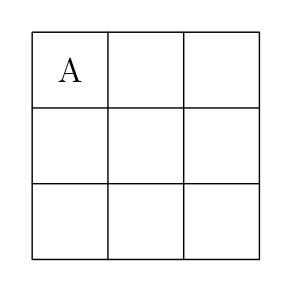
3. Three $A$'s, three $B$'s, and three $C$'s are placed in the nine spaces so that each row and column contains one of each letter. If $A$ is placed in the upper left corner, how many arrangements are possible?
(A) 2(B) 3(C) 4(D) 5(E) 6
Solution
Step 1: place the other two $A$'s — they must avoid row 1 and column 1
and each other's row/column: only $2$ ways (the two diagonals of the lower-right $2\times2$ block).
Step 2: fill column 1 below the $A$: $BC$ or $CB$ — $2$ ways.
Everything else is then forced. $2\cdot2 = 4$.
Answer: C
2018 AMC 8 #19
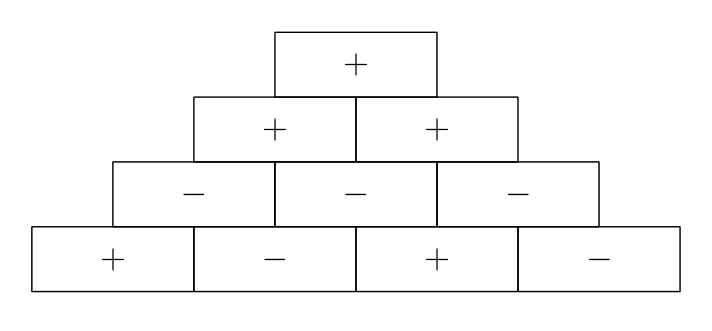
4. In a sign pyramid a cell gets a "+" if the two cells below it have the same sign, and it gets a "−" if the two cells below it have different signs. The diagram below illustrates a sign pyramid with four levels. How many possible ways are there to fill the four cells in the bottom row to produce a "+" at the top of the pyramid?
(A) 2(B) 4(C) 8(D) 12(E) 16
Solution
Work top-down: the top "+" forces row 2 to be equal signs — pick its left cell ($2$ ways), the right is forced.
In each lower row, once the row above is known, the leftmost cell is free ($2$ ways) and the rest are forced. So $2\cdot2\cdot2 = 8$.
Slicker: all $2^4 = 16$ bottom rows are possible and by symmetry half give "+": $16\div2 = 8$.
Answer: C
2009 AMC 8 #16
5. How many $3$-digit positive integers have digits whose product equals $24$?
(A) 12(B) 15(C) 18(D) 21(E) 24
Solution
Digit triples with product $24$: $\{2,2,6\}$, $\{2,3,4\}$, $\{1,3,8\}$, $\{1,4,6\}$.
$\{2,2,6\}$ has a repeat: $3!/2! = 3$ numbers. Each all-distinct triple gives $3! = 6$: three of them → $18$.
Total $3 + 18 = 21$.
Answer: D
mock · course problem
6. Three girls and four boys are to be seated in a row containing seven chairs. If the chairs at both ends of the row must be occupied by girls, in how many different ways can the children be seated?
(A) 120(B) 720(C) 5040(D) 2520(E) 240
Solution
Fill the special seats first: pick two of the three girls
in order for the two ends: $A_3^2 = 6$.
The remaining $5$ children fill the middle: $5! = 120$. Total $6\cdot120 = 720$.
Answer: B
2020 AMC 8 #10
7. Zara has a collection of $4$ marbles: an Aggie, a Bumblebee, a Steelie, and a Tiger. She wants to display them in a row on a shelf, but does not want to put the Steelie and the Tiger next to one another. In how many ways can she do this?
(A) 6(B) 8(C) 12(D) 18(E) 24
Solution
Arrange the two friendly marbles: $2! = 2$; they make $3$ gaps; drop Steelie and Tiger into different gaps in order: $A_3^2 = 6$.
Total $2\cdot6 = 12$. (Complement check: $4! - 2\cdot3! = 24 - 12 = 12$ ✓)
Answer: C
mock · course problem
8. In how many ways can $5$ books be arranged on a shelf if two of the books must remain together, but may be interchanged?
(A) 12(B) 24(C) 48(D) 96(E) 5
Solution
Bundle the two books ($2!$ inside), then arrange the bundle with the other three: $4! = 24$.
Total $2\cdot24 = 48$.
Answer: C
2012 AMC 8 #10
9. How many $4$-digit numbers greater than $1000$ are there that use the four digits of $2012$?
(A) 6(B) 7(C) 8(D) 9(E) 12
Solution
Digits $2,0,1,2$ (two $2$'s): total arrangements $\dfrac{4!}{2!} = 12$; those starting with $0$: arrange $2,1,2$ → $\dfrac{3!}{2!} = 3$.
$12 - 3 = 9$.
Answer: D
mock · course problem
10. In how many different ways can all the letters in INDIANA be arranged in a line? Assume that duplicate letters are indistinguishable.
(A) 5040(B) 2520(C) 1260(D) 630(E) none of these
Solution
Seven letters with two I's, two N's, two A's: $\dfrac{7!}{2!\,2!\,2!} = \dfrac{5040}{8} = 630$.
Answer: D
2020 AMC 8 #7
11. How many integers between $2020$ and $2400$ have four distinct digits arranged in increasing order? (For example, $2347$ is one integer.)
(A) 9(B) 10(C) 15(D) 21(E) 28
Solution
Increasing forces the first two digits to be $2,3$. The last two digits are any two of $\{4,\dots,9\}$ — and once chosen, their order is
forced (increasing), so it's a combination: $C_6^2 = 15$.
Answer: C
mock · course problem
12. Use four different colors to color the four rectangles $A$, $B$, $C$ and $D$ shown in the figure. No two rectangles sharing an edge may be the same color (colors may be reused otherwise). How many ways are there to color the rectangles?
(A) 120(B) 100(C) 84(D) 64(E) 24
Solution
Only diagonal pairs ($A,D$ and $B,C$) may share a color. Color in the order $A, B, C, D$ and split on whether $C$ copies $B$:
$C = B$: $A$: $4$, $B$: $3$ (≠$A$), $C$: $1$, $D$: $3$ (≠$B{=}C$) → $4\cdot3\cdot1\cdot3 = 36$.
$C \ne B$: $C$ ≠ $A,B$ → $2$; $D$ ≠ $B,C$ → $2$ → $4\cdot3\cdot2\cdot2 = 48$.
Total $36 + 48 = 84$.
(Instructor's coloring order: start from the region touching the most others.) Answer: C
2005 AMC 8 #21
13. How many distinct triangles can be drawn using three of the dots below as vertices?
(A) 9(B) 12(C) 18(D) 20(E) 24
Solution
Any $3$ of the $6$ dots: $C_6^3 = 20$. Subtract the degenerate "triangles": $3$ collinear dots — only the top row and the bottom row, $2$ cases.
$20 - 2 = 18$.
Answer: C
2022 AMC 8 #23
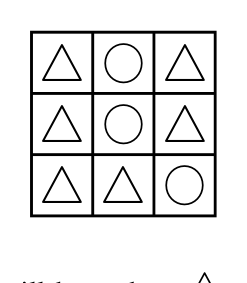
14. A $\triangle$ or $\bigcirc$ is placed in each of the nine squares in a $3$-by-$3$ grid. Shown below is a sample configuration with three $\triangle$s in a line. How many configurations will have three $\triangle$s in a line and three $\bigcirc$s in a line?
(A) 39(B) 42(C) 78(D) 84(E) 96
Solution
A diagonal line of $\triangle$s would block any line of $\bigcirc$s, so both lines are rows or both are columns — and by symmetry count rows, then double.
Two rows of $\triangle$: choose them, $C_3^2 = 3$; the last row must be all $\bigcirc$: $3$ ways total.
One row of $\triangle$: $C_3^1 = 3$; the other two rows: either both all-$\bigcirc$ ($1$ way), or one all-$\bigcirc$ ($2$ choices) and the last row mixed — not all-$\triangle$, not all-$\bigcirc$: $2^3 - 2 = 6$ ways. That's $3\,(1 + 2\cdot6) = 39$.
Rows total $3 + 39 = 42$; doubling for columns: $84$.
Answer: D
🆕 Fresh from the latest exams
The same ideas, exactly as they appeared on the most recent tests.
2024 AMC 8 #13
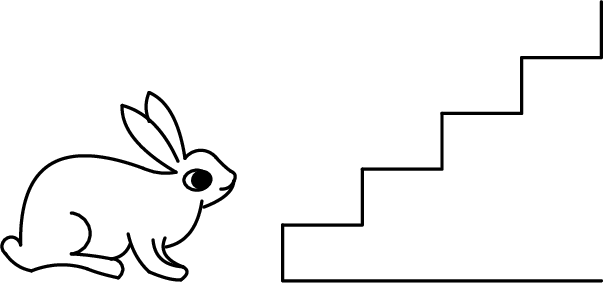
15. Buzz Bunny is hopping up and down a set of stairs, one step at a time. In how many ways can Buzz start on the ground, make a sequence of $6$ hops, and end up back on the ground? (For example, one sequence of hops is up-up-down-down-up-down.)
(A) 4(B) 5(C) 6(D) 8(E) 12
Solution
Six hops ending on the ground means $3$ ups and $3$ downs — but Buzz can never dip
below the ground, so list carefully (U = up, D = down):
UUUDDD, UUDUDD, UUDDUD, UDUUDD, UDUDUD — the other arrangements of $3$ U's and $3$ D's all sink below ground at some point.
That's $5$.
Answer: B
2026 AMC 8 #20
16. The land of Catania uses gold coins and silver coins. Gold coins are $1$ mm thick and silver coins are $3$ mm thick. In how many ways can Taylor make a stack of coins that is $8$ mm tall using any arrangement of gold and silver coins, assuming order matters?
(A) 3(B) 7(C) 10(D) 13(E) 16
Solution
Case on the number of silver coins $s$ (each $3$ mm), with $g$ gold coins: $g + 3s = 8$.
$s=0$: $8$ golds → $1$ stack. $s=1$: $5$ golds $+$ $1$ silver → $\dfrac{6!}{5!} = 6$ stacks. $s=2$: $2$ golds $+$ $2$ silvers → $\dfrac{4!}{2!\,2!} = 6$ stacks.
Total $1+6+6 = 13$.
Answer: D
2026 AMC 8 #17
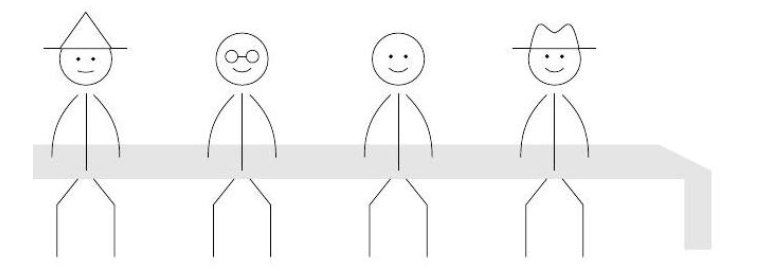
17. Four students are seated in a row. They chat with the people sitting next to them, then rearrange themselves so that they are no longer seated next to any of the same people. How many rearrangements are possible?
(A) 2(B) 4(C) 9(D) 12(E) 24
Solution
Call the original row $A,B,C,D$; the forbidden neighbor pairs are $AB$, $BC$, $CD$.
$B$ and $C$ each had two neighbors, so each can only sit next to one other person: $B$ next only to $D$, $C$ next only to $A$ — so the new row must glue $BD$ and $AC$ together, with $B,C$ on the
outside (they can't touch each other or their old partners in the middle):
$B\,D\,A\,C$ and $C\,A\,D\,B$. Just $2$.
Answer: A
⭐ Challenge (AMC 10 level)
2018 AMC 10A #4 · gap method
C1. How many ways can a student schedule $3$ mathematics courses — algebra, geometry, and number theory — in a $6$-period day if no two mathematics courses can be taken in consecutive periods? (What courses the student takes during the other $3$ periods is of no concern here.)
(A) 3(B) 6(C) 12(D) 18(E) 24
Solution
The three non-math periods create $4$ gaps ($\_x\_x\_x\_$); choose $3$ gaps for the math courses: $C_4^3 = 4$.
Then assign the three
different courses to those periods: $3! = 6$. Total $4\cdot6 = 24$.
Answer: E
2017 AMC 10A #19 · gap method
C2. Alice refuses to sit next to either Bob or Carla. Derek refuses to sit next to Eric. All five must sit in a row of $5$ chairs. In how many ways can they be seated?
(A) 12(B) 16(C) 28(D) 32(E) 40
Solution
Seat $A, B, C$ first, then insert $D, E$ into the gaps so that every forbidden touch is broken. Case on where $A$ sits relative to $B, C$:
$A$ on a side (orders $ABC$-type, $B,C$ swappable: $2$ ways each side): the $A$-$B$ gap
must get $D$ or $E$ ($2$ ways); the remaining person has $3$ slots. $2\cdot2\cdot3 = 12$ per side → $24$ for both sides.
$A$ in the middle ($B\,A\,C$, $2$ ways): both gaps around $A$ must be filled by $D$ and $E$: $2$ ways. $2\cdot2 = 4$.
Total $24 + 4 = 28$.
Answer: C
🗝 Answer key
| Example | 1 | 2 | 3 | 4 | 5 |
|---|
| D | D | D | C | B |
|---|
| Practice | 1 | 2 | 3 | 4 | 5 | 6 | 7 | 8 | 9 | 10 | 11 | 12 | 13 | 14 | 15 | 16 | 17 |
|---|
| B | C | C | C | D | B | C | C | D | D | C | C | C | D | B | D | A |
|---|
| Challenge | C1 | C2 |
|---|
| E | C |
|---|
Sources: prep-course Lecture 12 (video + board notes + 38 worked examples, translated to English) and official AMC 8 problems from the local bank
(kb/content/banks/). Answers verified against official AoPS answer keys where available.