Angles & Triangles · Lecture 01 · geo-angles-triangles
📺 Course materials — Lecture 01:
lecture video · handout PDF (Lecture 1) · board notes (01.jpg) · homework answer key (Chapter 1)
— all in the
amc8/video folder.
·
🖨 Printable PDF (answers & solutions at the back)
🔑 Key facts
The three angles of a triangle sum to $180^\circ$; an exterior angle equals the sum of the two remote interior angles — that one identity solves half the problems in this lecture.
An $n$-gon's interior angles sum to $(n-2)\cdot 180^\circ$ (split it into triangles from one vertex), and the exterior angles of any polygon sum to $360^\circ$.
Finally, sides are constrained too: in every triangle the sum of any two sides is greater than the third (the triangle inequality).
🧰 Instructor's toolbox (from the lecture video & board notes)
1 · Angle vocabulary → equations. Acute $<90^\circ$, right $=90^\circ$, obtuse, straight $=180^\circ$, and the reflex angle ($>180^\circ$) on the far side of any angle.
Two angles are supplementary if they sum to $180^\circ$ and complementary if they sum to $90^\circ$.
The instructor's move: name the unknown $x$ and translate the words directly — "twice the supplement is 27 more than five times the complement" becomes $2(180-x)=5(90-x)+27$ (Practice 10).
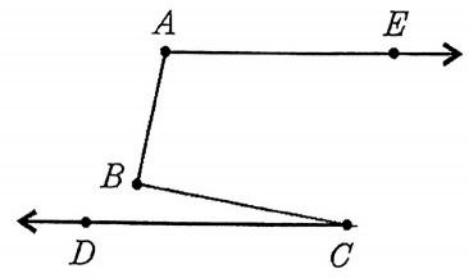
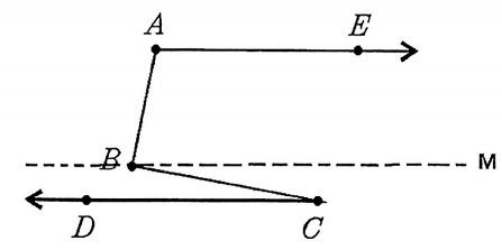
3 · No parallel line? Draw one. When a point sits between two parallel rays (a zig-zag / "Z with a bump"), draw the line through that point parallel to both.
The bump angle splits into two pieces, each handled by tip #2. That is the entire solution of Practice 8 — and the same auxiliary line proves the $180^\circ$ angle sum itself.
4 · Angle sums: triangle $180^\circ$, $n$-gon $(n-2)\cdot180^\circ$.
The proof is tip #3: a parallel line through the apex turns the three angles into a straight line.
For any polygon, split it into triangles from one vertex: quadrilateral $=2\times180^\circ=360^\circ$ (even a non-convex "arrow" — Practice 2), pentagon $=540^\circ$, hexagon $=720^\circ$.
A full turn around any interior point is $360^\circ$ — that closes out Practice 3 and Practice 12.
7 · Equilateral: all sides equal, all angles $60^\circ$.
Two ways it hides on exams: an isosceles triangle with any $60^\circ$ angle is automatically equilateral (Practice 1: $DA=CD$ and $\angle ADC = 60^\circ$ force $AC=DA$);
and chains of equilateral triangles share side lengths, so perimeters can be read off by counting (Practice 4).
Regular-polygon angles to know cold: $60^\circ$ (triangle), $90^\circ$, $108^\circ$, $120^\circ$ (hexagon).
9 · Angle chasing with algebra: hunt the SUM, not each angle.
Often the individual angles cannot be found — and don't need to be. In Example 5 the given difference $\angle CAB-\angle ABC=40^\circ$ simplifies to $2\angle BAD = 40^\circ$;
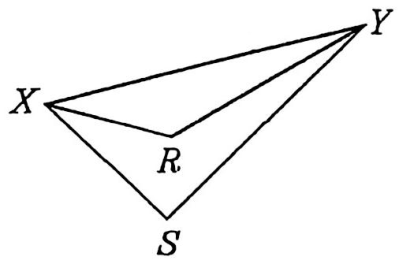
in Practice 9 you only ever need $\angle RXY+\angle RYX$, which the bisectors tie to $\frac12(180^\circ - a)$.
Write what you want in terms of sums the problem controls, and let the extra unknowns cancel.
📖 Worked examples
2015 AMC 8 #8 · triangle inequality
Example 1. What is the smallest whole number larger than the perimeter of any triangle with a side of length $5$ and a side of length $19$?
(A) 24(B) 29(C) 43(D) 48(E) 57
Key idea: pin down the third side, then shift the whole inequality.
Third side $c$: $19-5 < c < 19+5$, so $14 < c < 24$. Add $5+19=24$ to every part:
$38 < P < 48$. The perimeter can get as close to $48$ as it likes but never reaches it,
so the smallest whole number larger than every possible perimeter is $48$.
Answer: D
2014 AMC 8 #9 · exterior angle
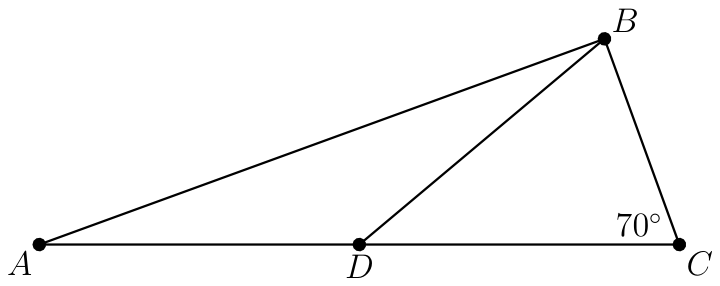
Example 2. In $\triangle ABC$, $D$ is a point on side $\overline{AC}$ such that $BD=DC$ and $\angle BCD$ measures $70^\circ$. What is the degree measure of $\angle ADB$?
(A) 100(B) 120(C) 135(D) 140(E) 150
Key idea: $BD=DC$ makes $\triangle BDC$ isosceles, so $\angle DBC = \angle DCB = 70^\circ$.
Now $\angle ADB$ is the exterior angle of $\triangle BDC$ at $D$:
$\angle ADB = \angle DBC + \angle DCB = 70^\circ + 70^\circ = 140^\circ$ — no other angle in the figure is ever computed.
Answer: D
2000 AMC 8 #13 · isosceles + bisector
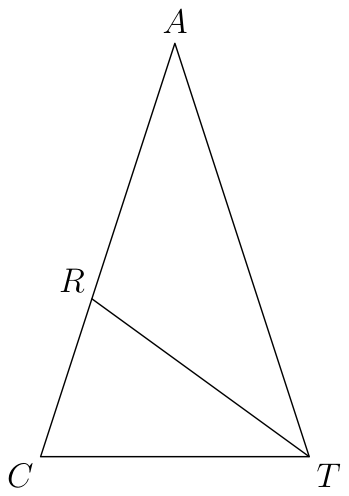
Example 3. In triangle $CAT$, we have $\angle ACT = \angle ATC$ and $\angle CAT = 36^\circ$. If $\overline{TR}$ bisects $\angle ATC$, then $\angle CRT = {}$?
(A) $36^\circ$(B) $54^\circ$(C) $72^\circ$(D) $90^\circ$(E) $108^\circ$
Key idea: apex $36^\circ$ → base angles $\angle ACT=\angle ATC = \dfrac{180^\circ-36^\circ}{2} = 72^\circ$.
The bisector gives $\angle ATR = 36^\circ$. Then $\angle CRT$ is the exterior angle of $\triangle ART$ at $R$:
$\angle CRT = \angle A + \angle ATR = 36^\circ + 36^\circ = 72^\circ$.
(Or inside $\triangle CRT$: $180^\circ - 72^\circ - 36^\circ = 72^\circ$.)
Answer: C
2000 AMC 8 #24 · exterior angle
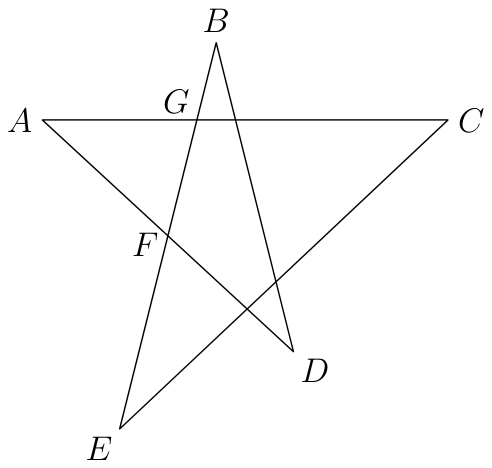
Example 4. If $\angle A = 20^\circ$ and $\angle AFG = \angle AGF$, then $\angle B + \angle D = {}$?
(A) $48^\circ$(B) $60^\circ$(C) $72^\circ$(D) $80^\circ$(E) $90^\circ$
Key idea: $\triangle AFG$ is isosceles with apex $20^\circ$, so $\angle AFG = \angle AGF = \dfrac{180^\circ-20^\circ}{2} = 80^\circ$.
But $\angle AFG$ is also an exterior angle of $\triangle BFD$ (the small triangle at $F$ on line $BE$),
so $\angle B + \angle D = \angle AFG = 80^\circ$ — the sum pops out even though $\angle B$ and $\angle D$ are individually unknown.
Answer: D
course mock · angle chasing
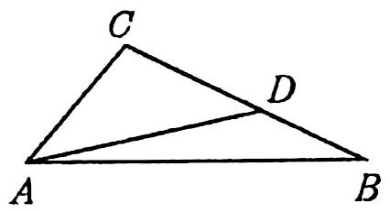
Example 5. In $\triangle ABC$, point $D$ lies on $\overline{CB}$ with $AC = CD$, and $\angle CAB - \angle ABC = 40^\circ$. What is $\angle BAD$?
(A) $15^\circ$(B) $20^\circ$(C) $30^\circ$(D) $35^\circ$(E) $40^\circ$
Key idea: rewrite the given difference until everything except $\angle BAD$ cancels.
$AC=CD$ gives $\angle CAD = \angle CDA$. Split: $\angle CAB = \angle CAD + \angle DAB$, so
\[\angle CAD + \angle DAB - \angle ABC = 40^\circ.\]
Replace $\angle CAD$ by $\angle CDA$, and $\angle CDA$ is the exterior angle of $\triangle ABD$ at $D$: $\angle CDA = \angle DAB + \angle ABC$. Substituting,
\[(\angle DAB + \angle ABC) + \angle DAB - \angle ABC = 2\angle DAB = 40^\circ,\]
so $\angle BAD = 20^\circ$ — neither $\angle CAB$ nor $\angle ABC$ is ever known alone.
Answer: B
✏️ Practice
Try each one before opening the solution. Figures are from the official exams and course handouts.
2005 AMC 8 #9
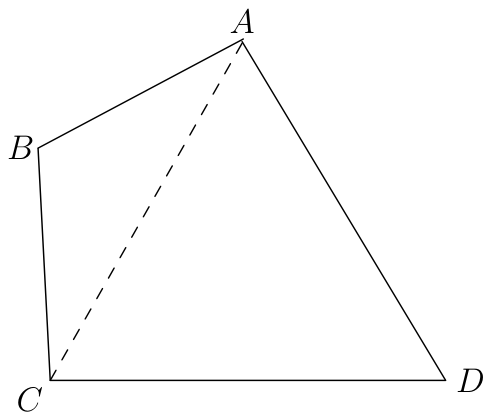
1. In quadrilateral $ABCD$, sides $\overline{AB}$ and $\overline{BC}$ both have length $10$, sides $\overline{CD}$ and $\overline{DA}$ both have length $17$, and the measure of angle $ADC$ is $60^\circ$. What is the length of diagonal $\overline{AC}$?
(A) 13.5(B) 14(C) 15.5(D) 17(E) 18.5
Solution
Look only at $\triangle ACD$: $DA = DC = 17$ with apex $\angle ADC = 60^\circ$, so the base angles are $\frac{180^\circ-60^\circ}{2}=60^\circ$ each —
all three angles are $60^\circ$, the triangle is equilateral, and $AC = 17$. The sides of length $10$ are a decoy.
Answer: D
course mock · non-convex quadrilateral
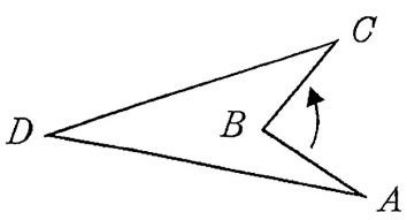
2. The tip of an arrow has the shape shown below. If the angle $ABC$ marked by the curved arrow is an acute angle, then the sum of the interior angles of quadrilateral $ABCD$:
(A) is less than $180^\circ$(B) is less than $360^\circ$(C) is exactly $360^\circ$(D) is more than $360^\circ$(E) none of the above
Solution
Connect $\overline{DB}$: the quadrilateral splits into $\triangle ABD$ and $\triangle CBD$, so its interior angles sum to $2\times180^\circ = 360^\circ$ — exactly as for any quadrilateral.
The catch the arrow is testing: at the notch $B$ the
interior angle is the reflex angle ($>180^\circ$), not the acute angle the arrow marks. Count the true interior angles and the sum is exactly $360^\circ$.
Answer: C
course mock · pinwheel
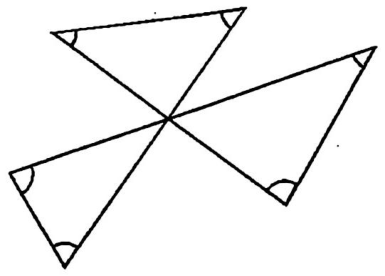
3. In the figure below, the sum of all the marked angles is:
(A) $180^\circ$(B) $360^\circ$(C) $540^\circ$(D) $270^\circ$(E) cannot be determined
Solution
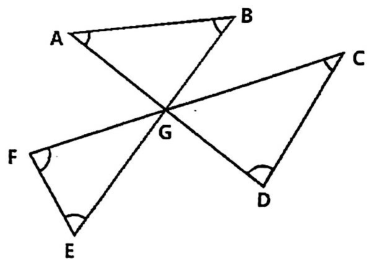
Label the triangles $\triangle ABG$, $\triangle CDG$, $\triangle EFG$ meeting at the center $G$ (figure below).
Each marked pair is swallowed by an exterior angle at the center: $\angle A+\angle B = \angle BGD$, $\angle C+\angle D = \angle DGF$, $\angle E+\angle F = \angle FGB$.
The three center angles make a full turn:
\[\angle A+\angle B+\angle C+\angle D+\angle E+\angle F = \angle BGD+\angle DGF+\angle FGB = 360^\circ.\]
Answer: B
2000 AMC 8 #15
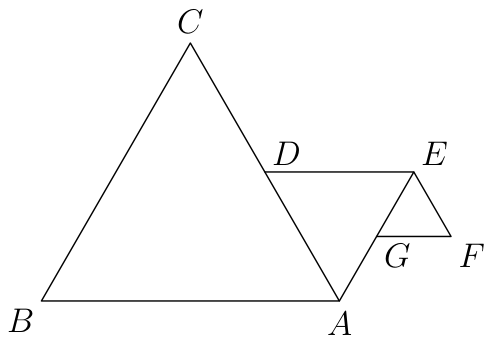
4. Triangles $ABC$, $ADE$, and $EFG$ are all equilateral. Points $D$ and $G$ are midpoints of $\overline{AC}$ and $\overline{AE}$, respectively. If $AB = 4$, what is the perimeter of figure $ABCDEFG$?
(A) 12(B) 13(C) 15(D) 18(E) 21
Solution
Equilateral triangles share all their side lengths: $\triangle ABC$ has side $4$, $\triangle ADE$ has side $AD = \tfrac12 AC = 2$, $\triangle EFG$ has side $EG=\tfrac12 AE = 1$.
Walk the boundary: $AB+BC+CD+DE+EF+FG+GA = 4+4+2+2+1+1+1 = 15$.
Answer: C
1999 AMC 8 #21
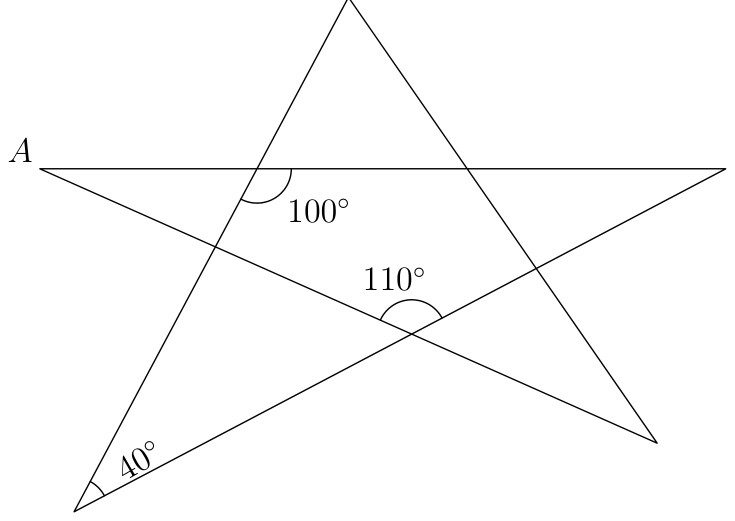
5. The degree measure of angle $A$ is:
(A) 20(B) 30(C) 35(D) 40(E) 45
Solution
Chain the exterior angle theorem twice through the star.
In the bottom-left triangle, the $110^\circ$ angle is exterior: $110^\circ = 40^\circ + x$, so the third marked crossing angle is $x = 70^\circ$.
In the triangle containing $A$, the $100^\circ$ angle is exterior: $100^\circ = 70^\circ + \angle A$, so $\angle A = 30^\circ$.
Answer: B
course mock · parallel lines
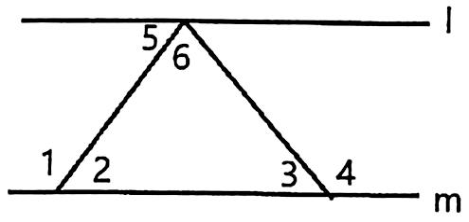
6. In the figure, $\angle 1 = 7x+10$, $\angle 5 = 3x$, and $l \parallel m$. The measure of $\angle 2$ equals:
(A) $17^\circ$(B) $51^\circ$(C) $87^\circ$(D) $129^\circ$(E) $139^\circ$
Solution
$\angle 1$ and $\angle 5$ are co-interior angles between the parallels, so they sum to $180^\circ$:
$(7x+10)+3x = 180$, giving $x = 17$ and $\angle 1 = 129^\circ$.
Then $\angle 2 = 180^\circ - \angle 1 = 51^\circ$.
Answer: B
course mock · parallel lines
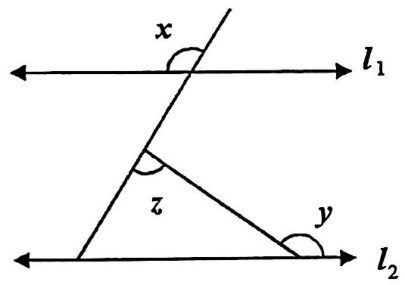
7. $x$, $y$, and $z$ are the measures of the angles shown, and $l_1 \parallel l_2$. The measure of $x$ is:
(A) $180^\circ - x$(B) $180^\circ - z$(C) $180^\circ - z + y$(D) $180^\circ + z - y$(E) $z + y - 180^\circ$
Solution
The angle the transversal makes below $l_1$ (alternate side) is $180^\circ - x$, and it sits inside the small triangle on $l_2$ whose exterior angle is $y$:
\[y = z + (180^\circ - x) \quad\Longrightarrow\quad x = 180^\circ + z - y.\]
Answer: D
course mock · auxiliary parallel line
8. In the figure shown, $\overrightarrow{AE}$ is parallel to $\overrightarrow{CD}$ and $B$ is a point between the rays. If $\angle BAE = 100^\circ$ and $\angle ABC = 90^\circ$, find the measure of $\angle BCD$.
(A) $5^\circ$(B) $90^\circ$(C) $100^\circ$(D) $30^\circ$(E) $10^\circ$
Solution
Draw line $M$ through $B$ parallel to both rays (dashed below).
Above it: $\angle ABM$ and $\angle BAE$ are co-interior, so $\angle ABM = 180^\circ - 100^\circ = 80^\circ$.
That leaves $\angle MBC = 90^\circ - 80^\circ = 10^\circ$, and by alternate angles $\angle BCD = \angle MBC = 10^\circ$.
Answer: E
course mock · angle bisectors
9. In the figure, $\overline{XR}$ bisects $\angle YXS$, $\overline{YR}$ bisects $\angle XYS$, and $\angle S = a$. Express the measure of $\angle R$ in terms of $a$.
(A) $90 + \frac{a}{2}$(B) $60 - \frac{a}{3}$(C) $30 + \frac{2a}{3}$(D) $180 + \frac{a}{2}$(E) $-30 + \frac{a}{3}$
Solution
Never find the four half-angles separately — only their sum matters.
\[\angle RXY + \angle RYX = \tfrac12(\angle SXY + \angle SYX) = \tfrac12(180^\circ - a) = 90^\circ - \tfrac{a}{2}.\]
Then in $\triangle XYR$: $\angle R = 180^\circ - \left(90^\circ - \tfrac{a}{2}\right) = 90^\circ + \tfrac{a}{2}$.
Answer: A
course mock · supplement & complement
10. What is the measure of an acute angle if twice the measure of its supplement is $27$ more than five times the measure of its complement?
(A) $17^\circ$(B) $23^\circ$(C) $31^\circ$(D) $39^\circ$(E) $47^\circ$
Solution
Translate word for word with the angle as $x$: supplement $=180-x$, complement $=90-x$:
\[2(180-x) = 5(90-x) + 27 \;\Longrightarrow\; 360 - 2x = 477 - 5x \;\Longrightarrow\; 3x = 117,\]
so $x = 39^\circ$ (an acute angle, as promised).
Answer: D
🆕 Fresh from the latest exams
The same ideas, exactly as they appeared on the most recent tests.
2024 AMC 8 #20
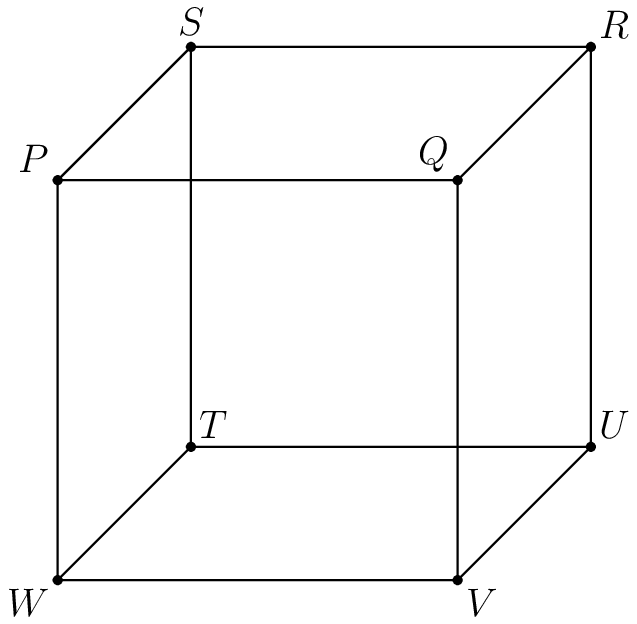
11. Any three vertices of the cube $PQRSTUVW$, shown in the figure below, can be connected to form a triangle. (For example, vertices $P$, $Q$, and $R$ can be connected to form $\triangle PQR$.) How many of these triangles are equilateral and contain $P$ as a vertex?
(A) 0(B) 1(C) 2(D) 3(E) 6
Solution
Cube vertex distances come in three sizes: edge, face diagonal, space diagonal — an equilateral triangle must use three sides of the
same size, and only face diagonals work
(edges and space diagonals can never close up into a triangle of equal sides).
Every face-diagonal triangle is a "corner slice": it connects the three neighbors of some cube vertex $v$, so it contains $P$ exactly when $v$ is adjacent to $P$.
$P$ has $3$ adjacent vertices, giving exactly $3$ equilateral triangles through $P$ — one per neighboring corner.
Answer: D
2024 AMC 8 #18
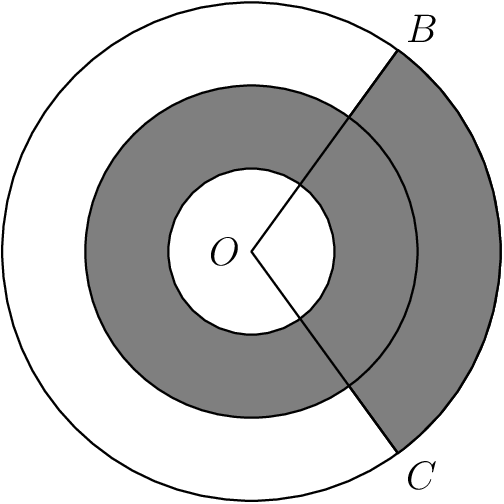
12. Three concentric circles centered at $O$ have radii of $1$, $2$, and $3$. Points $B$ and $C$ lie on the largest circle. The region between the two smaller circles is shaded, as is the portion of the region between the two larger circles bounded by central angle $BOC$, as shown in the figure below. Suppose the shaded and unshaded regions are equal in area. What is the measure of $\angle BOC$ in degrees?
(A) 108(B) 120(C) 135(D) 144(E) 150
Solution
A central angle takes its fraction $\frac{\theta}{360^\circ}$ of a ring's area.
Ring areas: inner ring ($1$ to $2$): $4\pi - \pi = 3\pi$, all shaded. Outer ring ($2$ to $3$): $9\pi - 4\pi = 5\pi$, shaded part $= \frac{\theta}{360}\cdot 5\pi$.
Total area is $9\pi$, so "shaded = unshaded" means shaded $= 4.5\pi$:
\[3\pi + \tfrac{\theta}{360}\cdot 5\pi = 4.5\pi \;\Longrightarrow\; \tfrac{\theta}{360} = \tfrac{3}{10} \;\Longrightarrow\; \theta = 108^\circ.\]
Answer: A
2025 AMC 8 #24
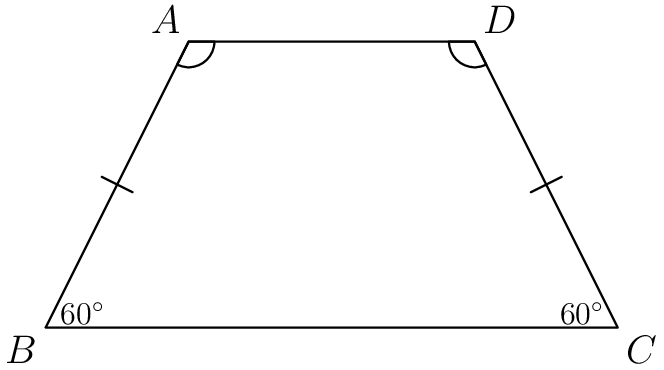
13. In trapezoid $ABCD$, angles $B$ and $C$ measure $60^\circ$ and $AB = DC$. The side lengths are all positive integers, and the perimeter of $ABCD$ is $30$ units. How many non-congruent trapezoids satisfy all of these conditions?
(A) 0(B) 1(C) 2(D) 3(E) 4
Solution
Extend the legs $BA$ and $CD$: with two $60^\circ$ base angles they meet at a third $60^\circ$ angle — an
equilateral triangle on base $BC$!
So $BC = AB + AD$ (leg + top). Let $AB=DC=x$ and $AD=a$: perimeter $= x + (a+x) + x + a = 3x + 2a = 30$.
For $a$ to be a positive integer, $x$ must be even: $x = 2,4,6,8$ give $a = 12,9,6,3$ ($x=10$ makes $a=0$, a degenerate triangle).
That's $4$ non-congruent trapezoids.
Answer: E
🗝 Answer key
| Example | 1 | 2 | 3 | 4 | 5 |
|---|
| D | D | C | D | B |
|---|
| Practice | 1 | 2 | 3 | 4 | 5 | 6 | 7 | 8 | 9 | 10 | 11 | 12 | 13 |
|---|
| D | C | B | C | B | B | D | E | A | D | D | A | E |
|---|
Sources: prep-course Lecture 01 (video + board notes + 15 worked examples, translated to English) and official AMC 8 problems from the local bank
(kb/content/banks/). Answers verified against official AoPS answer keys where available; course-mock answers follow the course solution manual.