Circles · Lecture 04 · geo-circles
📺 Course materials — Lecture 04 (96 min):
lecture video · handout PDF (Lecture 4) · board notes (04.jpg) · homework answer key (Chapter 4)
— all in the
amc8/video folder.
·
🖨 Printable PDF (answers & solutions at the back)
🔑 Key facts
For a circle of radius $r$: circumference $C = \pi d = 2\pi r$ and area $S = \pi r^2$
(and $\pi = \frac{C}{d} \approx 3.14$ — that's its definition).
A whole circle is $360^\circ$ of arc, and everything about arcs and sectors is proportional reasoning:
a piece that is $\frac{\theta}{360}$ of the circle has $\frac{\theta}{360}$ of the circumference and $\frac{\theta}{360}$ of the area.
The one theorem AMC 8 loves most: an inscribed angle is half the central angle on the same arc —
so an angle sitting on a diameter is always $90^\circ$.
🧰 Instructor's toolbox (from the lecture video & board notes)
6 · The shaded-area playbook: subtract, then complete.
Almost every shaded region is (easy shape) $-$ (easy pieces):
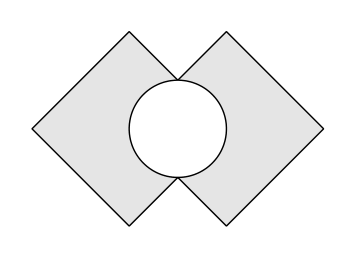
rectangle $-$ sectors (Example 4), two squares $-$ overlap $-$ circle (Practice 4).
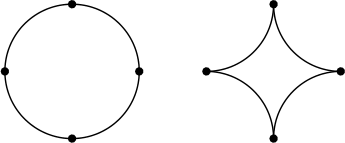
When the region has curved dents, complete the figure first: the star in Practice 2 completes to a $4\times4$ square minus four quarter-circles — which reassemble into one whole circle.
Watch for quarter-circles hiding in corners: their radii tell you the square's side.
7 · Equal areas ⇒ trade the regions.
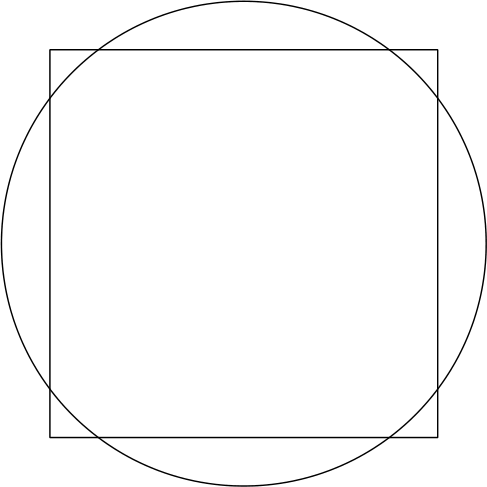
"Area inside the circle but outside the square $=$ area inside the square but outside the circle" means the crescents exactly fill the corner slivers —
so circle and square have equal total area (Practice 3: $\pi r^2 = 4$). Don't compute the overlap; trade it away.
Cousin of this move: comparing two figures by adding the same shared region to both.
8 · Rolling circles ride an offset track.
When a ball of radius $\rho$ rolls along a curve, its center traces the same curve shifted by $\rho$:
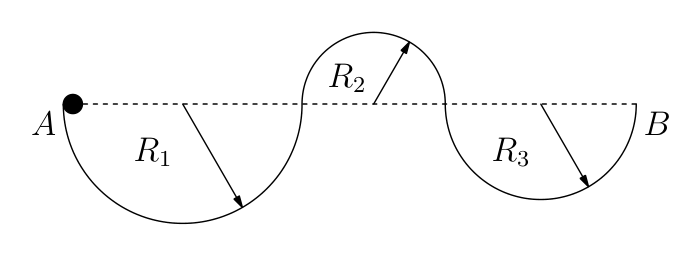
outside a hump the center's radius is $R - \rho$… inside a dip it's $R + \rho$ (Practice 5: $98, 62, 78$ instead of $100, 60, 80$).
Same idea wrapped around coins: a taut band = straight tangent segments $+$ arcs that always total one full circle (Fresh 9).
📖 Worked examples
2017 AMC 8 #22 · tangent + similar triangles
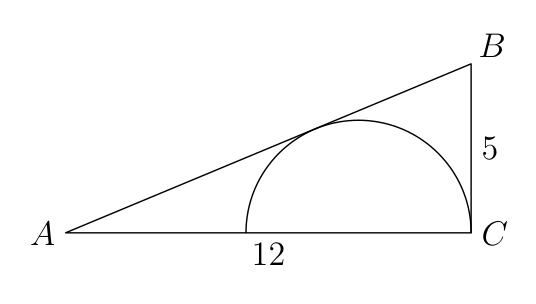
Example 1. In the right triangle $ABC$, $AC=12$, $BC=5$, and angle $C$ is a right angle. A semicircle is inscribed in the triangle as shown. What is the radius of the semicircle?
(A) $\frac{7}{6}$(B) $\frac{13}{5}$(C) $\frac{59}{18}$(D) $\frac{10}{3}$(E) $\frac{60}{13}$
Key idea: let $O$ be the center (on $AC$) and $M$ the point where the semicircle touches $AB$; connect $OM$, so $OM \perp AB$.
Then $\triangle AMO$ and $\triangle ACB$ share angle $A$ and both have a right angle, so $\triangle AMO \sim \triangle ACB$, giving
$\dfrac{OM}{BC} = \dfrac{AO}{AB}$, i.e. $\dfrac{r}{5} = \dfrac{12-r}{13}$ (note $AB = 13$ from the $5$-$12$-$13$ triple, and $AO = 12 - r$).
So $13r = 60 - 5r$, $18r = 60$, $r = \dfrac{10}{3}$.
Answer: D
2014 AMC 8 #15 · arcs & inscribed angles
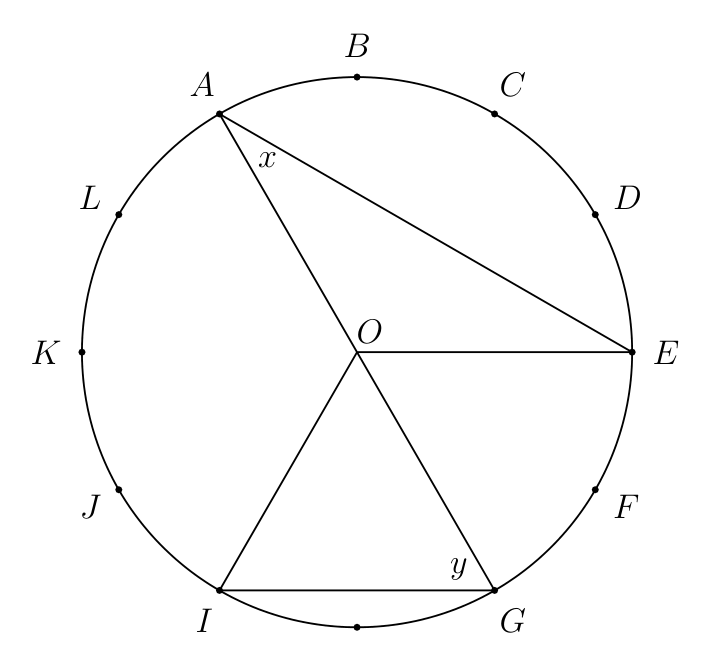
Example 2. The circumference of the circle with center $O$ is divided into $12$ equal arcs, marked with the letters $A$ through $L$ as seen below. What is the number of degrees in the sum of the angles $x$ and $y$?
(A) 75(B) 80(C) 90(D) 120(E) 150
Key idea: $12$ equal arcs → each arc is $360^\circ/12 = 30^\circ$.
Angle $x$ at $A$ is an inscribed angle standing on arc $EG$ ($2$ arcs $= 60^\circ$), so $x = \tfrac12\cdot 60^\circ = 30^\circ$.
For $y$: in $\triangle OIG$ the central angle $\angle IOG = 60^\circ$ and $OI = OG$ (radii), so the triangle is equilateral and $y = 60^\circ$.
Sum: $x + y = 90^\circ$.
Answer: C
2016 AMC 8 #23 · Thales on two circles
Example 3. Two congruent circles centered at points $A$ and $B$ each pass through the other circle's center. The line containing both $A$ and $B$ is extended to intersect the circles at points $C$ and $D$. The circles intersect at two points, one of which is $E$. What is the degree measure of $\angle CED$?
(A) 90(B) 105(C) 120(D) 135(E) 150
Key idea: let the common radius be $r$; then $AE = BE = AB = r$, so $\triangle ABE$ is equilateral.
Both $A$ and $D$ lie on circle $B$ ($BA = BD = r$), so $AD$ is a
diameter of circle $B$ — and $E$ is on that circle, so $\angle AED = 90^\circ$ (Thales).
Also $AE = r = \tfrac12 AD$ gives $\angle EAD = 60^\circ$. On the other side, $CA = AE = r$ makes $\triangle CAE$ isosceles, and its exterior angle at $A$ is $60^\circ$, so $\angle CEA = 30^\circ$.
Total: $\angle CED = 30^\circ + 90^\circ = 120^\circ$.
Answer: C
2014 AMC 8 #20 · sectors
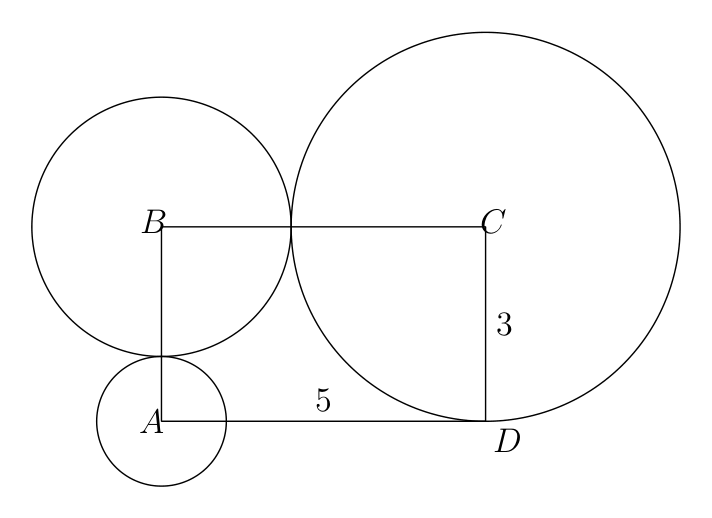
Example 4. Rectangle $ABCD$ has sides $CD=3$ and $DA=5$. A circle with radius $1$ is centered at $A$, a circle with radius $2$ is centered at $B$, and a circle with radius $3$ is centered at $C$. Which of the following is closest to the area of the region inside the rectangle but outside all three circles?
(A) 3.5(B) 4.0(C) 4.5(D) 5.0(E) 5.5
Key idea: each circle only pokes a
quarter into the rectangle (the corners are right angles).
Area $= 15 - \tfrac{\pi}{4}\left(1^2 + 2^2 + 3^2\right) = 15 - \tfrac{14\pi}{4} = 15 - 3.5\pi \approx 15 - 10.99 \approx 4.0$.
Answer: B
✏️ Practice
Try each one before opening the solution. Figures are from the official exams.
2003 AMC 8 #22
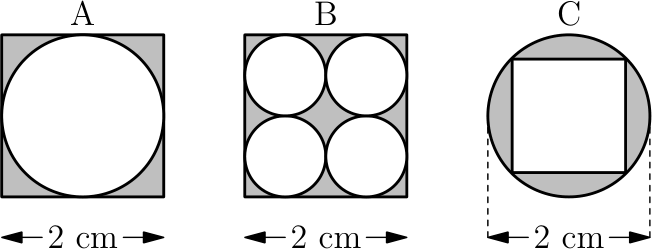
1. The following figures are composed of squares and circles. Which figure has a shaded region with the largest area?
(A) A only(B) B only(C) C only(D) both A and B(E) all are equal
Solution
A: $2^2 - \pi\cdot 1^2 = 4 - \pi \approx 0.86$.
B: four circles of radius $\tfrac12$: $4 - 4\pi\left(\tfrac12\right)^2 = 4 - \pi$ — the same!
C: the circle's diameter equals the square's
diagonal $= 2$, so the square's area is $\tfrac{2\cdot 2}{2} = 2$ and the shaded part is $\pi\cdot 1^2 - 2 = \pi - 2 \approx 1.14$. Largest is C.
Answer: C
2012 AMC 8 #24
2. A circle of radius $2$ is cut into four congruent arcs. The four arcs are joined to form the star figure shown. What is the ratio of the area of the star figure to the area of the original circle?
(A) $\frac{4-\pi}{\pi}$(B) $\frac{1}{\pi}$(C) $\frac{\sqrt2}{\pi}$(D) $\frac{\pi-1}{\pi}$(E) $\frac{3}{\pi}$
Solution
Complete the star to the $4\times4$ square through its four points.
The star is the square minus four quarter-circles of radius $2$ — and those four quarters are exactly one whole circle.
Star $= 16 - 4\pi$, so the ratio is $\dfrac{16-4\pi}{4\pi} = \dfrac{4-\pi}{\pi}$.
Answer: A
2005 AMC 8 #25
3. A square with side length $2$ and a circle share the same center. The total area of the regions that are inside the circle and outside the square is equal to the total area of the regions that are outside the circle and inside the square. What is the radius of the circle?
(A) $\frac{2}{\sqrt\pi}$(B) $\frac{1+\sqrt2}{2}$(C) $\frac{3}{2}$(D) $\sqrt3$(E) $\sqrt\pi$
Solution
The four crescents (circle-outside-square) exactly balance the four corner slivers (square-outside-circle),
so circle and square have equal areas: $\pi r^2 = 2^2 = 4$.
Then $r = \dfrac{2}{\sqrt\pi}$ $\left(= \dfrac{2\sqrt\pi}{\pi}\text{ after rationalizing}\right)$.
Answer: A
2004 AMC 8 #25
4. Two $4\times4$ squares intersect at right angles, bisecting their intersecting sides, as shown. The circle's diameter is the segment between the two points of intersection. What is the area of the shaded region created by removing the circle from the squares?
(A) $16-4\pi$(B) $16-2\pi$(C) $28-4\pi$(D) $28-2\pi$(E) $32-2\pi$
Solution
The overlap of the two squares is itself a small square whose diagonal joins the two intersection points; half-sides of length $2$ give diagonal $MN = 2\sqrt2$, so the circle's radius is $\sqrt2$.
Shaded $=$ two squares $-$ overlap $-$ circle $= 2\cdot16 - 4 - \pi(\sqrt2)^2 = 28 - 2\pi$.
Answer: D
2013 AMC 8 #25
5. A ball with diameter $4$ inches starts at point $A$ to roll along the track shown. The track is comprised of $3$ semicircular arcs whose radii are $R_1 = 100$ inches, $R_2 = 60$ inches, and $R_3 = 80$ inches, respectively. The ball always remains in contact with the track and does not slip. What is the distance the center of the ball travels over the course from $A$ to $B$?
(A) $238\pi$(B) $240\pi$(C) $260\pi$(D) $280\pi$(E) $500\pi$
Solution
The ball's radius is $2$, so its center follows three semicircles of radii
$r_1 = 100-2 = 98$ (riding
inside the dip), $r_2 = 60+2 = 62$ (over the hump), $r_3 = 80-2 = 78$.
Each semicircle contributes $\pi r$: total $= \pi(98+62+78) = 238\pi$.
Answer: A
2005 AMC 8 #23
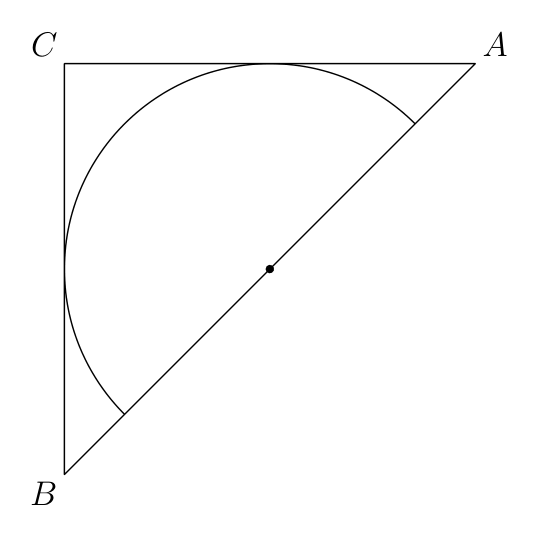
6. Isosceles right triangle $ABC$ encloses a semicircle of area $2\pi$. The circle has its center $O$ on hypotenuse $\overline{AB}$ and is tangent to sides $\overline{AC}$ and $\overline{BC}$. What is the area of triangle $ABC$?
(A) 6(B) 8(C) $3\pi$(D) 10(E) $4\pi$
Solution
Semicircle area: $\tfrac12\pi r^2 = 2\pi \Rightarrow r = 2$.
Draw radii $OM \perp AC$ and $ON \perp BC$ to the tangent points. In right triangle $AMO$, $\angle A = 45^\circ$, so $AM = MO = 2$.
$\angle C = \angle CMO = \angle CNO = 90^\circ$ with $OM = ON$ makes $CMON$ a square, so $CM = 2$.
Then $AC = AM + MC = 4 = BC$, and $S = \tfrac12\cdot4\cdot4 = 8$.
Answer: B
🆕 Fresh from the latest exams
The same ideas, exactly as they appeared on the most recent tests.
2024 AMC 8 #18
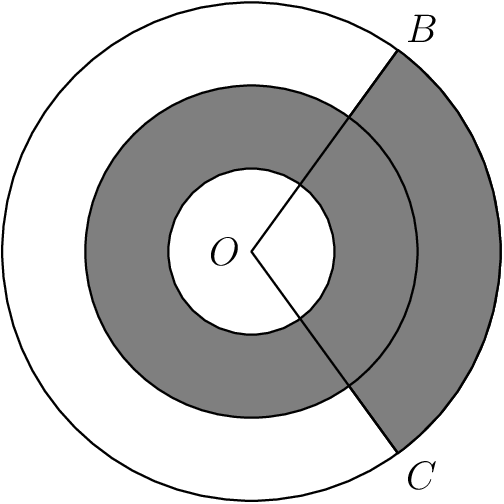
7. Three concentric circles centered at $O$ have radii of $1$, $2$, and $3$. Points $B$ and $C$ lie on the largest circle. The region between the two smaller circles is shaded, as is the portion of the region between the two larger circles bounded by central angle $BOC$, as shown in the figure below. Suppose the shaded and unshaded regions are equal in area. What is the measure of $\angle BOC$ in degrees?
(A) 108(B) 120(C) 135(D) 144(E) 150
Solution
Ring areas: middle ring $4\pi - \pi = 3\pi$ (all shaded); outer ring $9\pi - 4\pi = 5\pi$ (a $\frac{\theta}{360}$ slice is shaded).
Everything totals $9\pi$, so shaded $=$ unshaded means shaded $= 4.5\pi$:
$3\pi + \frac{\theta}{360}\cdot 5\pi = 4.5\pi \Rightarrow \frac{\theta}{360} = \frac{1.5}{5} = 0.3 \Rightarrow \theta = 108^\circ$.
Answer: A
2025 AMC 8 #18
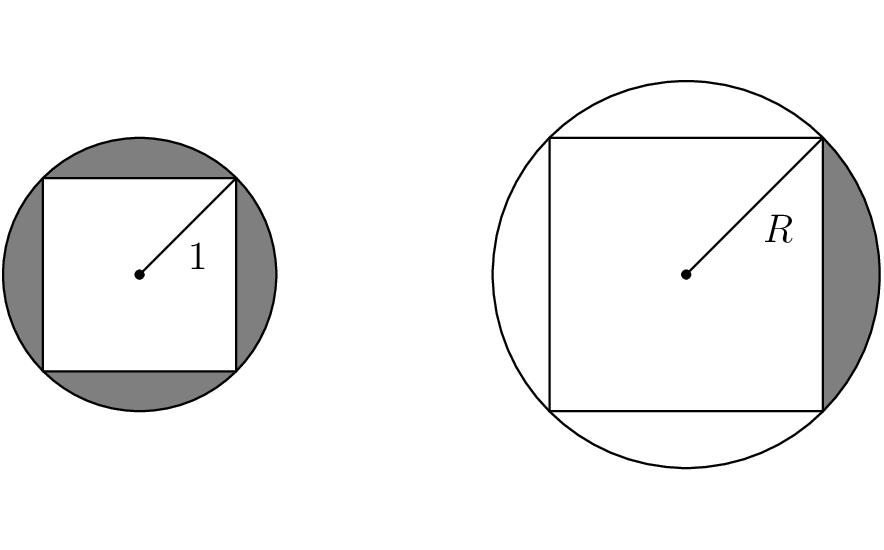
8. The circle shown below on the left has a radius of $1$ unit. The region between the circle and the inscribed square is shaded. In the circle shown on the right, one quarter of the region between the circle and the inscribed square is shaded. The shaded regions in the two circles have the same area. What is the radius $R$, in units, of the circle on the right?
(A) $\sqrt2$(B) 2(C) $2\sqrt2$(D) 4(E) $4\sqrt2$
Solution
A square inscribed in a circle of radius $r$ has diagonal $2r$, so its area is $\frac{(2r)^2}{2} = 2r^2$.
Left shaded: $\pi - 2$. Right shaded: $\tfrac14\left(\pi R^2 - 2R^2\right) = \tfrac{R^2}{4}(\pi - 2)$.
Equal areas: $\tfrac{R^2}{4}(\pi-2) = \pi - 2 \Rightarrow R^2 = 4 \Rightarrow R = 2$.
Answer: B
2026 AMC 8 #23
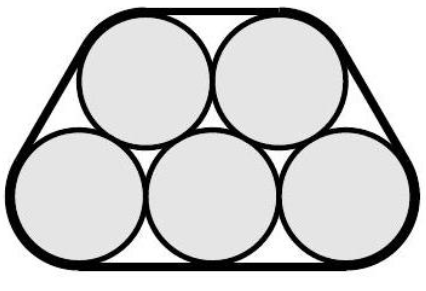
9. Lakshmi has $5$ round coins of diameter $4$ centimeters. She arranges the coins in $2$ rows on a table top, as shown below, and wraps an elastic band tightly around them. In centimeters, what will be the length of the band?
(A) $2\pi + 20$(B) $\frac{5}{2}\pi + 20$(C) $4\pi + 20$(D) $\frac{9}{2}\pi + 20$(E) $5\pi + 20$
Solution
The band alternates straight tangent segments and arcs.
Each straight segment equals the distance between the two coin centers it connects; walking around the outside, those center-to-center steps total $8 + 4 + 4 + 4 = 20$.
The curved pieces turn through all the corners of the loop — together exactly one full circle of radius $2$: $2\pi\cdot 2 = 4\pi$.
Length $= 4\pi + 20$.
Answer: C
⭐ Challenge (AMC 10 level)
2019 AMC 10A #13 · angle chase
C1. Let $\triangle ABC$ be an isosceles triangle with $BC = AC$ and $\angle ACB = 40^\circ$. Construct the circle with diameter $\overline{BC}$, and let $D$ and $E$ be the other intersection points of the circle with the sides $\overline{AC}$ and $\overline{AB}$, respectively. Let $F$ be the intersection of the diagonals of the quadrilateral $BCDE$. What is the degree measure of $\angle BFC$?
(A) 90(B) 100(C) 105(D) 110(E) 120
Solution
$BC$ is a diameter, so $\angle BDC = 90^\circ$ and $\angle BEC = 90^\circ$ — i.e. $CE \perp AB$.
In the isosceles triangle, that altitude is also the angle bisector: $\angle ECA = \tfrac12\cdot 40^\circ = 20^\circ$.
$\angle BFC$ is an exterior angle of $\triangle DFC$: $\angle BFC = \angle FDC + \angle DCF = 90^\circ + 20^\circ = 110^\circ$.
Answer: D
2011 AMC 10B #17 · cyclic trapezoid
C2. In a given circle, the diameter $\overline{EB}$ is parallel to $\overline{DC}$, and $\overline{AB}$ is parallel to $\overline{ED}$ (all five points lie on the circle). The angles $AEB$ and $ABE$ are in the ratio $4:5$. What is the degree measure of angle $BCD$?
(A) 120(B) 125(C) 130(D) 135(E) 140
Solution
$EB$ is a diameter, so $\angle EAB = 90^\circ$ and $\angle AEB + \angle ABE = 90^\circ$; the $4:5$ ratio gives $\angle ABE = 50^\circ$.
$AB \parallel ED$ → $\angle BED = \angle ABE = 50^\circ$ (alternate angles).
$EB \parallel CD$ makes $EBCD$ a trapezoid inscribed in a circle — always isosceles — so $\angle DEB = \angle CBE = 50^\circ$,
and co-interior angles between the parallel sides give $\angle BCD = 180^\circ - \angle CBE = 130^\circ$.
Answer: C
2015 AMC 12B #13 · same-arc angles
C3. Quadrilateral $ABCD$ is inscribed in a circle with $\angle BAC = 70^\circ$, $\angle ADB = 40^\circ$, $AD = 4$, and $BC = 6$. What is $AC$?
(A) $3+\sqrt5$(B) 6(C) $\frac{9\sqrt2}{2}$(D) $8-\sqrt2$(E) 7
Solution
$\angle ACB$ and $\angle ADB$ are inscribed angles on the same arc $AB$, so $\angle ACB = 40^\circ$.
In $\triangle ABC$: $\angle ABC = 180^\circ - 70^\circ - 40^\circ = 70^\circ = \angle BAC$, so the triangle is isosceles with $AC = BC = 6$.
(The $AD = 4$ is a decoy!)
Answer: B
2018 AMC 10A #15 · similar triangles
C4. Two circles of radius $5$ are externally tangent to each other and are internally tangent to a circle of radius $13$ at points $A$ and $B$, as shown in the diagram. The distance $AB$ can be written in the form $\frac{m}{n}$, where $m$ and $n$ are relatively prime positive integers. What is $m+n$?
(A) 21(B) 29(C) 58(D) 69(E) 93
Solution
Internal tangency puts each small center on the line from the big center $O$ to the tangent point: with small centers $M, N$,
$OM = ON = 13 - 5 = 8$ while $OA = OB = 13$.
The circles touch each other, so $MN = 5 + 5 = 10$. Since $\dfrac{OM}{OA} = \dfrac{ON}{OB} = \dfrac{8}{13}$ with the common angle at $O$: $\triangle OMN \sim \triangle OAB$,
so $AB = MN\cdot\dfrac{13}{8} = \dfrac{130}{8} = \dfrac{65}{4}$, and $m+n = 69$.
Answer: D
2017 AMC 10B #22 · Thales + similar
C5. The diameter $\overline{AB}$ of a circle of radius $2$ is extended to a point $D$ outside the circle so that $BD = 3$. Point $E$ is chosen so that $ED = 5$ and line $ED$ is perpendicular to line $AD$. Segment $\overline{AE}$ intersects the circle at a point $C$ between $A$ and $E$. What is the area of $\triangle ABC$?
(A) $\frac{120}{37}$(B) $\frac{140}{39}$(C) $\frac{145}{39}$(D) $\frac{140}{37}$(E) $\frac{120}{31}$
Solution
$AB$ is a diameter, so $\angle ACB = 90^\circ$; and $\angle ADE = 90^\circ$ too, so $\triangle ABC \sim \triangle AED$ (shared angle $A$).
$AD = 4 + 3 = 7$, $DE = 5$, so $AE = \sqrt{49+25} = \sqrt{74}$ and $S_{\triangle AED} = \tfrac12\cdot7\cdot5 = \tfrac{35}{2}$.
The similarity ratio is $\dfrac{AB}{AE} = \dfrac{4}{\sqrt{74}}$, so
$S_{\triangle ABC} = \left(\dfrac{4}{\sqrt{74}}\right)^{\!2}\cdot\dfrac{35}{2} = \dfrac{16}{74}\cdot\dfrac{35}{2} = \dfrac{140}{37}$.
Answer: D
2005 AMC 10A #23 · midsegment
C6. Let $\overline{AB}$ be a diameter of a circle and $C$ be a point on $\overline{AB}$ with $2\cdot AC = BC$. Let $D$ and $E$ be points on the circle such that $\overline{DC} \perp \overline{AB}$ and $\overline{DE}$ is a second diameter. What is the ratio of the area of $\triangle DCE$ to the area of $\triangle ABD$?
(A) $\frac16$(B) $\frac14$(C) $\frac13$(D) $\frac12$(E) $\frac23$
Solution
Both triangles have base $DC$, so the ratio is the ratio of the horizontal distances from $E$ and from… better: take $DC$ as the common base; then
$\dfrac{S_{\triangle DCE}}{S_{\triangle ABD}} = \dfrac{ME}{AB}$, where $ME$ is $E$'s distance from line $DC$.
Set the diameter $AB = 3$: then $AC = 1$, $BC = 2$, center $O$ with $AO = 1.5$, so $CO = 0.5$.
$O$ is the midpoint of $DE$, so $CO$ is a midsegment of $\triangle DME$: $ME = 2\cdot CO = 1$.
Ratio $= \dfrac{1}{3}$.
Answer: C
🗝 Answer key
| Example | 1 | 2 | 3 | 4 |
|---|
| D | C | C | B |
|---|
| Practice | 1 | 2 | 3 | 4 | 5 | 6 | 7 | 8 | 9 |
|---|
| C | A | A | D | A | B | A | B | C |
|---|
| Challenge | C1 | C2 | C3 | C4 | C5 | C6 |
|---|
| D | C | B | D | D | C |
|---|
Sources: prep-course Lecture 04 (video + board notes + 16 worked examples, translated to English) and official AMC 8 problems from the local bank
(kb/content/banks/). Answers verified against official answer keys where available.