Perimeter, Area, Volume · Lecture 05 · geo-perimeter-area-volume
📺 Course materials — Lecture 05 (95 min):
lecture video · handout PDF (Lecture 5) · board notes (05.jpg) · homework answer key (Chapter 5)
— all in the
amc8/video folder.
·
🖨 Printable PDF (answers & solutions at the back)
🔑 Key facts
The instructor's motto for this lecture: formulas + methods. The formulas fit on one line each —
triangle $\frac{bh}{2}$, trapezoid $\frac{(a+b)h}{2}$, rhombus $\frac{d_1 d_2}{2}$, circle $\pi r^2$,
any prism (box, cylinder, triangular prism) $V = \text{base area}\times\text{height}$.
The methods are what the AMC actually tests: slide sides to find perimeters, subtract a small easy shape from a big easy one,
count lattice points with Pick's theorem $S = I + \frac{B}{2} - 1$, and set up little equations when the picture won't cooperate.
🧰 Instructor's toolbox (from the lecture video & board notes)
2 · Every cut adds double. Cutting a shape along an internal segment of length $\ell$ adds $2\ell$
to the total perimeter of the pieces (both new edges are exposed). Board example: a square of side $10$ cut by two full-length lines —
sum of the four perimeters $= 4\times10 + 10\times2\times2 = 80$. Run it backwards too: gluing pieces together hides $2\times$ the glued edge.
5 · Big minus small. The instructor writes "big − small" next to half the problems in this chapter:
never wrestle an ugly region directly — find a big easy shape that contains it and subtract easy pieces.
Tilted square in a grid → big square minus four corner triangles (Practice 4); hollow fort → full box minus the air inside (Practice 8);
pentagon → big right triangle minus a rectangle (Practice 7). If the ugly region is what's left over, even better: it's already a difference.
6 · Cut, slide, rotate, flip — make it regular.
Translate, cut & patch, rotate, reflect — the four moves of equal-area surgery that turn a weird region into a standard one.
Practice 2: two quarter-circle bites refill exactly with the two halves of the bulge — the whole thing is just a rectangle.
Completing the figure is the same move in reverse (Practice 6 completes a curvy region to an equilateral triangle).
7 · Name the sides, write equations.
When lengths are unknown, give them letters and read the picture as equations — then look for a combination that answers the question directly, instead of solving for everything.
Example 2: width $a+b+c = 3322$, height $a-b+c = 2020$; subtracting gives $2b = 1302$ at once.
Example 3 never finds the rectangle's sides at all — only the product $xy = 18$ matters (the "whole substitution" trick, which returned on the final problem of AMC 8 2020).
9 · Surface area by direction pairs.
Look at a solid from the six directions. For solids built from boxes, front $=$ back, left $=$ right, top $=$ bottom (each pair shows the same silhouette),
so compute three views and double. Steps and notches don't change a view — they only shuffle it (Practice 10: tops still total $4$, the stepped sides still silhouette to the tallest piece).
Gluing a cube onto a face? Only the new side walls add area — the new top covers exactly what it hides (Practice 11).
📖 Worked examples
2004 AMC 8 #14 · Pick's theorem
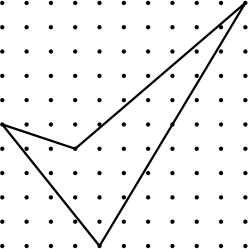
Example 1. What is the area enclosed by the geoboard quadrilateral below? (Grid points are spaced $1$ unit apart.)
(A) 15(B) $18\frac12$(C) $22\frac12$(D) 27(E) 41
Key idea: the vertices are on grid points, so count instead of dissecting.
Boundary points: $B = 5$ (the four vertices plus one more on an edge). Interior points: $I = 21$.
$S = I + \tfrac{B}{2} - 1 = 21 + 2\tfrac12 - 1 = 22\tfrac12$.
Answer: C
2020 AMC 8 #25 · equations
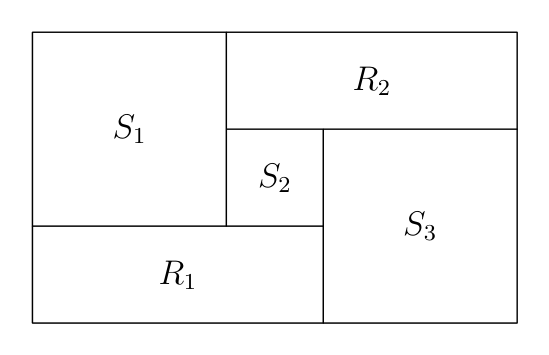
Example 2. Rectangles $R_1$ and $R_2$, and squares $S_1$, $S_2$, and $S_3$, shown below, combine to form a rectangle that is $3322$ units wide and $2020$ units high. What is the side length of $S_2$ in units?
(A) 651(B) 655(C) 656(D) 662(E) 666
Key idea: let $a, b, c$ be the side lengths of $S_1, S_2, S_3$.
Across the middle: $a + b + c = 3322$.
Vertically through $S_2$'s column: $(a-b) + b + (c-b) = a + c - b = 2020$ (check it on the figure: the rectangles above and below $S_2$ have heights $a-b$ and $c-b$).
Subtract: $2b = 3322 - 2020 = 1302$, so $b = 651$ — no need to find $a$ or $c$ at all.
Answer: A
2000 AMC 8 #25 · whole substitution
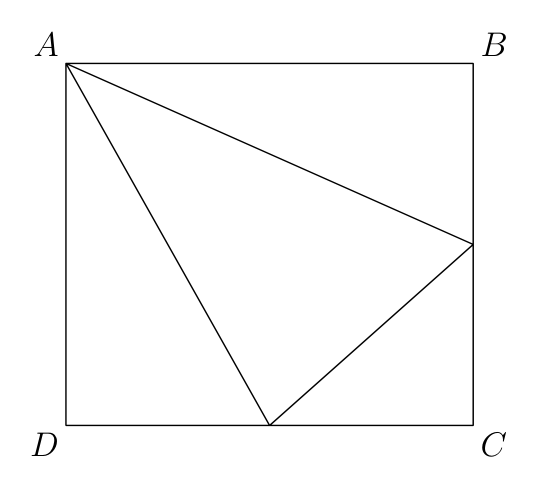
Example 3. The area of rectangle $ABCD$ is $72$ square units. If point $A$ and the midpoints of $\overline{BC}$ and $\overline{CD}$ are joined to form a triangle, what is the area of that triangle?
(A) 21(B) 27(C) 30(D) 36(E) 40
Key idea: let $CD = 2x$ and $BC = 2y$, so $4xy = 72$, i.e. $xy = 18$ — that's all we'll ever need.
Subtract the three right triangles from the rectangle (with $M$, $N$ the midpoints):
$S_{ABM} = \tfrac12\cdot 2x\cdot y = xy = 18$, $\quad S_{ADN} = \tfrac12\cdot 2y\cdot x = 18$, $\quad S_{CMN} = \tfrac12 xy = 9$.
Triangle $= 72 - 18 - 18 - 9 = 27$. We never learned $x$ or $y$ — only their product.
Answer: B
2022 AMC 8 #24 · prism from a net
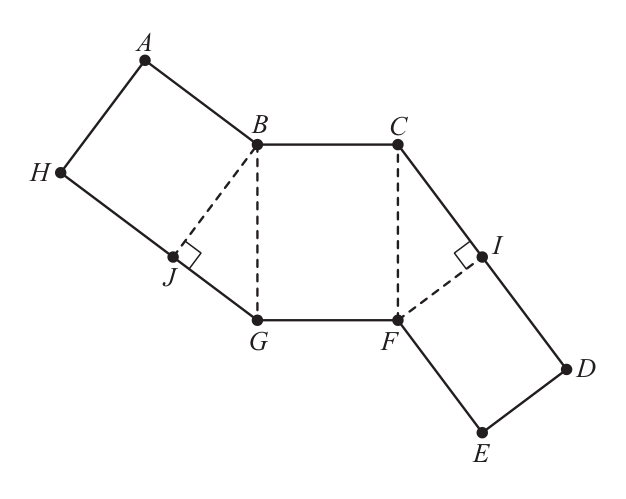
Example 4. The figure below shows a polygon $ABCDEFGH$, consisting of rectangles and right triangles. When cut out and folded on the dotted lines, the polygon forms a triangular prism. Suppose that $AH = EF = 8$ and $GH = 14$. What is the volume of the prism?
(A) 112(B) 128(C) 192(D) 240(E) 288
Key idea: the two right triangles of the net must become the two bases; the three rectangles are the sides.
Fold it mentally and match the edges: the triangle's legs turn out to be $8$ (from $AH$) and $GH - 8 = 14 - 8 = 6$
(the $8$ comes off $GH$ because it glues along an edge equal to $EF$).
Base area $= \tfrac12\cdot 8\cdot 6 = 24$; the prism's length is $8$.
$V = 24 \cdot 8 = 192$.
Answer: C
✏️ Practice
Try each one before opening the solution. Figures are from the official exams.
2015 AMC 8 #19
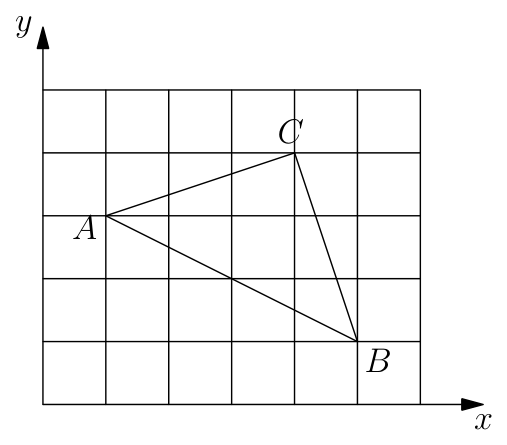
1. A triangle with vertices as $A=(1,3)$, $B=(5,1)$, and $C=(4,4)$ is plotted on a $6\times5$ grid. What fraction of the grid is covered by the triangle?
(A) $\frac{1}{6}$(B) $\frac{1}{5}$(C) $\frac{1}{4}$(D) $\frac{1}{3}$(E) $\frac{1}{2}$
Solution
All three vertices are lattice points, so Pick it:
$B = 4$ (the three vertices plus $(3,2)$, the midpoint of edge $AB$) and $I = 4$.
$S = 4 + \tfrac42 - 1 = 5$. The grid is $6\times5 = 30$, so the fraction is $\tfrac{5}{30} = \tfrac16$.
Answer: A
2000 AMC 8 #19
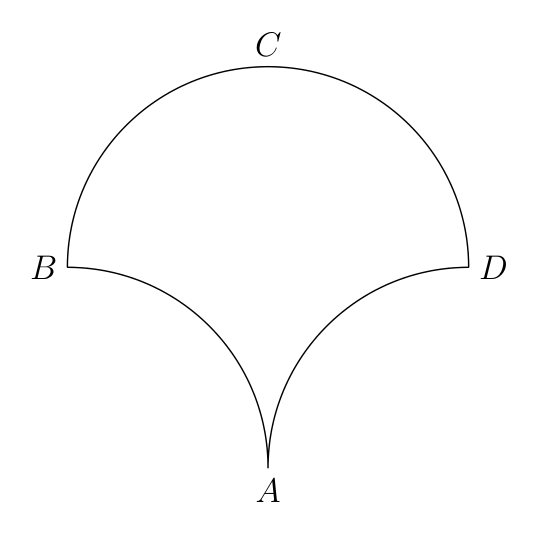
2. Three circular arcs of radius $5$ units bound the region shown. Arcs $AB$ and $AD$ are quarter-circles, and arc $BCD$ is a semicircle. What is the area, in square units, of the region?
(A) 25(B) $10+5\pi$(C) 50(D) $50+5\pi$(E) $25\pi$
Solution
Draw segment $BD$ ($=10$) and the $10\times5$ rectangle below it (the two quarter-arcs are centered at its bottom corners).
Below $BD$: rectangle minus two quarter-circles $= 50 - \tfrac{25\pi}{2}$. Above $BD$: the semicircle $= \tfrac{25\pi}{2}$.
The circular parts cancel exactly — the bulge refills the bites: $S = 50$.
Answer: C
2008 AMC 8 #23
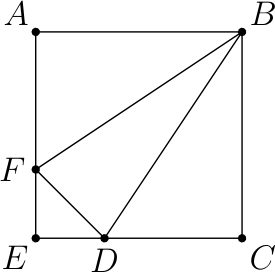
3. In square $ABCE$, $AF = 2FE$ and $CD = 2DE$. What is the ratio of the area of $\triangle BFD$ to the area of square $ABCE$?
(A) $\frac{1}{6}$(B) $\frac{2}{9}$(C) $\frac{5}{18}$(D) $\frac{1}{3}$(E) $\frac{7}{20}$
Solution
Set $FE = DE = 1$, so the square has side $3$ and area $9$. Don't chase $\triangle BFD$ directly — subtract the three easy right triangles around it:
$S_{BFD} = 9 - \underbrace{\tfrac12\cdot2\cdot3}_{ABF} - \underbrace{\tfrac12\cdot1\cdot1}_{FED} - \underbrace{\tfrac12\cdot2\cdot3}_{BCD} = 9 - 3 - \tfrac12 - 3 = \tfrac52$.
Ratio $= \tfrac{5/2}{9} = \tfrac{5}{18}$.
Answer: C
2015 AMC 8 #25
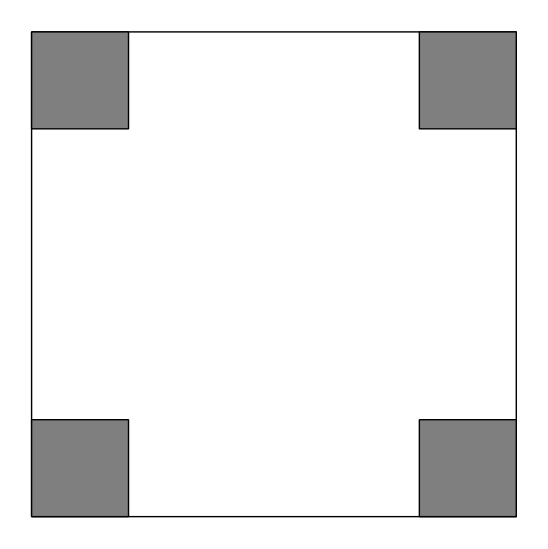
4. One-inch squares are cut from the corners of this $5$ inch square. What is the area in square inches of the largest square that can fit into the remaining space?
(A) 9(B) $12\frac12$(C) 15(D) $15\frac12$(E) 17
Solution
The best square sits tilted, its corners touching the notches.
Its area $=$ big square $-$ four corner squares $-$ four slim right triangles (legs $1$ and $3$):
$25 - 4\cdot1 - 4\cdot\tfrac{1\cdot3}{2} = 25 - 4 - 6 = 15$.
Answer: C
2007 AMC 8 #23
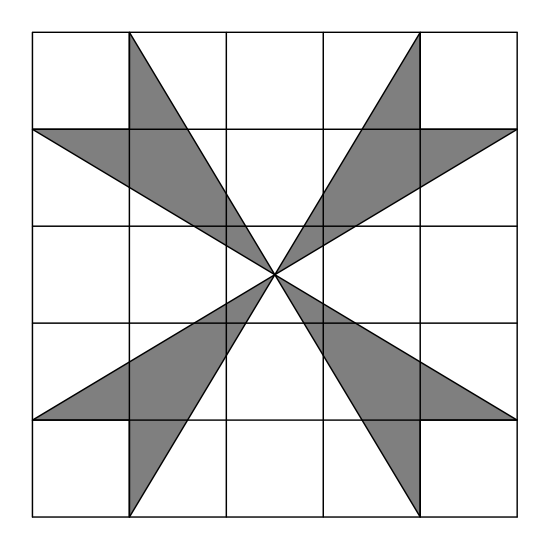
5. What is the area of the shaded pinwheel shown in the $5\times5$ grid?
(A) 4(B) 6(C) 8(D) 10(E) 12
Solution
Each of the four arms is a bent dart made of
two triangles, and every one of the $8$ triangles is congruent:
base $= 1$ (a unit segment along a grid line, like the one from $(1,4)$ to $(1,5)$) and apex at the center $(2.5, 2.5)$, so height $= 1.5$.
Each triangle: $\tfrac12\cdot1\cdot1.5 = \tfrac34$. Total: $8\cdot\tfrac34 = 6$.
Answer: B
2017 AMC 8 #25
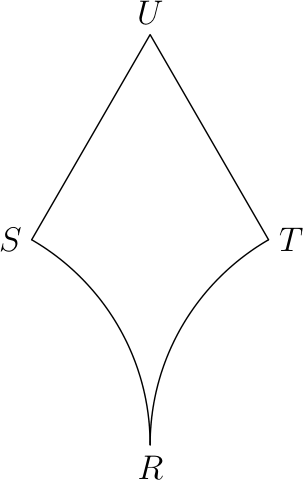
6. In the figure shown, $\overline{US}$ and $\overline{UT}$ are line segments each of length $2$, and $m\angle TUS = 60^\circ$. Arcs $\overset{\frown}{TR}$ and $\overset{\frown}{SR}$ are each one-sixth of a circle with radius $2$. What is the area of the region shown?
(A) $3\sqrt3-\pi$(B) $4\sqrt3-\frac{4\pi}{3}$(C) $2\sqrt3$(D) $4\sqrt3-\frac{2\pi}{3}$(E) $4+\frac{4\pi}{3}$
Solution
Complete the region to an equilateral triangle of side $4$ — its two lower vertices are the centers of the arcs.
$S_{\triangle} = \tfrac{\sqrt3}{4}\cdot 4^2 = 4\sqrt3$; each cut-away sector is $\tfrac16$ of a radius-$2$ circle, and there are two:
$2\cdot\tfrac16\pi\cdot 2^2 = \tfrac{4\pi}{3}$. Area $= 4\sqrt3 - \tfrac{4\pi}{3}$.
Answer: B
2013 AMC 8 #24
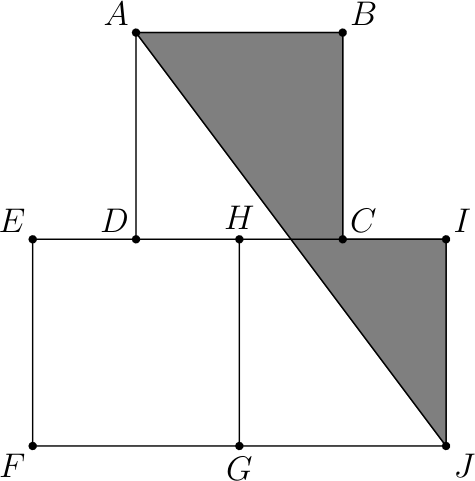
7. Squares $ABCD$, $EFGH$, and $GHIJ$ are equal in area. Points $C$ and $D$ are the midpoints of sides $\overline{IH}$ and $\overline{HE}$, respectively. What is the ratio of the area of the shaded pentagon $AJICB$ to the sum of the areas of the three squares?
(A) $\frac{1}{4}$(B) $\frac{7}{24}$(C) $\frac{1}{3}$(D) $\frac{3}{8}$(E) $\frac{5}{12}$
Solution
Let each square have side $1$ (total area $3$). Extend $\overline{AB}$ to the right and $\overline{JI}$ upward; they meet at a point $M$, forming right triangle $AMJ$ with legs $AM = \tfrac32$ and $MJ = 2$.
The pentagon is that triangle minus the $\tfrac12\times1$ rectangle $BMIC$:
$S = \tfrac12\cdot\tfrac32\cdot2 - \tfrac12 = \tfrac32 - \tfrac12 = 1$.
Ratio $= \tfrac13$.
Answer: C
2013 AMC 8 #18
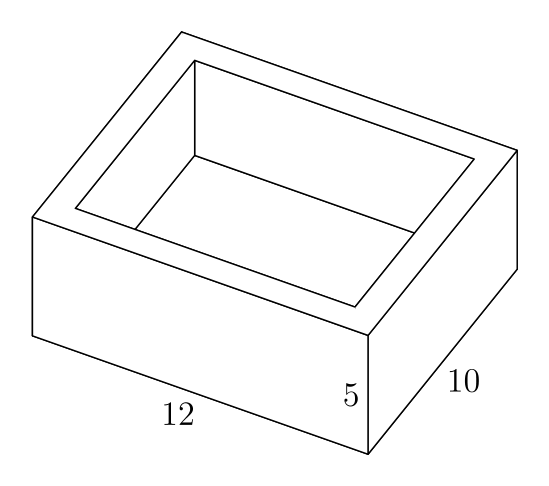
8. Isabella uses one-foot cubical blocks to build a rectangular fort that is $12$ feet long, $10$ feet wide, and $5$ feet high. The floor and the four walls are all one foot thick. How many blocks does the fort contain?
(A) 204(B) 280(C) 320(D) 340(E) 600
Solution
Each block is $1$ cubic foot, so count volume. Fill the fort solid: $12\cdot10\cdot5 = 600$.
The hollow inside is a box $1$ foot smaller on each side and $1$ foot shallower: $10\cdot8\cdot4 = 320$.
Blocks $= 600 - 320 = 280$.
Answer: B
2008 AMC 8 #21
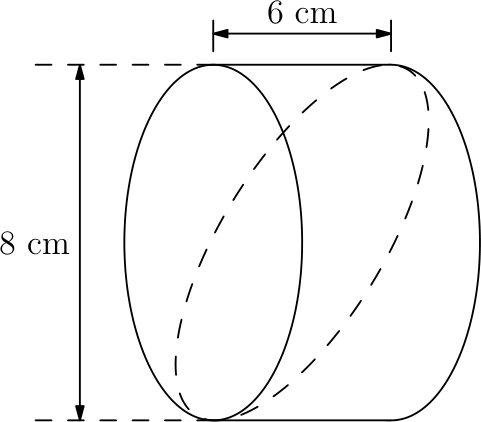
9. Jerry cuts a wedge from a $6$-cm cylinder of bologna as shown by the dashed curve. Which answer choice is closest to the volume of his wedge in cubic centimeters?
(A) 48(B) 75(C) 151(D) 192(E) 603
Solution
The wedge is exactly
half the cylinder (the cut runs through the axis).
Cylinder: radius $= 8/2 = 4$, length $6$: $V = \pi\cdot4^2\cdot6 = 96\pi$.
Wedge $= 48\pi \approx 150.8 \approx 151$.
Answer: C
2009 AMC 8 #25
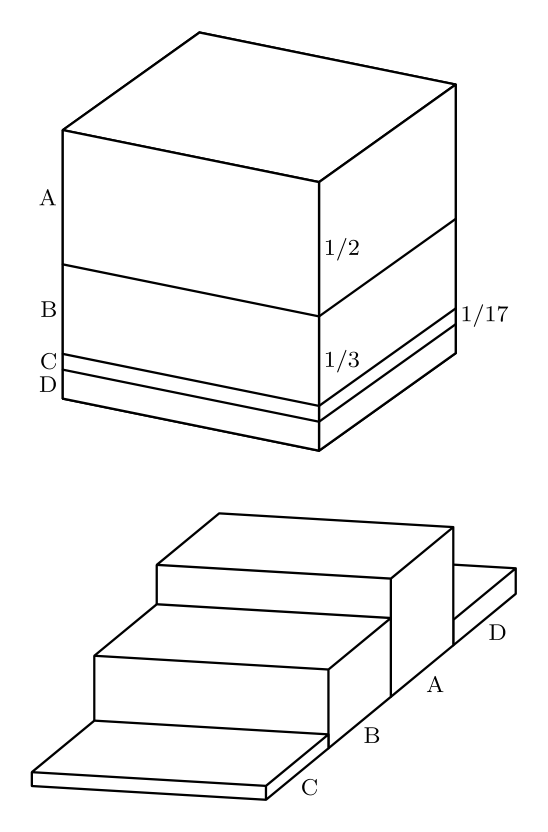
10. A one-cubic-foot cube is cut into four pieces by three cuts parallel to the top face of the cube. The first cut is $\frac12$ foot from the top face. The second cut is $\frac13$ foot below the first cut, and the third cut is $\frac{1}{17}$ foot below the second cut. From the top to the bottom the pieces are labeled A, B, C, and D. The pieces are then glued together end to end as shown in the second diagram. What is the total surface area of this solid in square feet?
(A) 6(B) 7(C) $\frac{419}{51}$(D) $\frac{158}{17}$(E) 11
Solution
Don't touch the fractions — look from the six directions.
Top: four $1\times1$ tops $= 4$;
bottom the same $= 4$.
Front: each piece shows a $1\times(\text{its height})$ strip, and the four heights add back to the full edge: $1$;
back $= 1$.
Left/right: the stepped side faces telescope — together each side shows exactly the tallest piece's cross-section: $\tfrac12$ each.
Total: $4+4+1+1+\tfrac12+\tfrac12 = 11$.
Answer: E
2000 AMC 8 #22
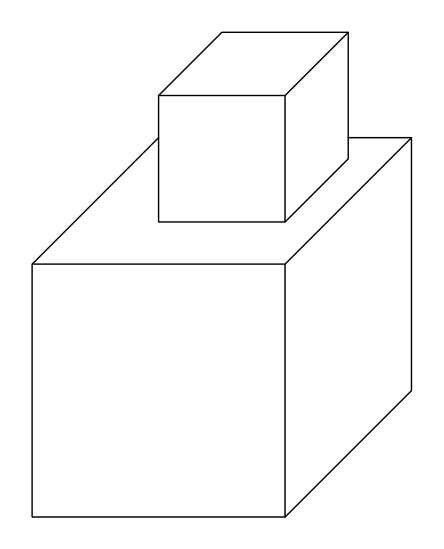
11. A cube has edge length $2$. Suppose that we glue a cube of edge length $1$ on top of the big cube so that one of its faces rests entirely on the top face of the larger cube. The percent increase in the surface area (sides, top, and bottom) from the original cube to the new solid formed is closest to:
(A) 10(B) 15(C) 17(D) 21(E) 25
Solution
Original surface: $6\cdot2^2 = 24$.
The small cube's bottom hides $1$ square unit of the big top — but its own top exposes $1$ back, a perfect trade.
Net gain: just its $4$ side faces $= 4$. Increase $= \tfrac{4}{24} = \tfrac16 \approx 17\%$.
Answer: C
🆕 Fresh from the latest exams
The same ideas, exactly as they appeared on the most recent tests.
2024 AMC 8 #3
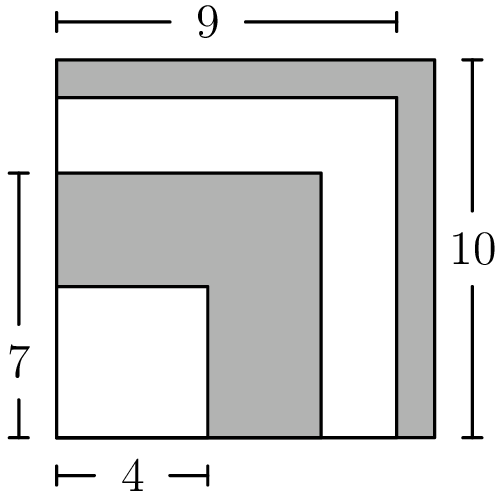
12. Four squares of side length $4$, $7$, $9$, and $10$ are arranged in increasing size order so that their left edges and bottom edges align. The squares alternate in color white-gray-white-gray, respectively, as shown in the figure. What is the area of the visible gray region in square units?
(A) 42(B) 45(C) 49(D) 50(E) 52
Solution
Each gray square is visible except where the next (smaller, white) square covers it:
gray $7$ minus white $4$: $49 - 16 = 33$; gray $10$ minus white $9$: $100 - 81 = 19$.
Total $= 33 + 19 = 52$.
Answer: E
2025 AMC 8 #10
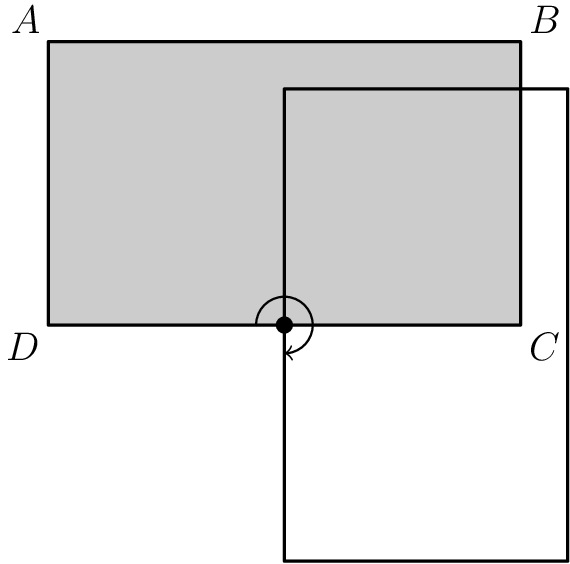
13. In the figure below, $ABCD$ is a rectangle with sides of length $AB = 5$ inches and $AD = 3$ inches. Rectangle $ABCD$ is rotated $90^\circ$ clockwise around the midpoint of side $\overline{DC}$ to give a second rectangle. What is the total area, in square inches, covered by the two overlapping rectangles?
(A) 21(B) 22.25(C) 23(D) 23.75(E) 25
Solution
Covered area $=$ both rectangles minus the double-counted overlap: $15 + 15 - \text{overlap}$.
After the quarter turn about the midpoint $M$ of $\overline{DC}$, the long side stands vertical: the new rectangle reaches $2.5$ above and $2.5$ below line $DC$, and extends $3$ to the right of $M$.
Its overlap with the original ($2.5$ of width remains to the right of $M$, and only the part above $DC$ up to height $2.5$ counts) is a $2.5\times2.5$ square: $6.25$.
Total $= 30 - 6.25 = 23.75$.
Answer: D
2026 AMC 8 #6
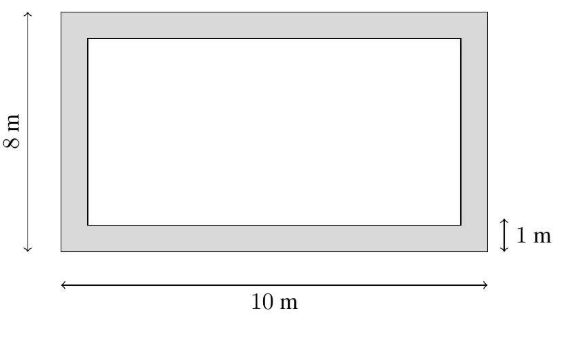
14. Peter lives near a rectangular field that is filled with blackberry bushes. The field is $10$ meters long and $8$ meters wide, and Peter can reach any blackberries that are within $1$ meter of an edge of the field. The portion of the field he can reach is shaded in the figure below. What fraction of the area of the field can Peter reach?
(A) $\frac{1}{6}$(B) $\frac{1}{4}$(C) $\frac{1}{3}$(D) $\frac{3}{8}$(E) $\frac{2}{5}$
Solution
The reachable band is the field minus the unreachable core, which is $1$ meter smaller on
every side:
$(10-2)\times(8-2) = 48$. Reachable $= 80 - 48 = 32$, and $\tfrac{32}{80} = \tfrac25$.
(Classic trap: the core loses $2$ from each dimension, not $1$.)
Answer: E
⭐ Challenge (AMC 10 level)
2019 AMC 10B #20 · area dissection
C1. As shown in the figure, line segment $\overline{AD}$ is trisected by points $B$ and $C$ so that $AB = BC = CD = 2$. Three semicircles of radius $1$, $\overset{\frown}{AEB}$, $\overset{\frown}{BFC}$, and $\overset{\frown}{CGD}$, have their diameters on $\overline{AD}$, and are tangent to line $EG$ at $E$, $F$, and $G$, respectively. A circle of radius $2$ has its center on $F$. The area of the region inside the circle but outside the three semicircles, shaded in the figure, can be expressed in the form $\frac{a}{b}\pi + c - \sqrt{d}$, where $a, b, c, d$ are positive integers and $a$ and $b$ are relatively prime. What is $a+b+c+d$?
(A) 13(B) 14(C) 15(D) 16(E) 17
Solution
Don't subtract the white region — build the gray directly from three easy pieces (symmetric about line $EG$):
(1) the top half of the big circle: $\tfrac12\pi\cdot4 = 2\pi$;
(2) two side pockets between the big circle, line $EG$ and the outer semicircles: together $2\left(2 - \tfrac{\pi}{2}\right) = 4 - \pi$
(each is a $2\times1$ rectangle minus two white quarter-circles of radius 1);
(3) the bottom lune: big-circle sector minus triangle. The chord meets the middle semicircle where $FP = 1 = \tfrac12 FH$,
so the half-angle is $60^\circ$: sector $= \tfrac{120}{360}\pi\cdot4 = \tfrac{4\pi}{3}$, triangle $= \tfrac12\cdot2\sqrt3\cdot1 = \sqrt3$; lune $= \tfrac{4\pi}{3} - \sqrt3$.
Total: $2\pi + (4-\pi) + \tfrac{4\pi}{3} - \sqrt3 = \tfrac{7}{3}\pi + 4 - \sqrt3$, so $a+b+c+d = 7+3+4+3 = 17$.
Answer: E
🗝 Answer key
| Example | 1 | 2 | 3 | 4 |
|---|
| C | A | B | C |
|---|
| Practice | 1 | 2 | 3 | 4 | 5 | 6 | 7 | 8 | 9 | 10 | 11 | 12 | 13 | 14 |
|---|
| A | C | C | C | B | B | C | B | C | E | C | E | D | E |
|---|
| Challenge | C1 |
|---|
| E |
|---|
Sources: prep-course Lecture 05 (video + board notes + 16 worked examples, translated to English) and official AMC 8 problems from the local bank
(kb/content/banks/). Answers verified against official answer keys where available.