Pythagorean Theorem · Lecture 02 · geo-pythagorean
📺 Course materials — Lecture 02 (94 min):
lecture video · handout PDF (Lecture 2) · board notes (02.jpg) · homework answer key (Chapter 2)
— all in the
amc8/video folder.
·
🖨 Printable PDF (answers & solutions at the back)
🔑 Key facts
In a right triangle with legs $a, b$ and hypotenuse $c$: $a^2 + b^2 = c^2$.
The converse is just as useful on AMC 8: if $a^2+b^2=c^2$, the angle opposite $c$ is a right angle — see Example 2, where spotting $5$-$12$-$13$ reveals a hidden right angle.
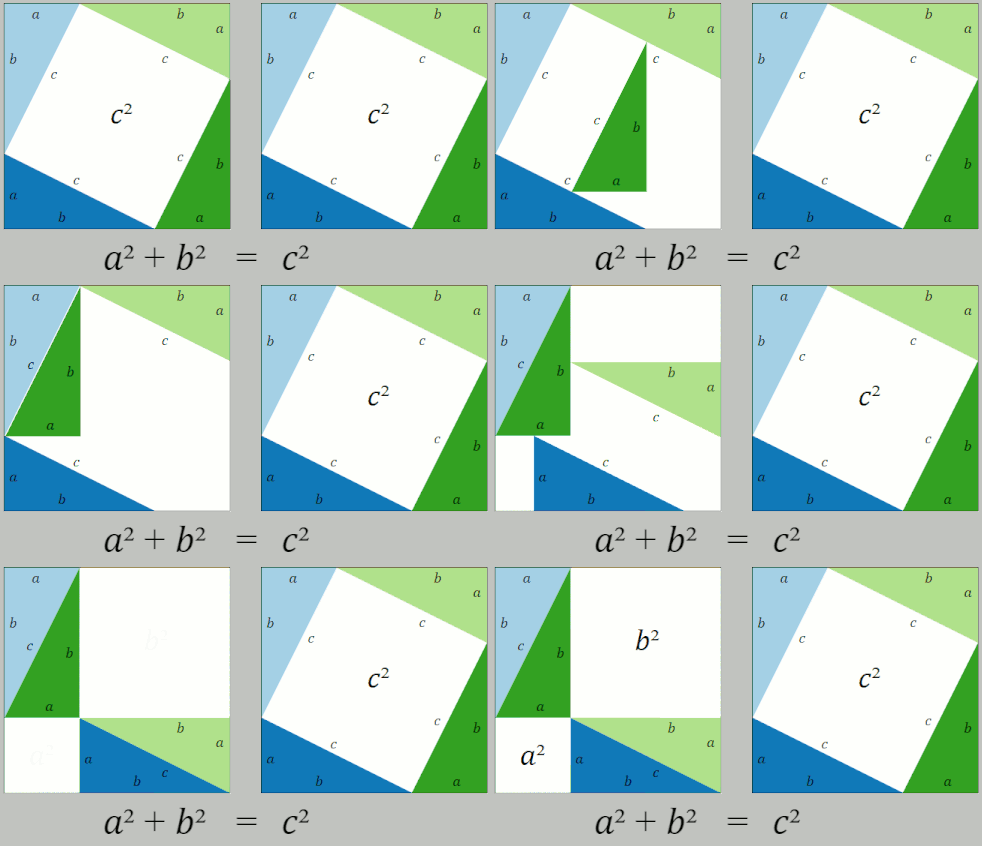
Why it works — watch the proof: the same four copies of the triangle sit inside the same big square two ways;
what's left over is $c^2$ on one side and $a^2 + b^2$ on the other. (This is exactly the proof from the lecture.)
One more animated proof (area-preserving shearing)
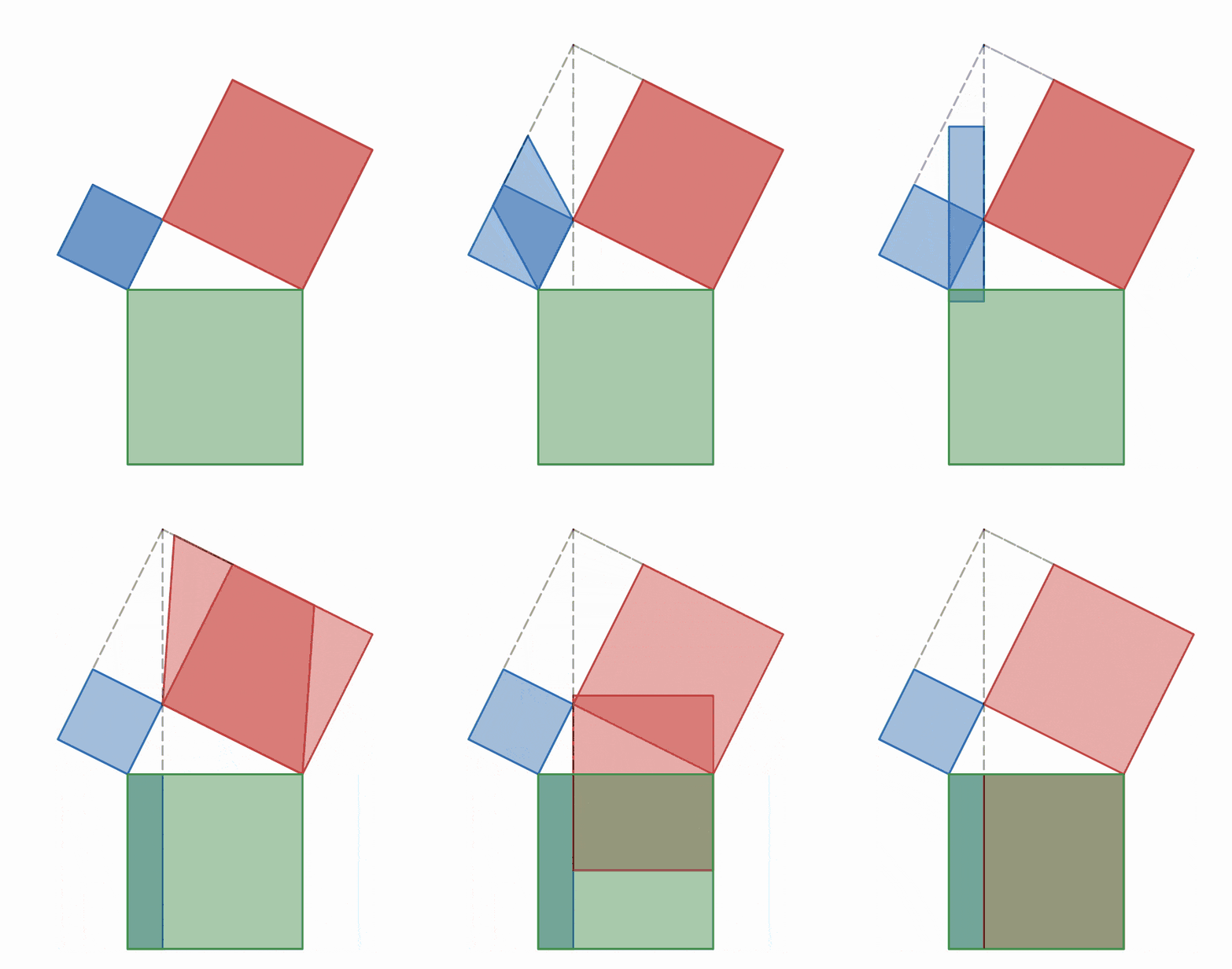
Sliding a parallelogram sideways never changes its area — shear the two leg-squares until they stack exactly into the hypotenuse-square.
🧰 Instructor's toolbox (from the lecture video & board notes)
2 · Un-scale to find hidden triples. Big numbers usually hide a small triple: divide by the common factor first.
The instructor's example: $18$-$24$-$30$ — divide by $6$ and it's just $3$-$4$-$5$. In Example 3 below, $\sqrt{25^2-24^2}$ is instant if you recognize $7$-$24$-$25$; no squaring needed.
8 · Radical survival kit. Pythagorean answers rarely come out whole, so simplify like the instructor:
$\sqrt{A\cdot B}=\sqrt A\cdot\sqrt B$ and $\sqrt{\tfrac AB}=\tfrac{\sqrt A}{\sqrt B}$.
To simplify, factor out the perfect square: $\sqrt{20}=\sqrt{4\times5}=2\sqrt5$ (choose $4\times5$, not $2\times10$); $\sqrt{32}=4\sqrt2$; $\sqrt{200}=10\sqrt2$.
To clear a root from a denominator: $\sqrt{\tfrac23}=\tfrac{\sqrt2}{\sqrt3}\cdot\tfrac{\sqrt3}{\sqrt3}=\tfrac{\sqrt6}{3}$.
Know your perfect squares to $20^2 = 400$.
9 · Angle-sum quickies (used with the theorem constantly).
Interior angles of an $n$-gon sum to $(n-2)\cdot180^\circ$; exterior angles of any polygon sum to $360^\circ$
(regular: $120^\circ\!\times\!3$, $90^\circ\!\times\!4$, $72^\circ\!\times\!5$, $60^\circ\!\times\!6$).
That's how Practice 11 finds the $90^\circ$ hiding in the hexagon.
Also: three sides determine a triangle completely (SSS), three angles only determine its shape — and side-side-angle is not a congruence test.
📖 Worked examples
2019 AMC 8 #4 · rhombus
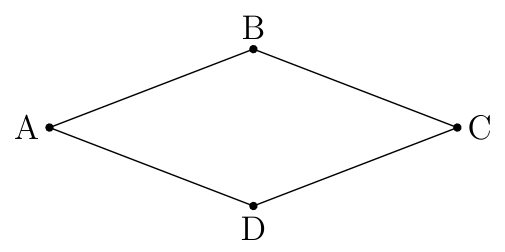
Example 1. Quadrilateral $ABCD$ is a rhombus with perimeter $52$ meters. The length of diagonal $\overline{AC}$ is $24$ meters. What is the area in square meters of rhombus $ABCD$?
(A) 60(B) 90(C) 105(D) 120(E) 144
Key idea: a rhombus's diagonals are perpendicular and bisect each other.
Where they cross at $O$: each side is $52/4 = 13$ and $AO = 24/2 = 12$ — that's the $5$-$12$-$13$ triple, so $BO = 5$.
Then $S_{\triangle ABO} = \tfrac12\cdot 5\cdot 12 = 30$ and the rhombus is $4$ such triangles: $4 \cdot 30 = 120$.
Answer: D
Shortcut: $S = \tfrac12 d_1 d_2 = \tfrac12\cdot24\cdot10 = 120$.
2017 AMC 8 #18 · converse
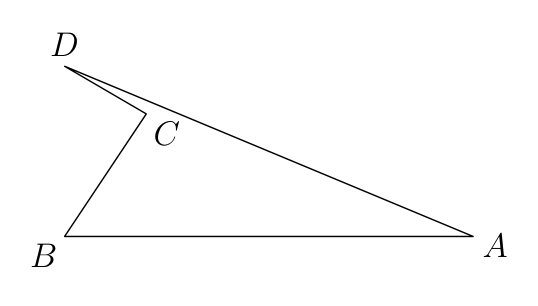
Example 2. In the non-convex quadrilateral $ABCD$ shown below, $\angle BCD$ is a right angle, $AB=12$, $BC=4$, $CD=3$, and $AD=13$. What is the area of quadrilateral $ABCD$?
(A) 12(B) 24(C) 26(D) 30(E) 36
Key idea: draw $\overline{BD}$. In right $\triangle BCD$: $3$-$4$-$5$, so $BD = 5$.
Now look at $\triangle ABD$: sides $5, 12, 13$ — the converse says $\angle ABD = 90^\circ$!
So the area is the big right triangle minus the small one:
$\tfrac12\cdot12\cdot5 - \tfrac12\cdot4\cdot3 = 30 - 6 = 24$.
Answer: B
2005 AMC 8 #19 · trapezoid
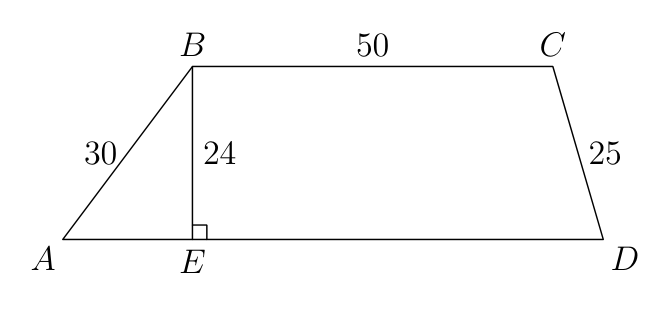
Example 3. What is the perimeter of trapezoid $ABCD$?
(A) 180(B) 188(C) 196(D) 200(E) 204
Key idea: the classic trapezoid move — drop heights from both ends of the top base, splitting the figure into two right triangles and a rectangle.
Left triangle: $AE=\sqrt{30^2-24^2}=18$. Right triangle: $DF=\sqrt{25^2-24^2}=7$.
So $AD = 18+50+7 = 75$ and $P = 50+30+75+25 = 180$.
Answer: A
2015 AMC 8 #6 · isosceles
Example 4. In $\triangle ABC$, $AB = BC = 29$, and $AC = 42$. What is the area of $\triangle ABC$?
(A) 100(B) 420(C) 500(D) 609(E) 701
Key idea: in an isosceles triangle the altitude to the base bisects it.
Drop $BH \perp AC$: then $AH = 21$ and $BH = \sqrt{29^2-21^2} = \sqrt{400} = 20$ (a $20$-$21$-$29$ triple!).
Area $= \tfrac12\cdot42\cdot20 = 420$.
Answer: B
✏️ Practice
Try each one before opening the solution. Figures are from the official exams.
2014 AMC 8 #14
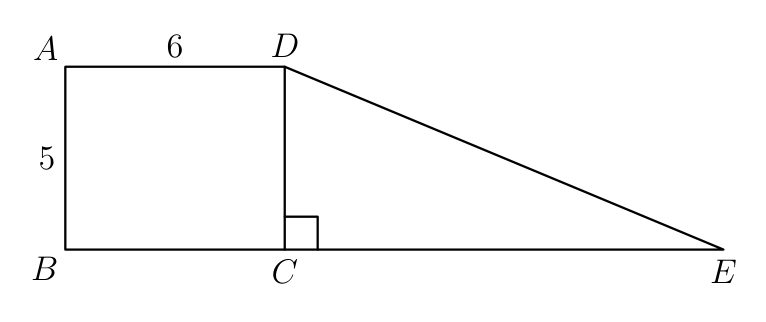
1. Rectangle $ABCD$ and right triangle $DCE$ have the same area. They are joined to form a trapezoid, as shown. What is $DE$?
(A) 12(B) 13(C) 14(D) 15(E) 16
Solution
$S_{\triangle DCE}=S_{ABCD}=30$, so $\tfrac12\cdot CE\cdot 5=30 \Rightarrow CE=12$.
In right $\triangle DCE$ with legs $5$ and $12$: $DE = 13$.
Answer: B
2020 AMC 8 #18
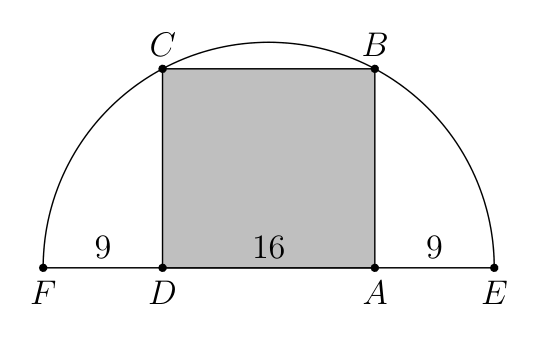
2. Rectangle $ABCD$ is inscribed in a semicircle with diameter $\overline{FE}$, as shown. Let $DA=16$, and $FD=AE=9$. What is the area of $ABCD$?
(A) 240(B) 248(C) 256(D) 264(E) 272
Solution
Let $O$ be the center. The radius is $OB = (9+16+9)/2 = 17$ and $OA = 8$.
In right $\triangle AOB$: $AB = \sqrt{17^2-8^2} = 15$ (the $8$-$15$-$17$ triple). Area $= 15\cdot16 = 240$.
Answer: A
2013 AMC 8 #20
3. A $1\times2$ rectangle is inscribed in a semicircle with the longer side on the diameter. What is the area of the semicircle?
(A) $\frac{\pi}{2}$(B) $\frac{2\pi}{3}$(C) $\pi$(D) $\frac{4\pi}{3}$(E) $\frac{5\pi}{3}$
Solution
Connect the center $O$ to a top corner $B$: $OB = \sqrt{1^2+1^2} = \sqrt2$ — that's the radius.
Semicircle area $= \tfrac12\pi(\sqrt2)^2 = \pi$.
Answer: C
2013 AMC 8 #23
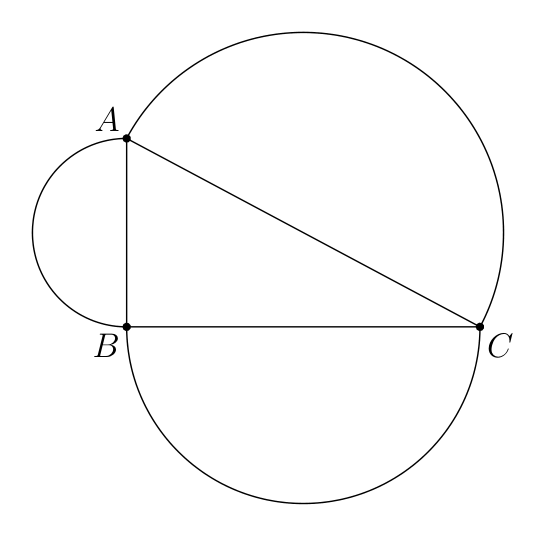
4. $\angle ABC$ of $\triangle ABC$ is a right angle. The sides of $\triangle ABC$ are the diameters of semicircles as shown. The area of the semicircle on $\overline{AB}$ equals $8\pi$, and the arc of the semicircle on $\overline{AC}$ has length $8.5\pi$. What is the radius of the semicircle on $\overline{BC}$?
(A) 7(B) 7.5(C) 8(D) 8.5(E) 9
Solution
Semicircle on $AB$: $\tfrac12\pi(AB/2)^2 = 8\pi \Rightarrow AB = 8$.
Arc on $AC$: $\tfrac12\pi\, AC = 8.5\pi \Rightarrow AC = 17$.
Then $BC = \sqrt{17^2 - 8^2} = 15$ ($8$-$15$-$17$ again), so the radius is $7.5$.
Answer: B
2018 AMC 8 #24
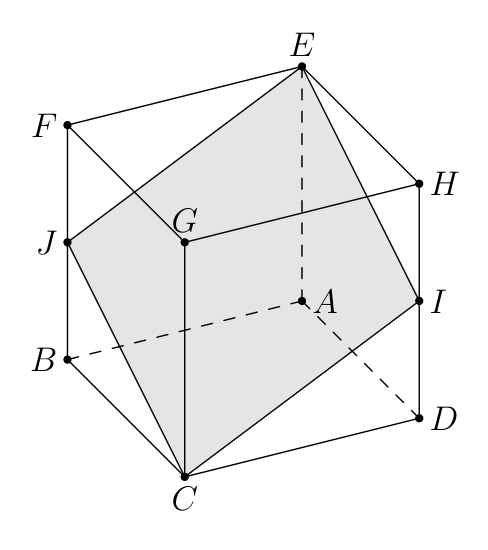
5. In the cube $ABCDEFGH$ with opposite vertices $C$ and $E$, $J$ and $I$ are the midpoints of segments $\overline{FB}$ and $\overline{HD}$, respectively. Let $R$ be the ratio of the area of the cross-section $EJCI$ to the area of one of the faces of the cube. What is $R^2$?
(A) $\frac54$(B) $\frac43$(C) $\frac32$(D) $\frac{25}{16}$(E) $\frac94$
Solution
By SAS, $\triangle EFJ\cong\triangle CBJ\cong\triangle CDI\cong\triangle HEI$, so $EJCI$ is a rhombus — use $S=\tfrac12 d_1 d_2$.
With side $1$: diagonal $JI = BD = \sqrt2$; space diagonal $CE = \sqrt{1^2+1^2+1^2}=\sqrt3$.
$S = \tfrac12\sqrt2\sqrt3 = \tfrac{\sqrt6}{2}$, so $R = \tfrac{\sqrt6}{2}$ and $R^2 = \tfrac32$.
Answer: C
2004 AMC 8 #24
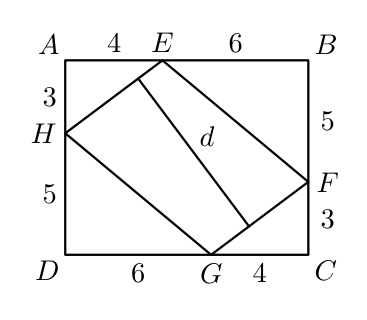
6. In the figure, $ABCD$ is a rectangle and $EFGH$ is a parallelogram. Using the measurements given in the figure, what is the length $d$ of the segment that is perpendicular to $\overline{HE}$ and $\overline{FG}$?
(A) 6.8(B) 7.1(C) 7.6(D) 7.8(E) 8.1
Solution
Area two ways. $HE = \sqrt{3^2+4^2} = 5$.
Parallelogram area $=$ rectangle $-$ four corner right triangles $= 80 - 6 - 15 - 6 - 15 = 38$.
But the area is also $HE\cdot d = 5d$, so $d = 38/5 = 7.6$.
Answer: C
mock · course problem
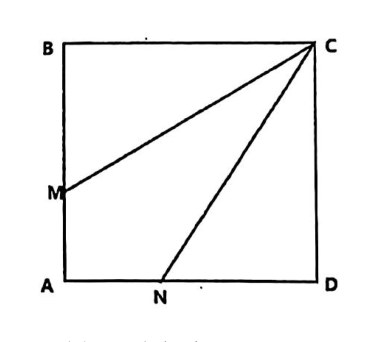
7. Square $ABCD$ has sides of length $3$. Segments $\overline{CM}$ and $\overline{CN}$ divide the square's area into three equal parts. How long is the segment connecting $M$ and $N$?
Solution
Each part has area $3$: $\tfrac12\cdot BM\cdot 3 = 3 \Rightarrow BM = 2$, so $AM = 1$; likewise $AN = 1$.
$\triangle AMN$ is an isosceles right triangle: $MN = \sqrt2$.
Answer: $\sqrt2$
mock · course problem
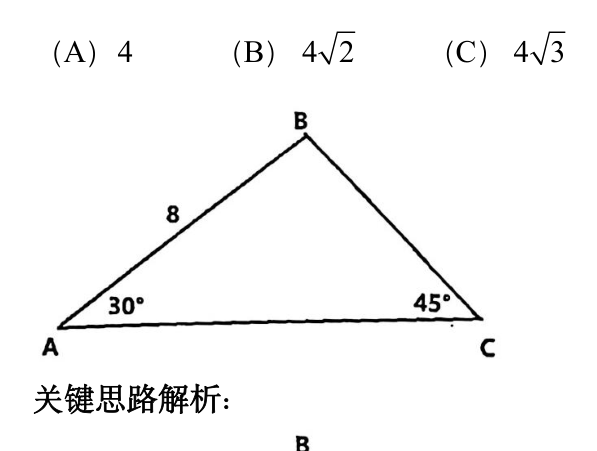
8. Triangle $ABC$ is shown with $AB = 8$, $\angle A = 30^\circ$, $\angle C = 45^\circ$. Find $BC$.
Solution
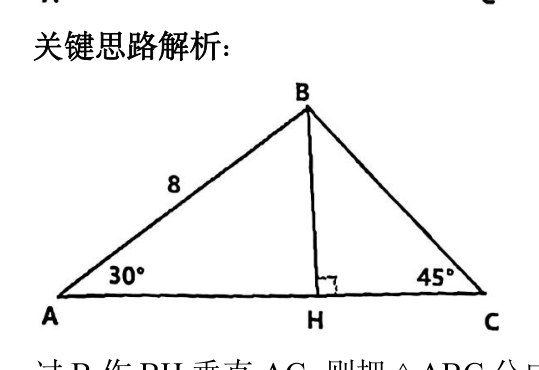
Drop $BH \perp AC$ to split into two special triangles.
In the $30$-$60$-$90$ triangle $ABH$: $BH = 8/2 = 4$. In the $45$-$45$-$90$ triangle $BHC$: $BC = 4\sqrt2$.
Answer: $4\sqrt2$ (B)
2006 AMC 8 #19
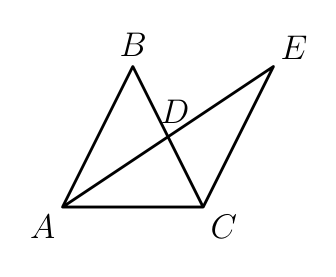
9. Triangle $ABC$ is an isosceles triangle with $\overline{AB}=\overline{BC}$. Point $D$ is the midpoint of both $\overline{BC}$ and $\overline{AE}$, and $\overline{CE}$ is $11$ units long. Triangle $ABD$ is congruent to triangle $ECD$. What is the length of $\overline{BD}$?
(A) 4(B) 4.5(C) 5(D) 5.5(E) 6
Solution
From the congruence, $AB = CE = 11$; isosceles gives $BC = AB = 11$, so $BD = 11/2 = 5.5$.
Answer: D
2015 AMC 8 #19
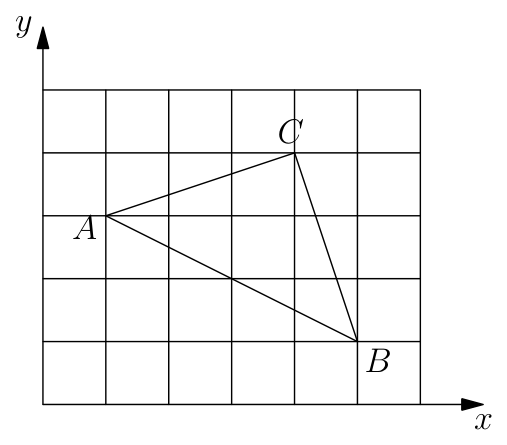
10. A triangle with vertices $A=(1,3)$, $B=(5,1)$, $C=(4,4)$ is plotted on a $6\times5$ grid. What fraction of the grid is covered by the triangle?
(A) $\frac16$(B) $\frac15$(C) $\frac14$(D) $\frac13$(E) $\frac12$
Solution
Congruent right triangles ($1$-$3$ legs) show $AC = CB = \sqrt{10}$ and $\angle ACB = 90^\circ$,
so the area is $\tfrac12\sqrt{10}\cdot\sqrt{10} = 5$. The grid is $30$, so the fraction is $\tfrac16$.
(Or: box the triangle and subtract the three corner triangles.)
Answer: A
2015 AMC 8 #21
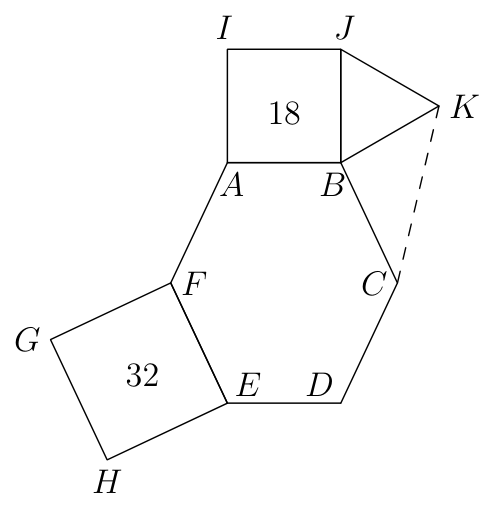
11. In the figure, hexagon $ABCDEF$ is equiangular, $ABJI$ and $FEHG$ are squares with areas $18$ and $32$ respectively, $\triangle JBK$ is equilateral and $FE = BC$. What is the area of $\triangle KBC$?
(A) $6\sqrt2$(B) $9$(C) $12$(D) $9\sqrt2$(E) $32$
Solution
Equiangular hexagon → each interior angle $120^\circ$. Around $B$: $\angle ABC = 120^\circ$, $\angle JBA = 90^\circ$, $\angle JBK = 60^\circ$, so $\angle KBC = 90^\circ$ — a right triangle!
$KB = JB = \sqrt{18} = 3\sqrt2$ and $BC = FE = \sqrt{32} = 4\sqrt2$, so $S = \tfrac12\cdot3\sqrt2\cdot4\sqrt2 = 12$.
Answer: C
2017 AMC 8 #25
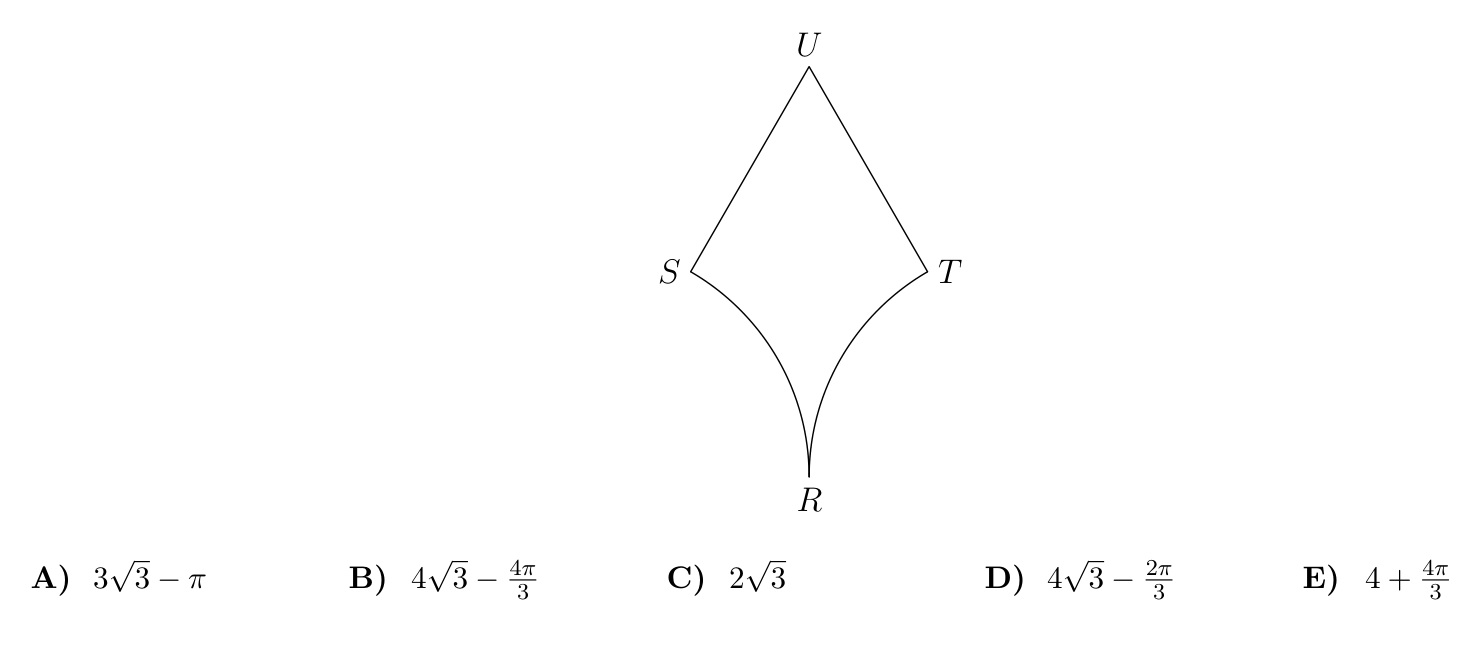
12. In the figure shown, $\overline{US}$ and $\overline{UT}$ are line segments each of length $2$, and $m\angle TUS = 60^\circ$. Arcs $\overset{\frown}{TR}$ and $\overset{\frown}{SR}$ are each one-sixth of a circle with radius $2$. What is the area of the region shown?
(A) $3\sqrt3-\pi$(B) $4\sqrt3-\frac{4\pi}{3}$(C) $2\sqrt3$(D) $4\sqrt3-\frac{2\pi}{3}$(E) $4+\frac{4\pi}{3}$
Solution
Complete the picture: extend to the equilateral triangle of side $4$ whose two other vertices are the arc centers.
Its area is $\tfrac{\sqrt3}{4}\cdot16 = 4\sqrt3$; subtract the two $60^\circ$ sectors: $2\cdot\tfrac16\pi\cdot4 = \tfrac{4\pi}{3}$.
Answer: B
2009 AMC 8 #9
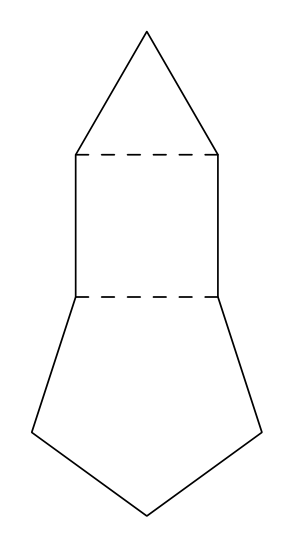
13. Construct a square on one side of an equilateral triangle. On one non-adjacent side of the square, construct a regular pentagon, as shown. On a non-adjacent side of the pentagon, construct a hexagon. Continue until you construct an octagon. How many sides does the resulting polygon have?
(A) 21(B) 23(C) 25(D) 27(E) 29
Solution
Each new $n$-gon adds $n$ sides but glues away $2$: $3+(4-2)+(5-2)+(6-2)+(7-2)+(8-2) = 23$.
Answer: B
2012 AMC 8 #23
14. An equilateral triangle and a regular hexagon have equal perimeters. If the triangle's area is $4$, what is the area of the hexagon?
(A) 4(B) 5(C) 6(D) $4\sqrt3$(E) $6\sqrt3$
Solution
Equal perimeters → the hexagon's side is
half the triangle's side $s$.
A regular hexagon splits into $6$ equilateral triangles of side $\tfrac{s}{2}$, and each of those has $\tfrac14$ the area of a side-$s$ equilateral triangle, i.e. area $1$.
So the hexagon's area is $6 \cdot \tfrac{4}{4} \cdot \tfrac14 = 6\cdot 1 = 6$.
Answer: C
🆕 Fresh from the latest exams
The same ideas, exactly as they appeared on the most recent tests.
2026 AMC 8 #3
15. Haruki has a piece of wire that is $24$ centimeters long. He wants to bend it to form each of the following shapes, one at a time: (1) a regular hexagon with side length $5$ cm; (2) a square of area $36$ cm²; (3) a right triangle whose legs are $6$ and $8$ cm long. Which of the shapes can Haruki make?
(A) Triangle only(B) Hexagon and square only(C) Hexagon and triangle only(D) Square and triangle only(E) Hexagon, triangle, and square
Solution
Hexagon: $6\cdot5 = 30 > 24$ ✗. Square: area $36$ → side $6$ → perimeter $24$ ✓.
Right triangle with legs $6, 8$: that's the doubled $3$-$4$-$5$, so the hypotenuse is $10$ and the perimeter is $6+8+10 = 24$ ✓.
Answer: D
2026 AMC 8 #13
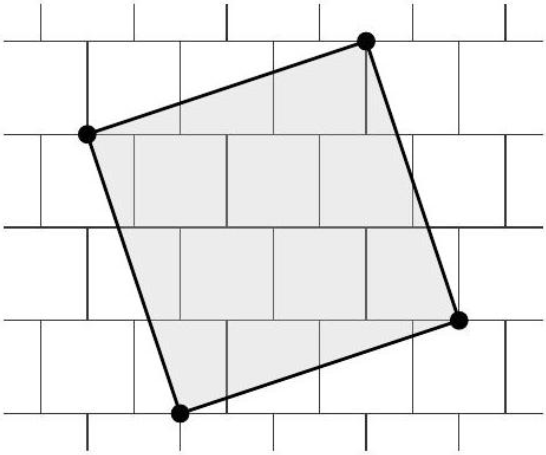
16. The figure below shows a tiling of $1\times1$ unit squares. Each row of unit squares is shifted horizontally by half a unit relative to the row above it. A shaded square is drawn on top of the tiling. Each vertex of the shaded square is a vertex of one of the unit squares. In square units, what is the area of the shaded square?
(A) 10(B) $\frac{21}{2}$(C) $\frac{32}{3}$(D) 11(E) $\frac{34}{3}$
Solution
Follow one side of the shaded square: it goes $3$ units across and $1$ unit down (the half-unit brick shifts mean grid vertices sit every half unit along each horizontal line, so this lands on a vertex).
By the Pythagorean theorem, $\text{side}^2 = 3^2 + 1^2 = 10$ — and $\text{side}^2$
is the square's area.
Answer: A
2024 AMC 8 #24
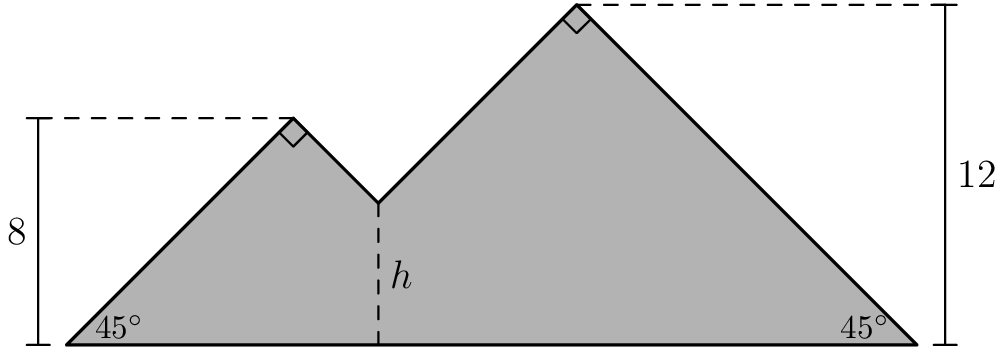
17. Jean has made a piece of stained glass art in the shape of two mountains, as shown in the figure below. One mountain peak is $8$ feet high while the other peak is $12$ feet high. Each peak forms a $90^\circ$ angle, and the straight sides form a $45^\circ$ angle with the ground. The artwork has an area of $183$ square feet. The sides of the mountain meet at an intersection point near the center of the artwork, $h$ feet above the ground. What is the value of $h$?
(A) 4(B) 5(C) $4\sqrt2$(D) 6(E) $5\sqrt2$
Solution
Each mountain is a $45$-$45$-$90$ "roof": height $8$ → base $16$ → area $64$; height $12$ → base $24$ → area $144$. Together $208$.
The overlap (counted twice) is $208 - 183 = 25$. The overlap is itself an upside-down $45$-$45$-$90$ triangle with apex height $h$, so its area is $h^2$.
Thus $h^2 = 25$, $h = 5$.
Answer: B
⭐ Challenge (AMC 10 level)
2011 AMC 10B #18 · 30-60-90
C1. Rectangle $ABCD$ has $AB=6$ and $BC=3$. Point $M$ is chosen on side $\overline{AB}$ so that $\angle AMD = \angle CMD$. What is the degree measure of $\angle AMD$?
(A) 15(B) 30(C) 45(D) 60(E) 75
Solution
$\angle AMD = \angle CDM$ (alternate angles), so $\angle CDM = \angle CMD$, giving $CM = CD = 6$.
In right $\triangle CBM$: $CB = 3 = \tfrac12 CM$ — a $30$-$60$-$90$! So $\angle CMB = 30^\circ$ and $\angle AMD = (180-30)/2 = 75^\circ$.
Answer: E
2015 AMC 10A #19 · 30-60-90
C2. The isosceles right triangle $ABC$ has right angle at $C$ and area $12.5$. The rays trisecting $\angle ACB$ intersect $AB$ at $D$ and $E$. What is the area of $\triangle CDE$?
(A) $\frac{5\sqrt2}{3}$(B) $\frac{50\sqrt3-75}{4}$(C) $\frac{15\sqrt3}{8}$(D) $\frac{50-25\sqrt3}{2}$(E) $\frac{25}{6}$
Solution
$AC=BC=5$, $AB=5\sqrt2$. Since $\triangle CDE$ and $\triangle CAB$ share the altitude from $C$,
$\frac{S_{\triangle CDE}}{12.5} = \frac{DE}{AB}$. Drop $EF\perp BC$; with $\angle ECB=30^\circ$, $\angle B = 45^\circ$: $EF = x$, $CF = x\sqrt3$, $FB = x$, so $x(\sqrt3+1) = 5$ and $BE = x\sqrt2$.
Solving: $x = \frac{5}{\sqrt3+1} = \frac{5(\sqrt3-1)}{2}$, so $BE = AD = \frac{5\sqrt6-5\sqrt2}{2}$ and $DE = 5\sqrt2 - (5\sqrt6-5\sqrt2) = 10\sqrt2-5\sqrt6$.
Then $S_{\triangle CDE} = 12.5\cdot\frac{DE}{5\sqrt2} = \frac{50-25\sqrt3}{2}$.
Answer: D
🗝 Answer key
| Example | 1 | 2 | 3 | 4 |
|---|
| D | B | A | B |
|---|
| Practice | 1 | 2 | 3 | 4 | 5 | 6 | 7 | 8 | 9 | 10 | 11 | 12 | 13 | 14 | 15 | 16 | 17 |
|---|
| B | A | C | B | C | C | $\sqrt2$ | $4\sqrt2$ | D | A | C | B | B | C | D | A | B |
|---|
| Challenge | C1 | C2 |
|---|
| E | D |
|---|
Sources: prep-course Lecture 02 (video + board notes + 20 worked examples, translated to English) and official AMC 8 problems from the local bank
(kb/content/banks/). Answers verified against official AoPS answer keys where available.
Proof animations from Wikimedia Commons (CC BY-SA 4.0): rearrangement proof by William B. Faulk; shearing proof by RajRaizada.