Similar Triangles · Lecture 03 · geo-similar-triangles
📺 Course materials — Lecture 03:
lecture video · handout PDF (Lecture 3) · board notes (03.jpg) · homework answer key (Chapter 3)
— all in the
amc8/video folder.
·
🖨 Printable PDF (answers & solutions at the back)
🔑 Key facts
Two triangles are similar ($\sim$) when they have the same shape at different sizes: two equal angle pairs is enough (AA).
Every length-type quantity — sides, perimeter, heights, medians — scales by the same similarity ratio $k$, while areas scale by $k^2$.
On AMC 8 nearly every similar-triangle pair is manufactured by parallel lines: the "hourglass" ($\!\times\!$ shape) and the "pyramid" (a line across a triangle).
🧰 Instructor's toolbox (from the lecture video & board notes)
1 · Same shape, one number $k$: lengths scale by $k$, areas by $k^2$.
The board's table for a $1:2$ pair — side ratio $1:2$, perimeter ratio $1:2$, height ratio $1:2$ (every length is the similarity ratio), but area ratio $1:4$, "the square of the similarity ratio".
Angles don't change at all — that's what "same shape" means.
Going from areas back to lengths, take a square root: areas $1:9$ → lengths $1:3$.
2 · AA: two angles equal → similar.
"Angles determine the shape; sides only determine the size" — a $3$-$4$-$5$ and any right triangle with the same second angle are the same picture at different zoom.
The everyday case: a shared angle plus a right angle (Example 5: $\triangle ADO \sim \triangle AOB$ share $\angle A$, each has a right angle).
4 · Write the letters in corresponding order — the ratios then write themselves.
The teacher crossed out "$\triangle AOB \sim \triangle COD$" on the board: in the hourglass it must be $\triangle AOB \sim \triangle DOC$, matching equal angles letter by letter ($A\!\leftrightarrow\!D$, $O\!\leftrightarrow\!O$, $B\!\leftrightarrow\!C$).
Once the order is right, read ratios straight across:
\[\frac{AO}{DO} = \frac{OB}{OC} = \frac{AB}{DC}.\]
Get the order wrong and every ratio you write after it is wrong too.
5 · Part : whole. In the pyramid model the small triangle is a scaled copy of the whole triangle, so
\[\frac{S_{\text{small}}}{S_{\text{whole}}} = \left(\frac{\text{near piece}}{\text{whole side}}\right)^{2}.\]
Example 2: $AE:AB = 1:3$ → areas $1:9$; Practice 1: midline → $1:4$.
Complements work too: the leftover region is "whole minus similar part".
8 · Chain area ratios — never compute a single length.
Two triangles with the same height have areas in the ratio of their bases (same base → ratio of heights).
Alternate these with similarity squares to walk from the known area to the target:
Example 4 goes $360 \to 240 \to 120 \to 30$ without measuring anything.
And when the similar triangle you need doesn't exist yet, draw a parallel line to create it (Example 4's $DG \parallel AF$).
📖 Worked examples
course mock · projection theorem
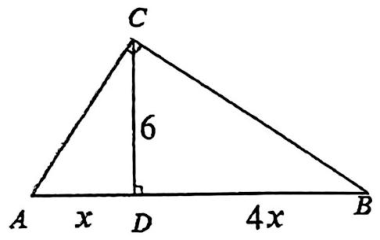
Example 1. In a right triangle, a perpendicular is dropped from the right angle to the hypotenuse, dividing the hypotenuse into segments of lengths $x$ and $4x$ inches. If the altitude is $6$ inches long, then $x$, in inches, is:
(A) $\frac13$(B) $\frac23$(C) $\frac32$(D) $3$(E) cannot be determined
Key idea: altitude to the hypotenuse → $CD^2 = AD\cdot DB$ (that's just $\triangle ACD \sim \triangle CBD$ written as a product).
\[6^2 = x \cdot 4x \;\Longrightarrow\; 4x^2 = 36 \;\Longrightarrow\; x = 3.\]
Answer: D
2018 AMC 8 #20 · pyramid ×2
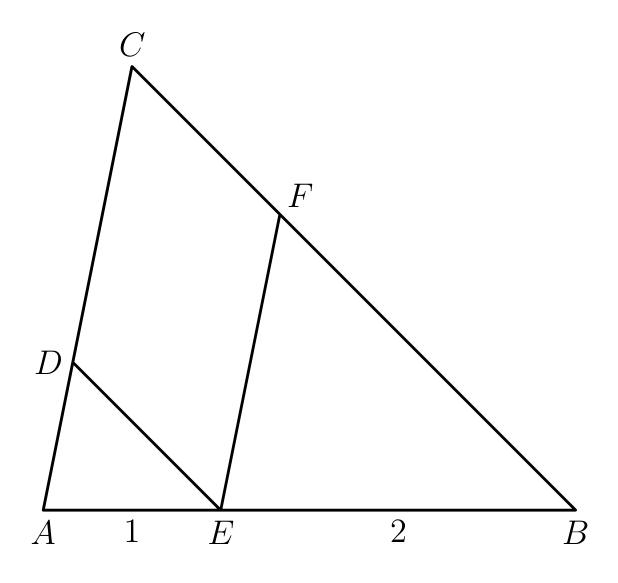
Example 2. In $\triangle ABC$, point $E$ is on $\overline{AB}$ with $AE=1$ and $EB=2$. Point $D$ is on $\overline{AC}$ so that $\overline{DE} \parallel \overline{BC}$ and point $F$ is on $\overline{BC}$ so that $\overline{EF} \parallel \overline{AC}$. What is the ratio of the area of $CDEF$ to the area of $\triangle ABC$?
(A) $\frac{4}{9}$(B) $\frac{1}{2}$(C) $\frac{5}{9}$(D) $\frac{3}{5}$(E) $\frac{2}{3}$
Key idea: two pyramid models cut two similar corners off the whole triangle; the parallelogram $CDEF$ is what's left.
$DE \parallel BC$: $\triangle ADE \sim \triangle ABC$ with $k = \frac{AE}{AB} = \frac13$, so $\frac{S_{ADE}}{S_{ABC}} = \frac19$.
$EF \parallel AC$: $\triangle BEF \sim \triangle BAC$ with $k = \frac{BE}{BA} = \frac23$, so $\frac{S_{BEF}}{S_{ABC}} = \frac49$.
\[\frac{S_{CDEF}}{S_{ABC}} = 1 - \frac19 - \frac49 = \frac49.\]
Answer: A
2018 AMC 8 #22 · hourglass
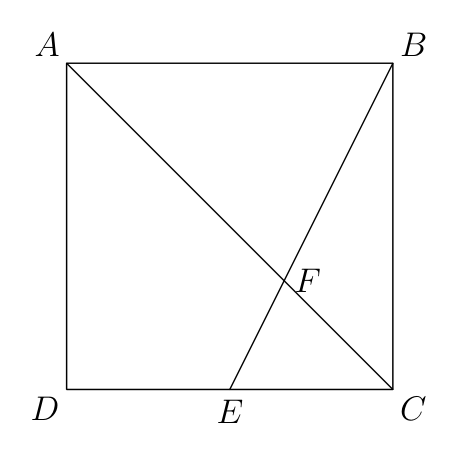
Example 3. Point $E$ is the midpoint of side $\overline{CD}$ in square $ABCD$, and $\overline{BE}$ meets diagonal $\overline{AC}$ at $F$. The area of quadrilateral $AFED$ is $45$. What is the area of $ABCD$?
(A) 100(B) 108(C) 120(D) 135(E) 144
Key idea: $CE \parallel AB$ makes an hourglass at $F$: $\triangle CEF \sim \triangle ABF$ with ratio $CE:AB = 1:2$.
Set $S_{CEF} = k$. Areas scale by $k^2$: $S_{ABF} = 4k$. Sharing heights over $AF:FC = 2:1$ (from the same hourglass): $S_{CBF} = \tfrac12 S_{ABF} = 2k$.
So $S_{ABC} = 4k + 2k = 6k$, and the diagonal halves the square: $S_{ACD} = 6k$ too.
Quadrilateral $AFED$ is $\triangle ACD$ with the corner triangle $FCE$ cut off ($F$ on $\overline{AC}$, $E$ on $\overline{CD}$):
\[S_{AFED} = S_{ACD} - S_{FCE} = 6k - k = 5k = 45 \;\Longrightarrow\; k = 9.\]
The square is $12k = 108$.
Answer: B
2019 AMC 8 #24 · auxiliary parallel
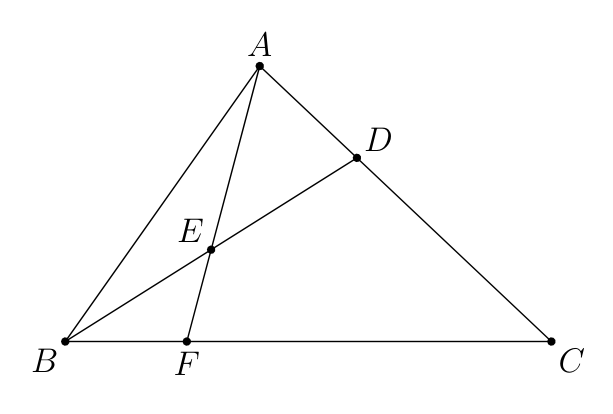
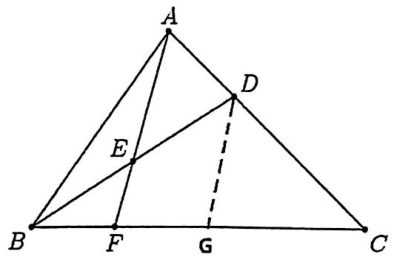
Example 4. In triangle $ABC$, point $D$ divides side $\overline{AC}$ so that $AD:DC = 1:2$. Let $E$ be the midpoint of $\overline{BD}$ and let $F$ be the point of intersection of line $BC$ and line $AE$. Given that the area of $\triangle ABC$ is $360$, what is the area of $\triangle EBF$?
(A) 24(B) 30(C) 32(D) 36(E) 40
Key idea: the similar triangle you need doesn't exist — draw $DG \parallel AF$ (meeting $\overline{BC}$ at $G$) and chain ratios down to the target.
In $\triangle CAF$: $DG \parallel AF$ gives $FG:GC = AD:DC = 1:2$. In $\triangle BDG$: $E$ is the midpoint of $\overline{BD}$ and $EF \parallel DG$, so $BF = FG$.
Hence $BF:FG:GC$ has $BF=FG$ and $FG:GC=1:2$, so $BG:BC = 2:4 = 1:2$. Now walk the areas:
\[S_{BDC} = \tfrac{DC}{AC}\,S_{ABC} = \tfrac23\cdot360 = 240,\qquad S_{BGD} = \tfrac{BG}{BC}\,S_{BDC} = \tfrac12\cdot240 = 120,\]
and $\triangle BEF \sim \triangle BDG$ (pyramid, $EF\parallel DG$) with $k = \tfrac{BE}{BD} = \tfrac12$:
\[S_{BEF} = \tfrac14\cdot120 = 30.\]
Answer: B
2016 AMC 8 #25 · projection model
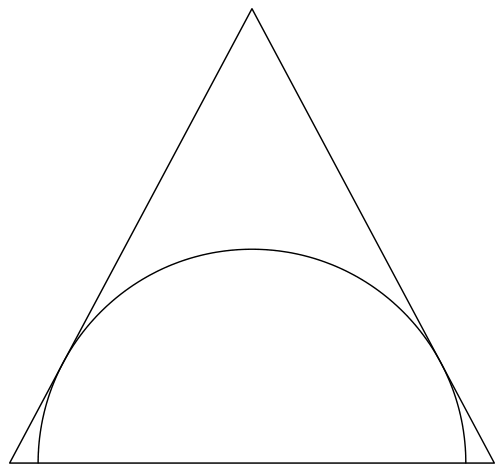
Example 5. A semicircle is inscribed in an isosceles triangle with base $16$ and height $15$ so that the diameter of the semicircle is contained in the base of the triangle as shown. What is the radius of the semicircle?
(A) $4\sqrt{3}$(B) $\frac{120}{17}$(C) $10$(D) $\frac{17\sqrt{2}}{2}$(E) $\frac{17\sqrt{3}}{2}$
Key idea: the radius to the tangent point is an altitude-to-hypotenuse in disguise.
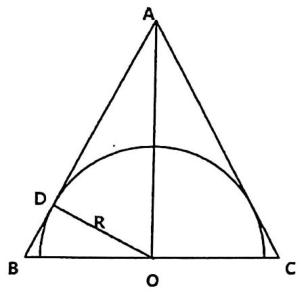
Let $O$ be the center (midpoint of base $BC$) and $D$ the tangent point on leg $AB$. Isosceles → $AO \perp BC$, with $BO = 8$, $AO = 15$, so $AB = \sqrt{8^2+15^2} = 17$ (the $8$-$15$-$17$ triple).
$OD \perp AB$ (radius ⟂ tangent), so $\triangle ADO \sim \triangle AOB$ (right angle + shared $\angle A$):
\[\frac{DO}{OB} = \frac{AO}{AB} \;\Longrightarrow\; \frac{R}{8} = \frac{15}{17} \;\Longrightarrow\; R = \frac{120}{17}.\]
Answer: B
✏️ Practice
Try each one before opening the solution. Figures are from the official exams and course handouts.
2002 AMC 8 #20
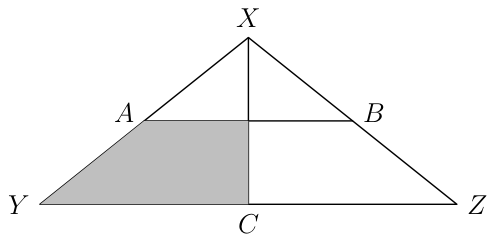
1. The area of triangle $XYZ$ is $8$ square inches. Points $A$ and $B$ are midpoints of congruent segments $\overline{XY}$ and $\overline{XZ}$. Altitude $\overline{XC}$ bisects $\overline{YZ}$. What is the area (in square inches) of the shaded region?
(A) $1\frac12$(B) $2$(C) $2\frac12$(D) $3$(E) $3\frac12$
Solution
$A$ and $B$ are midpoints, so $\overline{AB}$ is a midsegment: $AB \parallel YZ$. Let $M$ be where $\overline{AB}$ crosses $\overline{XC}$.
$S_{XYC} = \tfrac12 \cdot 8 = 4$ (the altitude bisects the base). Pyramid model in $\triangle XYC$: $\triangle XAM \sim \triangle XYC$ with $k = \tfrac12$, so
$S_{XAM} = \tfrac14\cdot 4 = 1$. The shaded region is the rest: $S_{AMCY} = 4 - 1 = 3$.
Answer: D
2016 AMC 8 #22
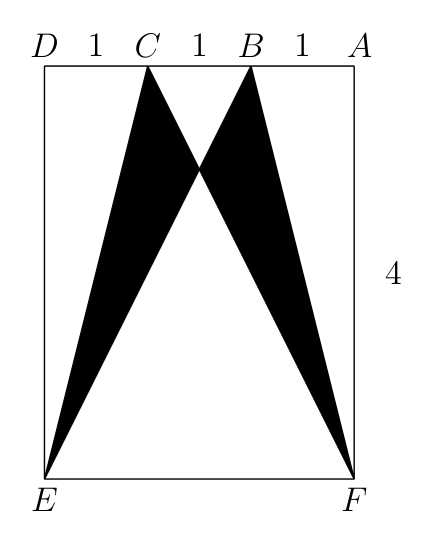
2. Rectangle $DEFA$ below is a $3\times4$ rectangle with $DC=CB=BA$. What is the area of the "bat wings" (shaded area)?
(A) $2$(B) $2\frac12$(C) $3$(D) $3\frac12$(E) $5$
Solution
The two wings have equal area (symmetry), so find one. Let $M$ be the crossing of $\overline{CE}$ and $\overline{BF}$ — one wing is $\triangle ECM$.
Start from $S_{BCE} = \tfrac12\cdot CB\cdot(\text{height }4) = \tfrac12\cdot1\cdot4 = 2$.
$CB \parallel EF$ makes an hourglass: $\triangle MCB \sim \triangle MEF$ with ratio $CB:EF = 1:3$, so the crossing point $M$ splits the height so that
$\dfrac{S_{MCB}}{S_{MCE}} = \dfrac{BM}{ME} = \dfrac13$ — i.e. $S_{ECM} = \tfrac34 S_{BCE} = \tfrac32$.
One wing $= \tfrac32$, both wings $= 3$.
Answer: C
course mock · midsegments
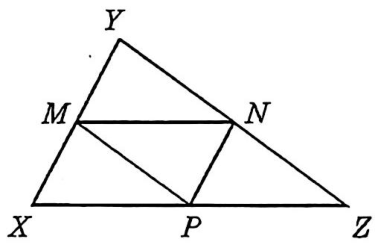
3. In $\triangle XYZ$, points $M$, $N$, and $P$ are all midpoints. If $XY=10$, $YZ=15$, and $XZ=17$, what is the perimeter of triangle $MNP$?
(A) $14$(B) $16$(C) $10\frac23$(D) $21$(E) cannot be determined
Solution
Each side of $\triangle MNP$ is a midsegment — parallel to a side of $\triangle XYZ$ and half as long.
So $\triangle MNP \sim \triangle ZXY$ with ratio $1:2$, and perimeter is a
length: it scales by $k$, not $k^2$:
\[P_{MNP} = \tfrac12 (10+15+17) = \tfrac12\cdot 42 = 21.\]
Answer: D
🆕 Fresh from the latest exams
The same ideas, exactly as they appeared on the most recent tests.
2025 AMC 8 #18
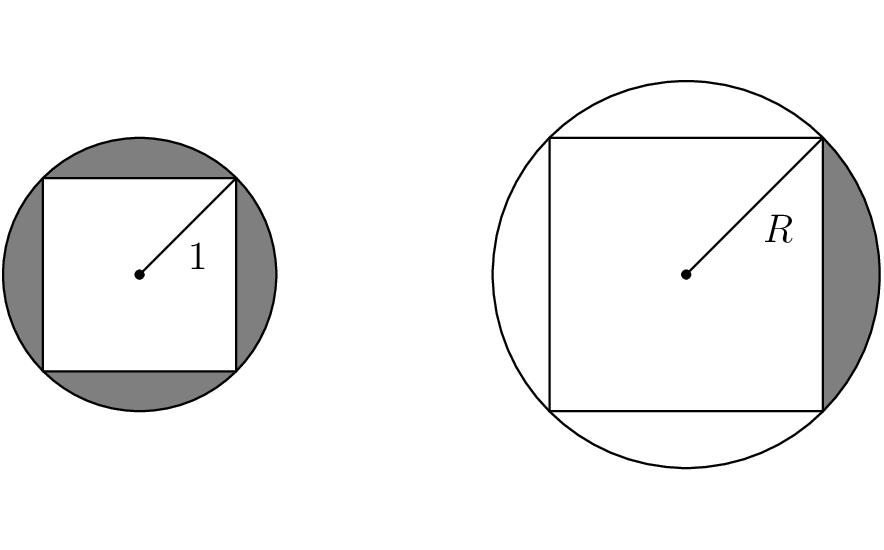
4. The circle shown below on the left has a radius of $1$ unit. The region between the circle and the inscribed square is shaded. In the circle shown on the right, one quarter of the region between the circle and the inscribed square is shaded. The shaded regions in the two circles have the same area. What is the radius $R$, in units, of the circle on the right?
(A) $\sqrt2$(B) $2$(C) $2\sqrt2$(D) $4$(E) $4\sqrt2$
Solution
"Circle + inscribed square" is one shape at two zooms — every region of it scales by $R^2$.
At radius $1$: square has diagonal $2$, side $\sqrt2$, area $2$; ring-shaped leftover $= \pi - 2$.
At radius $R$ the leftover is $(\pi-2)R^2$, and a quarter of it is shaded:
\[\tfrac14(\pi-2)R^2 = \pi - 2 \;\Longrightarrow\; R^2 = 4 \;\Longrightarrow\; R = 2.\]
Answer: B
2024 AMC 8 #23
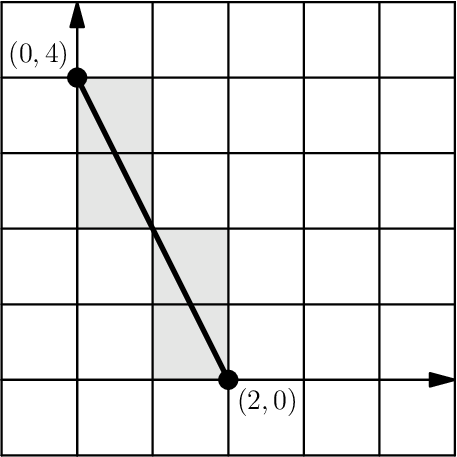
5. Rodrigo has a very large sheet of graph paper. First he draws a line segment connecting point $(0,4)$ to point $(2,0)$ and colors the $4$ cells whose interiors intersect the segment, as shown below. Next Rodrigo draws a line segment connecting point $(2000,3000)$ to point $(5000,8000)$. How many cells will he color this time?
(A) 6000(B) 6500(C) 7000(D) 7500(E) 8000
Solution
Scale the segment down: it runs $\Delta x = 3000$, $\Delta y = 5000$, and $\gcd(3000,5000) = 1000$, so it is $1000$ identical copies (laid corner to corner) of a segment with $\Delta x = 3$, $\Delta y = 5$ — same shape, smaller size.
One $(3,5)$ piece never passes through an interior lattice point ($\gcd = 1$), so it colors $3 + 5 - 1 = 7$ cells
(each of the $2$ vertical and $4$ horizontal grid lines it crosses starts a new cell).
Sanity-check on the given example: $(2,4)$ segment → $2+4-2 = 4$ cells ✓. Total: $1000 \times 7 = 7000$.
Answer: C
⭐ Challenge (AMC 10 level)
2018 AMC 10A #13 · fold = perpendicular bisector
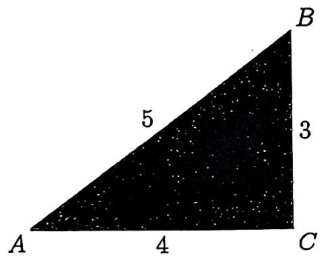
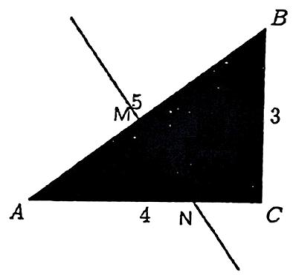
C1. A paper triangle with sides of lengths $3$, $4$, and $5$ inches, as shown, is folded so that point $A$ falls on point $B$. What is the length in inches of the crease?
(A) $1+\frac12\sqrt2$(B) $\sqrt3$(C) $\frac74$(D) $\frac{15}{8}$(E) $2$
Solution
Folding $A$ onto $B$ means the crease is the
perpendicular bisector of $\overline{AB}$: it hits $\overline{AB}$ at its midpoint $M$ (so $AM = \tfrac52$) at a right angle, and crosses $\overline{AC}$ at $N$.
$\triangle AMN \sim \triangle ACB$ (right angle + shared $\angle A$ — note the order: $M \leftrightarrow C$), so
\[\frac{AM}{AC} = \frac{MN}{CB} \;\Longrightarrow\; \frac{5/2}{4} = \frac{MN}{3} \;\Longrightarrow\; MN = \frac{15}{8}.\]
Answer: D
2009 AMC 10A #17 · projection ×2
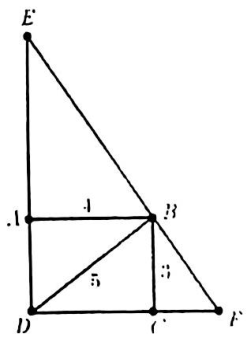
C2. Rectangle $ABCD$ has $AB = 4$ and $BC = 3$. Segment $EF$ is constructed through $B$ so that $EF \perp DB$, and $A$ and $C$ lie on $\overline{DE}$ and $\overline{DF}$, respectively. What is $EF$?
(A) $9$(B) $10$(C) $\frac{125}{12}$(D) $\frac{103}{9}$(E) $12$
Solution
$BD = 5$ ($3$-$4$-$5$). Use the projection theorem twice, in two different right triangles.
In right $\triangle BDF$ (right angle at $B$), $BC \perp DF$ is the altitude to the hypotenuse:
$BD^2 = DC\cdot DF \Rightarrow 25 = 4\cdot DF \Rightarrow DF = \tfrac{25}{4}$, so $CF = \tfrac{25}{4} - 4 = \tfrac94$, and
$FB^2 = FC\cdot FD = \tfrac94\cdot\tfrac{25}{4} \Rightarrow FB = \tfrac{15}{4}$.
In right $\triangle EDF$ (right angle at $D$), $DB \perp EF$ is the altitude:
$BD^2 = EB\cdot BF \Rightarrow EB = \dfrac{25}{15/4} = \dfrac{20}{3}$.
\[EF = EB + BF = \frac{20}{3} + \frac{15}{4} = \frac{80+45}{12} = \frac{125}{12}.\]
Answer: C
2021 AMC 10A #17 · hourglass in a trapezoid
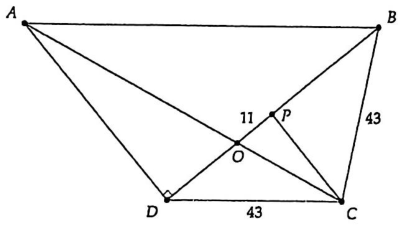
C3. Trapezoid $ABCD$ has $AB \parallel CD$, $BC = CD = 43$, and $AD \perp BD$. Let $O$ be the intersection of the diagonals $\overline{AC}$ and $\overline{BD}$, and let $P$ be the midpoint of $\overline{BD}$. Given that $OP = 11$, the length of $AD$ can be written in the form $m\sqrt{n}$, where $m$ and $n$ are positive integers and $n$ is not divisible by the square of any prime. What is $m+n$?
(A) 65(B) 132(C) 157(D) 194(E) 215
Solution
$CD = CB$ and $P$ the midpoint of $\overline{BD}$ give $CP \perp BD$ — so $CP$ and $AD$ are both $\perp BD$, making $\triangle CPD \sim \triangle ADB$ with ratio $DP:DB = 1:2$. Hence $AB = 2\,CD = 86$.
Now the hourglass on $AB \parallel CD$: $\triangle CDO \sim \triangle ABO$, so with $DO = x$ and $BP = DP = 11 + x$ (so $BO = 22 + x$):
\[\frac{AB}{CD} = \frac{BO}{DO} \;\Longrightarrow\; \frac{86}{43} = \frac{22+x}{x} \;\Longrightarrow\; x = 22,\]
giving $BD = 2(11+22) = 66$. Finally, right $\triangle ADB$: $AD = \sqrt{86^2 - 66^2} = \sqrt{3040} = 4\sqrt{190}$, so $m+n = 4+190 = 194$.
Answer: D
🗝 Answer key
| Example | 1 | 2 | 3 | 4 | 5 |
|---|
| D | A | B | B | B |
|---|
| Practice | 1 | 2 | 3 | 4 | 5 |
|---|
| D | C | D | B | C |
|---|
| Challenge | C1 | C2 | C3 |
|---|
| D | C | D |
|---|
Sources: prep-course Lecture 03 (video + board notes + 11 worked examples, translated to English) and official AMC 8 problems from the local bank
(kb/content/banks/). Answers verified against official AoPS answer keys where available; course-mock answers follow the course solution manual.