Logic & Data Analysis · Lecture 09 · logic-data-analysis
📺 Course materials — Lecture 09 (95 min):
lecture video · handout PDF (Lecture 9) · board notes (09.jpg) · homework answer key (Chapter 9)
— all in the amc8/video folder.
· 🖨 Printable PDF (answers & solutions at the back)
🔑 Key facts
Logic: a statement "if $P$ then $Q$" is equivalent to its contrapositive "if not $Q$ then not $P$" — and not equivalent to its converse or inverse.
Two statements that cannot both be true form a contradictory pair: exactly one of them is true.
Data: for a sorted list — mean $=\dfrac{\text{sum}}{\text{count}}$; median = middle value (average of the two middle values when the count is even);
mode = most frequent value; range $=\max-\min$; mid-range $=\dfrac{\max+\min}{2}$.
Sets (Venn): $|A\cup B| = |A| + |B| - |A\cap B|$ — "or" means the union, "both" means the intersection.
🧰 Instructor's toolbox (from the lecture video & board notes)
1 · The three weapons. The instructor opens the lecture with them: hunt for a contradiction, eliminate (test the choices / cross out impossible cases), make a table.
Every AMC 8 logic puzzle falls to one of these three — when stuck, switch weapons.
2 · Contrapositive — the only safe flip. The board example: "If I am in Pudong, then I am in Shanghai."
Equivalent: "If I am not in Shanghai, then I am not in Pudong" (contrapositive ✓).
NOT equivalent: "If I am in Shanghai, then I am in Pudong" (converse ✗) and "If I am not in Pudong, then I am not in Shanghai" (inverse ✗).
So to verify "if star, then triangle", you must also check every card that could break the contrapositive: "if no triangle, then no star" (Example 1).
3 · Spend the truth budget on a contradictory (or consistent) pair.
When "exactly $k$ of these statements are true", first find two statements that contradict each other — exactly one of that pair is true, which fixes the truth of all the rest (Examples 2–3).
Two consistent statements (one forces the other) live or die together — if only one statement in total is true, a consistent pair must both be false (Practice 1–2).
4 · Ranking puzzles: turn every remark into an inequality. Whoever was shown a score is secretly comparing with it.
Board shorthand for Practice 3: Cassie saw Hannah's score and says "I'm not the lowest" $\Rightarrow H<C$; Bridget: "I'm not the highest" $\Rightarrow H>B$. Chain: $C>H>B$ — done, no cases needed.
5 · Median mechanics: sort first, then count positions. With $n$ values the median sits at position $\tfrac{n+1}{2}$; for even $n$ it is the average of the two middle values — $20$ scores $\to$ positions $10$ and $11$ (Example 5 turns entirely on those two positions).
Know the whole stat family: range $=\max-\min$, mode = most frequent, mid-range $=\tfrac{\max+\min}{2}$ — Practice 5's trap is that a new minimum moves the range and mid-range but may leave the median and mode untouched.
6 · Squeeze the median: push everything else to its extreme. To make a median as large (small) as possible, make every value on the other side as small (large) as the rules allow — the total is fixed, so whatever you save goes to the middle.
Beverage Barn (Practice 8): $49$ customers buy just $1$ can each, positions $52$–$100$ are capped at the median's own ceiling, and the leftover $252-49=203$ cans among $51$ customers give $203\div51=3$ r $50$ — so positions $50$ and $51$ get $3$ and $4$.
7 · Two-circle Venn: fill from the middle out. $|A\cup B| = |A|+|B|-|A\cap B|$ — adding $|A|$ and $|B|$ counts the overlap twice, so subtract it once.
Word cues: "or / at least one" $\to$ union, "both" $\to$ intersection, "neither" $\to$ outside both circles (subtract from the total first — Practice 11).
Always write the overlap number into the diagram first, then the "only" parts.
8 · Three circles: subtract the doubles once, add the triple back.
\[|A\cup B\cup C|=|A|+|B|+|C|-|A\cap B|-|A\cap C|-|B\cap C|+|A\cap B\cap C|\]
The instructor's memo: elements in exactly two sets got counted twice — subtract once; elements in all three got counted $3$ times then subtracted $3$ times — add them back.
For "every 3 / 4 / 5 days" problems, count multiples with the floor: $\left\lfloor\tfrac{365}{3}\right\rfloor=121$, $\left\lfloor\tfrac{365}{12}\right\rfloor=30$ (both 3 and 4 = multiples of 12), $\left\lfloor\tfrac{365}{60}\right\rfloor=6$ (Practice 13).
📖 Worked examples
course problem · contrapositive
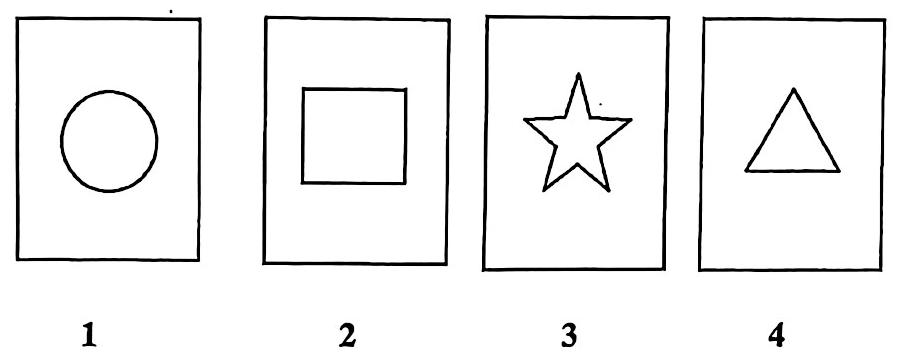
Example 1. Each card has either a circle or a star on one side, and either a triangle or a square on the other side. To verify the statement "every card with a star on it also has a triangle on it," which numbered card(s) must be turned over?
Key idea: check the statement and its contrapositive ("every card without a triangle has no star") — nothing else can break it.
Card 3 (star): its back must be a triangle — flip it.
Card 2 (square = no triangle): its back must not be a star — flip it.
Card 1 (circle): a circle card makes no claim — the statement only restricts star cards. Card 4 (triangle): a triangle back is fine no matter what's on the front (the statement is not "triangle $\Rightarrow$ star").
Answer: cards 2 and 3
2017 AMC 8 #8 · contradiction
Example 2. Malcolm wants to visit Isabella after school today and knows the street where she lives but doesn't know her house number. She tells him, "My house number has two digits, and exactly three of the following four statements about it are true."
(1) It is prime. (2) It is even. (3) It is divisible by $7$. (4) One of its digits is $9$.
This information allows Malcolm to determine Isabella's house number. What is its units digit?
Key idea: a two-digit number can't be both prime and even — (1) and (2) contradict, so the single false statement is one of them. But (1) also contradicts (3) (a two-digit multiple of $7$ isn't prime), so (1) is the false one, and (2), (3), (4) are all true.
Two-digit even multiples of $7$: $14, 28, 42, 56, 70, 84, 98$. With a digit $9$: only $98$. Units digit $8$.
Answer: D
course problem · contradictory pair
Example 3. There are three boxes of different colors: red, yellow, and blue. An apple is in one of the three boxes. Exactly one of the following statements is true, and the others are false:
I. The apple is in the red box. II. The apple is not in the yellow box. III. The apple is not in the red box.
Which box is the apple in?
Key idea: I and III contradict each other, so the one true statement lives in that pair — which means II is false.
"Not in the yellow box" being false puts the apple in the yellow box. (Check: then III is true, I is false — exactly one true ✓.)
Answer: the yellow box
2020 AMC 8 #20 · reconstruction
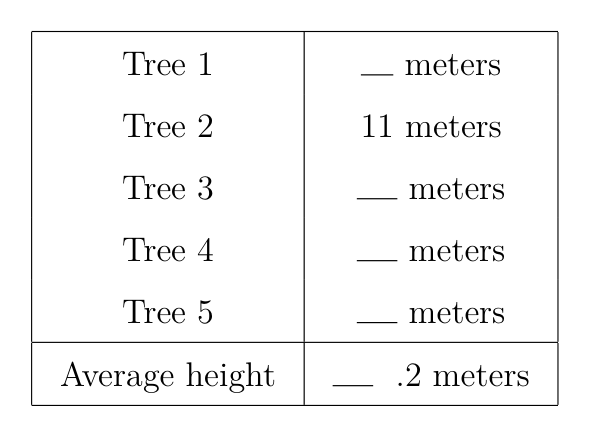
Example 4. A scientist walking through a forest recorded as integers the heights of $5$ trees standing in a row. She observed that each tree was either twice as tall or half as tall as the one to its right. Unfortunately some of her data was lost when rain fell on her notebook. Her notes are shown below, with blanks indicating the missing numbers. Based on her observations, the scientist was able to reconstruct the lost data. What was the average height of the trees, in meters?
Key idea: heights are integers, so no neighbor of $11$ can be $5.5$ — trees 1 and 3 are both $22$.
The average ends in $.2$, so the total ends in $1$ or $6$ (total $=5\times$average).
Tree 4 is $44$ or $11$: if $11$, tree 5 is $22$ (integer), total $22+11+22+11+22=88$ ✗.
So tree 4 $=44$; tree 5 is $88$ or $22$: total $187$ ✗ or $121$ ✓ (ends in 1).
Average $=121\div5=24.2$.
Answer: B
2022 AMC 8 #19 · median positions
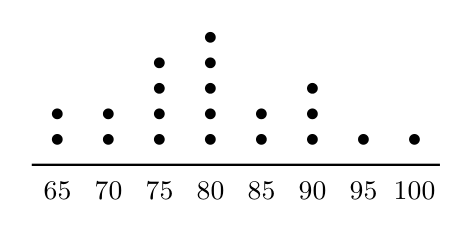
Example 5. Mr. Ramos gave a test to his class of $20$ students. The dot plot below shows the distribution of test scores. Later Mr. Ramos discovered that there was a scoring error on one of the questions. He regraded the tests, awarding some of the students $5$ extra points, which increased the median test score to $85$. What is the minimum number of students who received extra points? (Note that the median test score equals the average of the $2$ scores in the middle if the $20$ test scores are arranged in increasing order.)
Key idea: only positions $10$ and $11$ matter. Before regrading, positions $10$–$13$ all score $80$ (median $80$).
For the new median to be $85$, the $10$th and $11$th scores must both become $85$.
But if you bump only two of the four $80$s, the two untouched $80$s slide down into positions $10$–$11$ and the median stays $80$ — so all four $80$s (positions $10,11,12,13$) need the $+5$.
Answer: C
✏️ Practice
Try each one before opening the solution. Figures are from the official exams and course handouts.
course problem · contradictory pair
1. A car is hidden in one of three boxes, and each box has a sign on it. Exactly one of the three signs is true. Which box is the car in?
Signs 1 and 3 contradict each other, so the single true sign is one of those two — sign 2 must be false.
A false "the car is not in this box" means the car is in box 2.
(Check: car in box 2 makes sign 1 false, sign 3 true — exactly one true ✓. Note signs 1 and 2 are also consistent: sign 1 true would force sign 2 true, two truths — impossible, so sign 1 is false either way.)
Answer: box 2
course problem · consistent pair
2. Each of three marbles $A$, $B$, and $C$ is colored one of three colors: one is white, one is red, and one is blue. Exactly one of these statements is true:
1) $A$ is red. 2) $B$ is not blue. 3) $C$ is not red.
What color is marble $B$?
Statements 1) and 3) are consistent: if $A$ is red then $C$ certainly isn't — 1) true forces 3) true.
So 1) and 3) can't split; with only one truth available they must both be false, and 2) is the true one.
3) false $\Rightarrow$ $C$ is red. 2) true $\Rightarrow$ $B$ is not blue, so $B$ is white (and $A$ is blue).
Answer: white
2013 AMC 8 #19
3. Bridget, Cassie, and Hannah are discussing the results of their last math test. Hannah shows Bridget and Cassie her test, but Bridget and Cassie don't show theirs to anyone. Cassie says, "I didn't get the lowest score in our class," and Bridget adds, "I didn't get the highest score." What is the ranking of the three girls from highest to lowest?
Both girls are comparing themselves with the one score they saw — Hannah's.
Cassie, "not the lowest": she beats someone she knows about $\Rightarrow C>H$. Bridget, "not the highest": $\Rightarrow B<H$.
Chain: $C>H>B$. Answer: D
2001 AMC 8 #20
4. Kaleana shows her test score to Quay, Marty and Shana, but the others keep theirs hidden. Quay thinks, "At least two of us have the same score." Marty thinks, "I didn't get the lowest score." Shana thinks, "I didn't get the highest score." List the scores from lowest to highest for Marty (M), Quay (Q) and Shana (S).
(A) S, Q, M(B) Q, M, S(C) Q, S, M(D) M, S, Q(E) S, M, Q
Everyone is comparing with Kaleana's score $K$, the only one they saw.
Quay's "at least two of us are equal" can only mean $Q=K$. Marty's "not the lowest" $\Rightarrow M>K$. Shana's "not the highest" $\Rightarrow S<K$.
So $S<Q=K<M$: from lowest to highest, S, Q, M. Answer: A
2015 AMC 8 #5
5. Billy's basketball team scored the following points over the course of the first $11$ games of the season: \[42, 47, 53, 53, 58, 58, 58, 61, 64, 65, 73\] If his team scores $40$ in the $12$th game, which of the following statistics will show an increase?
$40$ is a new minimum. Range $=\max-\min$: the min drops, so the range grows ✓.
Median: $12$ values now, average of the $6$th and $7$th $=\tfrac{58+58}{2}=58$ — unchanged. Mean: a below-average value pulls it down. Mode: still $58$. Mid-range $=\tfrac{73+40}{2}$ — smaller.
Answer: A
2004 AMC 8 #11
6. The numbers $-2, 4, 6, 9$ and $12$ are rearranged according to these rules: (1) the largest isn't first, but it is in one of the first three places; (2) the smallest isn't last, but it is in one of the last three places; (3) the median isn't first or last. What is the average of the first and last numbers?
Rule (1): $12$ is in place $2$ or $3$. Rule (2): $-2$ is in place $3$ or $4$. Rule (3): the median $6$ is in place $2$, $3$, or $4$.
So places $1$ and $5$ can only hold $4$ and $9$ (in some order) — average $\tfrac{4+9}{2}=6.5$.
Answer: C
2012 AMC 8 #11
7. The mean, median, and unique mode of the positive integers $3, 4, 5, 6, 6, 7,$ and $x$ are all equal. What is the value of $x$?
$x$ can't be $3,4,5$ or $7$ — that would create a second mode. So the unique mode is $6$, which must also be the mean:
$\dfrac{3+4+5+6+6+7+x}{7}=6 \Rightarrow x=42-31=11$. (Sorted with $x=11$ the median — the 4th value — is indeed $6$ ✓.)
Answer: D
2014 AMC 8 #24
8. One day the Beverage Barn sold $252$ cans of soda to $100$ customers, and every customer bought at least one can of soda. What is the maximum possible median number of cans of soda bought per customer on that day?
Sort the $100$ purchases; the median is the average of positions $50$ and $51$.
Starve the left side: customers $1$–$49$ buy just $1$ can each, leaving $252-49=203$ cans for the $51$ customers in positions $50$–$100$.
Could the median be $4$? Then positions $50$–$100$ each need $\ge4$ cans: $51\cdot4=204>203$ ✗ — one can short.
So aim for $3.5$: positions $52$–$100$ take $4$ cans each ($49\cdot4=196$), leaving $203-196=7$ for positions $50$ and $51$: they get $3$ and $4$ ✓ (sorted order holds).
Median $=\tfrac{3+4}{2}=3.5$.
Answer: C
2011 AMC 8 #6
9. In a town of $351$ adults, every adult owns a car, motorcycle, or both. If $331$ adults own cars and $45$ adults own motorcycles, how many of the car owners do not own a motorcycle?
$|A\cup B|=351$, so $351=331+45-|A\cap B|\Rightarrow|A\cap B|=25$ own both.
Car owners without a motorcycle: $331-25=306$. Answer: D
2007 AMC 8 #13
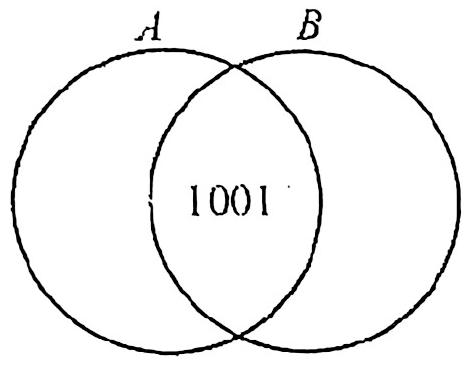
10. Sets $A$ and $B$, shown in the Venn diagram, have the same number of elements. Their union has $2007$ elements and their intersection has $1001$ elements. Find the number of elements in $A$.
$|A\cup B|=|A|+|B|-|A\cap B|$ with $|A|=|B|$:
$2007=2|A|-1001\Rightarrow|A|=1504$. Answer: C
2015 AMC 8 #15
11. At Euler Middle School, $198$ students voted on two issues in a school referendum with the following results: $149$ voted in favor of the first issue and $119$ voted in favor of the second issue. If there were exactly $29$ students who voted against both issues, how many students voted in favor of both issues?
"Against both" lives outside both circles — remove it first: $|A\cup B|=198-29=169$.
Then $169=149+119-|A\cap B|\Rightarrow|A\cap B|=99$. Answer: D
2019 AMC 8 #15
12. On a beach $50$ people are wearing sunglasses and $35$ people are wearing caps. Some people are wearing both sunglasses and caps. If one of the people wearing a cap is selected at random, the probability that this person is also wearing sunglasses is $\frac25$. If instead, someone wearing sunglasses is selected at random, what is the probability that this person is also wearing a cap?
Both probabilities share the same overlap. From the cap side: both $=35\cdot\tfrac25=14$.
From the sunglasses side: $P=\tfrac{14}{50}=\tfrac{7}{25}$. Answer: B
2017 AMC 8 #24
13. Mrs. Sanders has three grandchildren, who call her regularly. One calls her every three days, one calls her every four days, and one calls her every five days. All three called her on December 31, 2016. On how many days during the next year did she not receive a phone call from any of her grandchildren?
Number the days $1$–$365$; the calls land on multiples of $3$, $4$, $5$.
Singles: $\lfloor\tfrac{365}{3}\rfloor=121$, $\lfloor\tfrac{365}{4}\rfloor=91$, $\lfloor\tfrac{365}{5}\rfloor=73$.
Pairs (lcm): $\lfloor\tfrac{365}{12}\rfloor=30$, $\lfloor\tfrac{365}{15}\rfloor=24$, $\lfloor\tfrac{365}{20}\rfloor=18$. Triple: $\lfloor\tfrac{365}{60}\rfloor=6$.
Days with a call: $121+91+73-(30+24+18)+6=219$. Days without: $365-219=146$.
Answer: D
🆕 Fresh from the latest exams
The same ideas, exactly as they appeared on the most recent tests.
2025 AMC 8 #9
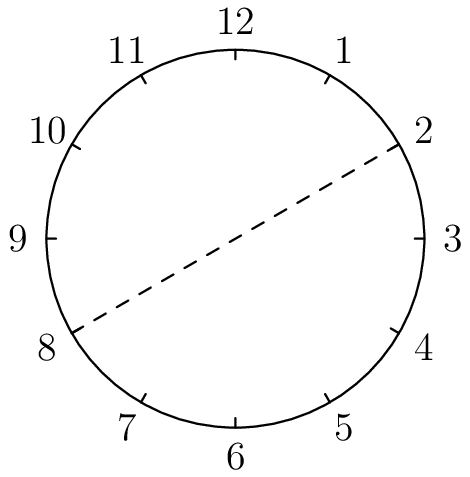
14. Ningli looks at the $6$ pairs of numbers directly across from each other on a clock. She takes the average of each pair of numbers. What is the average of the resulting $6$ numbers?
An average of averages over equal-size groups is just the average of everything:
$\dfrac{1+2+\cdots+12}{12}=\dfrac{78}{12}=6.5$.
(Slow way: the pairs $(12,6),(1,7),\ldots,(5,11)$ average to $9,4,5,6,7,8$ — mean $\tfrac{39}{6}=6.5$.)
Answer: B
2025 AMC 8 #14
15. A number $N$ is inserted into the list $2, 6, 7, 7, 28$. The mean is now twice as great as the median. What is $N$?
Six values: the median is the average of the $3$rd and $4$th.
If $N\ge7$: sorted list $2,6,7,7,\ldots$ — median $=\tfrac{7+7}{2}=7$, so the mean is $14$ and the sum is $84$: $N=84-50=34$ ✓ (consistent with $N\ge7$).
If $N\le6$: median $=\tfrac{6+7}{2}=6.5$, mean $13$, sum $78$, $N=28$ — contradicts $N\le6$ ✗.
Answer: E
2026 AMC 8 #22
16. The integers from $1$ to $25$ are arbitrarily separated into five groups of $5$ numbers each. The median of each group is identified. Let $M$ equal the median of the five medians. What is the least possible value of $M$?
$M$ is the $3$rd-smallest of the five group medians, so make three medians tiny and let the other two blow up.
Construction: groups starting $\{1,2,3,\ast,\ast\}$, $\{4,5,6,\ast,\ast\}$, $\{7,8,9,\ast,\ast\}$ (big numbers fill the $\ast$s) have medians $3, 6, 9$ — so $M=9$.
Why no lower: each of the three smallest medians needs $2$ group members below it, so at least $3\cdot3=9$ distinct integers are $\le$ the third median — it is at least $9$.
Answer: A
⭐ Challenge (AMC 10 level)
2021 AMC 10A #7 · contrapositive
C1. Tom has a collection of $13$ snakes, $4$ of which are purple and $5$ of which are happy. He observes that: all of his happy snakes can add; none of his purple snakes can subtract; and all of his snakes that can't subtract also can't add. Which of these conclusions can be drawn about Tom's snakes?
(A) Purple snakes can add.(B) Purple snakes are happy.(C) Snakes that can add are purple.(D) Happy snakes are not purple.(E) Happy snakes can't subtract.
Chain the facts: purple $\Rightarrow$ can't subtract $\Rightarrow$ can't add.
The contrapositive of "happy $\Rightarrow$ can add" is "can't add $\Rightarrow$ not happy" — so purple $\Rightarrow$ not happy, and (contrapositive again) happy $\Rightarrow$ not purple ✓ (D).
The others fail: (A) purple snakes can't add; (B) purple snakes aren't happy; (C) reverses an implication (converse!); (E) happy $\Rightarrow$ can add $\Rightarrow$ can subtract (contrapositive of fact 3).
Answer: D
2010 AMC 10A #15 · truth-tellers & liars
C2. In a magical swamp there are two species of talking amphibians: toads, whose statements are always true, and frogs, whose statements are always false. Four amphibians, Brian, Chris, LeRoy, and Mike, live together in this swamp, and they make the following statements.
Brian: "Mike and I are different species."
Chris: "LeRoy is a frog."
LeRoy: "Chris is a frog."
Mike: "Of the four of us, at least two are toads."
How many of these amphibians are frogs?
Chris and LeRoy accuse each other — if both were toads, both statements would be true, making both frogs (contradiction); both frogs is symmetric. So exactly one of Chris/LeRoy is a toad.
Now test Brian: if Brian is a toad, Mike is a frog, giving $2$ toads (Brian + one of C/L) — but then Mike's "at least two are toads" would be true from a frog ✗.
So Brian is a frog; his statement is false, so Mike is also a frog. Now only one toad exists (among C/L), so Mike's statement is false ✓ consistent.
Frogs: Brian, Mike, and one of Chris/LeRoy — three.
Answer: D
2018 AMC 10B #14 · mode
C3. A list of $2018$ positive integers has a unique mode, which occurs exactly $10$ times. What is the least number of distinct values that can occur in the list?
To use as few distinct values as possible, repeat every other value as often as allowed — at most $9$ times each (the mode of $10$ must stay unique).
Non-mode occurrences: $2018-10=2008=9\cdot223+1$ — so $223$ values used $9$ times and $1$ more value used once.
Total distinct: $223+1+1=225$.
Answer: D
course problem · three-set Venn
C4. There are $20$ students participating in an after-school program offering classes in yoga, bridge, and painting. Each student must take at least one of these three classes, but may take two or all three. There are $10$ students taking yoga, $13$ taking bridge, and $9$ taking painting. There are $9$ students taking at least two classes. How many students are taking all three classes?
Let $P=|A\cap B|+|A\cap C|+|B\cap C|$ and $T=|A\cap B\cap C|$.
Inclusion–exclusion: $20=10+13+9-P+T=32-P+T$.
"At least two classes" counts each double once and each triple once — but $P$ counts triples three times, so $P-2T=9$.
Substitute $P=9+2T$: $\;20=32-(9+2T)+T=23-T\Rightarrow T=3$.
Answer: C
🗝 Answer key
Example
1
2
3
4
5
cards 2 & 3
D
yellow box
B
C
Practice
1
2
3
4
5
6
7
8
9
10
11
12
13
14
15
16
box 2
white
D
A
A
C
D
C
D
C
D
B
D
B
E
A
Challenge
C1
C2
C3
C4
D
D
D
C
Sources: prep-course Lecture 09 (video + board notes + 22 worked examples, translated to English) and official AMC 8 / AMC 10 problems from the local bank
(kb/content/banks/) and course handouts. Answers verified against official answer keys where available.