Lines · Lecture 06 · geo-lines
📺 Course materials — Lecture 06 (93 min):
lecture video · handout PDF (Lecture 6) · board notes (06.jpg) · homework answer key (Chapter 6)
— all in the
amc8/video folder.
·
🖨 Printable PDF (answers & solutions at the back)
🔑 Key facts
Every non-vertical line is $y = mx + b$, where $m$ is the slope (steepness: $m=\dfrac{\text{rise}}{\text{run}}=\dfrac{y_2-y_1}{x_2-x_1}$)
and $b$ is the $y$-intercept (where it crosses the $y$-axis).
Parallel lines share a slope; perpendicular slopes multiply to $-1$.
For two points: distance $=\sqrt{(x_2-x_1)^2+(y_2-y_1)^2}$, midpoint $=\left(\dfrac{x_1+x_2}{2},\dfrac{y_1+y_2}{2}\right)$.
🧰 Instructor's toolbox (from the lecture video & board notes)
2 · Slope is a rate — "cause → effect". The instructor's table: width $1\to$ area $1$, $1.5\to1.5$, $2\to2\ldots$ gives $y=x$;
doubling ($1\to2$, $2\to4$) gives $y=2x$. The coefficient of $x$ is the rate.
In a distance–time graph the slope is the speed: constant speed = straight segment, resting = flat (slope $0$), faster = steeper.
That single idea solves Examples 1–2 and Practice 3 with no computation.
3 · Slope from two points. $m=\dfrac{y_2-y_1}{x_2-x_1}$ — board example: through $(0,-3)$ and $(7,6)$,
$m=\dfrac{6-(-3)}{7-0}=\dfrac{9}{7}$. Careful: subtract in the same order on top and bottom — mixing orders flips the sign.
5 · Parallel and perpendicular. Parallel $\Leftrightarrow$ same slope (different $b$).
Perpendicular $\Leftrightarrow$ $k_1\cdot k_2=-1$ — the board example: a line perpendicular to $y=2x+1$ has slope $-\tfrac12$.
To pin down the line, plug the known point into $y=kx+b$ and solve for $b$: through $(2,1)$, $\;1=-\tfrac12\cdot2+b \Rightarrow b=2$ (Practice 1's full solution).
6 · Intersection = solve the system; intercepts = set the other variable to 0.
Where $y=x$ meets $y=-x+6$: set them equal, $x=-x+6 \Rightarrow x=3$, point $(3,3)$ — that's the whole board demo.
$x$-intercept: set $y=0$; $y$-intercept: set $x=0$. Three lines enclosing a triangle? The vertices are the three pairwise intersections (Example 3).
8 · Midpoint = average of the ends — and it works backwards.
$M=\left(\dfrac{x_1+x_2}{2},\dfrac{y_1+y_2}{2}\right)$. The board runs it in reverse: if $D(-1,3)$ is the midpoint of $\overline{BC}$ with $B(2,-3)$,
then $\dfrac{2+m}{2}=-1\Rightarrow m=-4$ and $\dfrac{-3+n}{2}=3\Rightarrow n=9$, so $C(-4,9)$ — that is Example 5's entire solution.
9 · No coordinates? Build your own. When a pure-geometry figure gets messy, drop the origin on a natural corner so lengths become coordinates
and intersections become systems of equations. The instructor solves Practice 11 this way ("you could chase similar triangles — we'll use line equations instead"):
rectangle corner $D=(0,0)$, then every line through it is two points and tip #3.
📖 Worked examples
2019 AMC 8 #5 · slope = speed
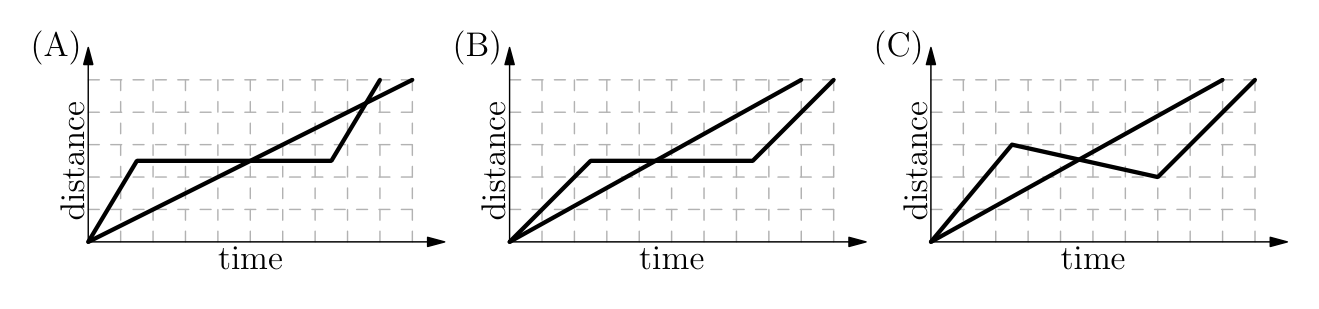
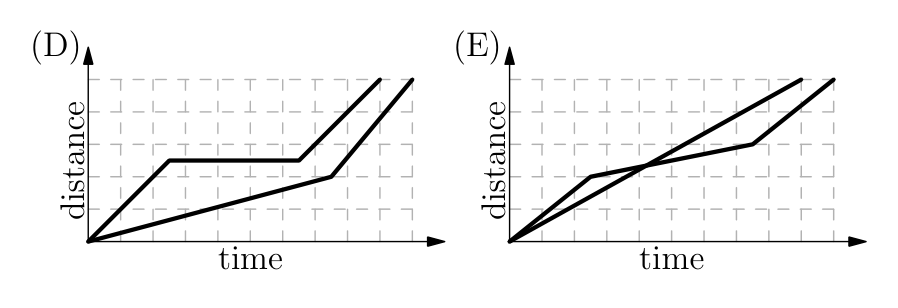
Example 1. A tortoise challenges a hare to a race. The hare eagerly agrees and quickly runs ahead, leaving the slow-moving tortoise behind. Confident that he will win, the hare stops to take a nap. Meanwhile, the tortoise walks at a slow, steady pace for the entire race. The hare awakes and runs to the finish line, only to find the tortoise already there. Which of the following graphs matches the description of the race, showing the distance $d$ traveled by the two animals over time $t$ from start to finish?
Key idea: in a distance–time graph, slope is speed.
The tortoise moves at one constant speed the whole way — one straight line, never flat.
The hare runs fast (steep), naps (flat, slope $0$), then runs again — that shape appears only in (A) and (B).
The hare arrives
later than the tortoise, so the hare's graph must reach the finish distance at a later time: that's (B).
Answer: B
2022 AMC 8 #15 · slope as unit price
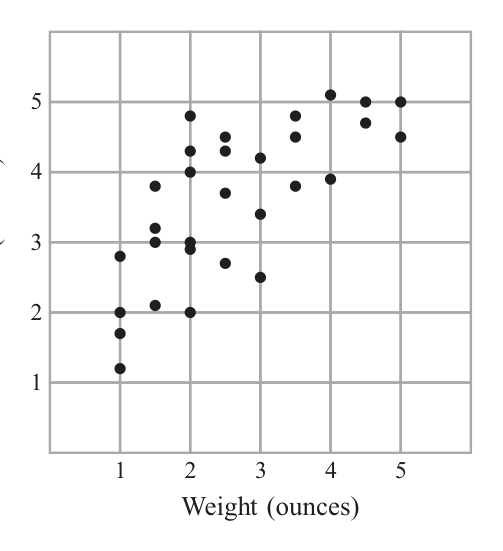
Example 2. Laszlo went online to shop for black pepper and found thirty different black pepper options varying in weight and price, shown in the scatter plot below. In ounces, what is the weight of the pepper that offers the lowest price per ounce?
(A) 1(B) 2(C) 3(D) 4(E) 5
Key idea: price per ounce $=\dfrac{\text{price}}{\text{weight}}$ is exactly the slope of the segment from the
origin to the point.
Lowest unit price = flattest such segment: sweep a ray up from the $x$-axis and the first point you touch wins.
That point is at weight $3$ ounces (price $\$2.50$ — slope $\approx0.83$ dollars/oz; every other point sits above that ray).
Answer: C
2019 AMC 8 #21 · triangle from 3 lines
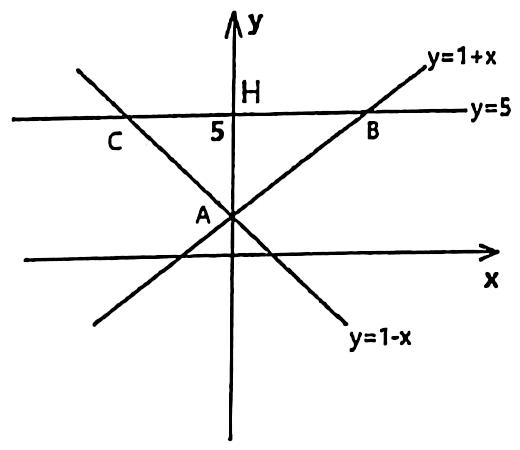
Example 3. What is the area of the triangle formed by the lines $y=5$, $y=1+x$, and $y=1-x$?
(A) 4(B) 8(C) 10(D) 12(E) 16
Key idea: the vertices are the pairwise intersections.
$y=1+x$ and $y=1-x$: $\;1+x=1-x\Rightarrow x=0$, vertex $A(0,1)$.
$y=5$ and $y=1+x$: $\;x=4$, vertex $B(4,5)$. $y=5$ and $y=1-x$: $\;x=-4$, vertex $C(-4,5)$.
Base $BC=8$ lies on $y=5$; height from $A$ is $5-1=4$. Area $=\tfrac12\cdot8\cdot4=16$.
Answer: E
2022 AMC 8 #18 · distance formula
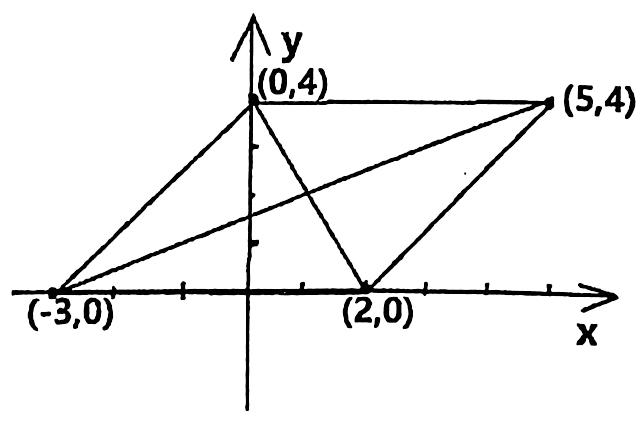
Example 4. The midpoints of the four sides of a rectangle are $(-3,0)$, $(2,0)$, $(5,4)$, and $(0,4)$. What is the area of the rectangle?
(A) 20(B) 25(C) 40(D) 50(E) 80
Key idea: joining the four side-midpoints of a rectangle always makes a
rhombus (the four corner right triangles are congruent by SAS), and the rhombus's diagonals run parallel to the rectangle's sides — each diagonal
equals a side length of the rectangle.
Diagonal 1: $(-3,0)$ to $(5,4)$: $\sqrt{8^2+4^2}=\sqrt{80}=4\sqrt5$. Diagonal 2: $(2,0)$ to $(0,4)$: $\sqrt{2^2+4^2}=\sqrt{20}=2\sqrt5$.
Rectangle area $=4\sqrt5\cdot2\sqrt5=40$.
Answer: C
course problem · midpoint backwards
Example 5. Points $A(11,9)$ and $B(2,-3)$ are vertices of $\triangle ABC$ with $AB=AC$. The altitude from $A$ meets the opposite side at $D(-1,3)$. What are the coordinates of point $C$?
(A) $(-8,9)$(B) $(-4,8)$(C) $(-4,9)$(D) $(-2,3)$(E) $(-1,0)$
Key idea: in an isosceles triangle the altitude from the apex is also the median — so $D$ is the
midpoint of $\overline{BC}$.
Run the midpoint formula backwards: $x_C=2x_D-x_B=-2-2=-4$, $\;y_C=2y_D-y_B=6-(-3)=9$. So $C(-4,9)$.
Answer: C
✏️ Practice
Try each one before opening the solution. Figures are from the official exams and course handouts.
course problem · perpendicular
1. What is an equation of the line perpendicular to the line $y=2x+1$ that contains the point $(2,1)$?
Solution
Perpendicular to slope $2$ means slope $-\tfrac12$, so $y=-\tfrac12x+b$.
Plug in $(2,1)$: $\;1=-\tfrac12\cdot2+b\Rightarrow b=2$.
Answer: $y=-\tfrac12x+2$
course problem · parallel
2. What is an equation of the line parallel to the line $y=-2x+3$ with a $y$-intercept of $-2$?
Solution
Parallel means the same slope, $-2$; the $y$-intercept is given directly, $b=-2$.
Both parts of $y=kx+b$ are handed to you: $y=-2x-2$.
Answer: $y=-2x-2$
2022 AMC 8 #10
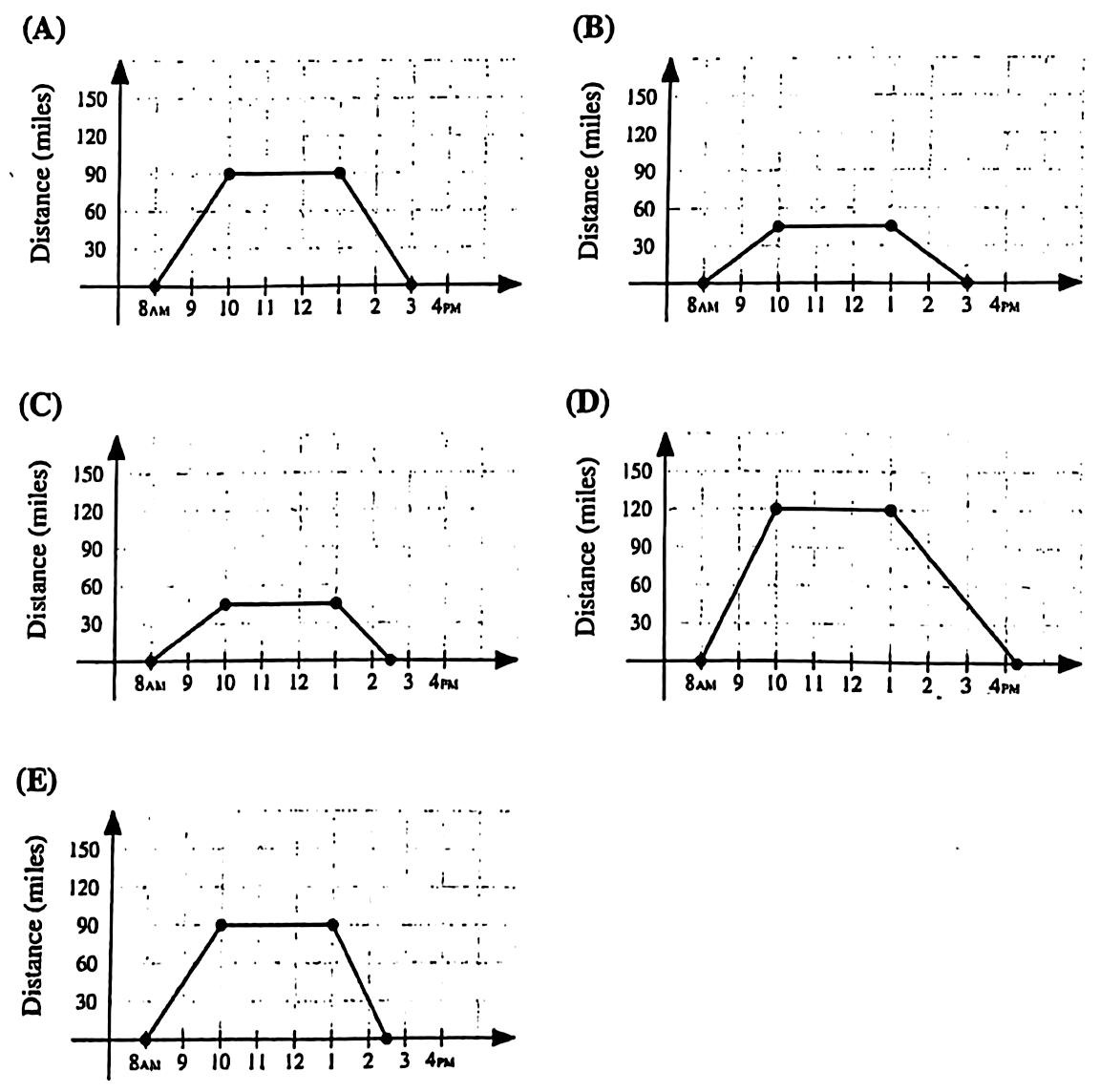
3. One sunny day, Ling decided to take a hike in the mountains. She left her house at 8 AM, drove at a constant speed of $45$ miles per hour, and arrived at the hiking trail at 10 AM. After hiking for $3$ hours, Ling drove home at a constant speed of $60$ miles per hour. Which of the following graphs best illustrates the distance between Ling's car and her house over the course of her trip?
(A)(B)(C)(D)(E)
Solution
Trace the trip: 8–10 AM, distance climbs $0\to 45\cdot2=90$ miles.
10 AM–1 PM the car is parked at the trail: flat at $90$ for $3$ hours.
Then home at $60$ mph: $90\div60=1.5$ h back to $0$, a
steeper segment down, ending at 2:30 PM.
Peak at $90$ (kills D), flat top of length 3 h ending at 1 PM, faster return than outbound — that's (E).
Answer: E
course problem · common point
4. All lines with equation $ax+by=c$ such that $a+c=2b$ pass through a common point. What are the coordinates of that point?
(A) $(-1,2)$(B) $(0,1)$(C) $(1,-2)$(D) $(1,0)$(E) $(1,2)$
Solution
A point is on the line exactly when it satisfies the equation.
Rewrite the condition $a+c=2b$ as $a\cdot(-1)+b\cdot 2=c$ — but that is precisely $ax+by=c$ evaluated at $x=-1,\ y=2$.
So every such line passes through $(-1,2)$.
Answer: A
2017 AMC 10B #10 · AMC 10
5. The lines with equations $ax-2y=c$ and $2x+by=-c$ are perpendicular and intersect at $(1,-5)$. What is $c$?
(A) $-13$(B) $-8$(C) $2$(D) $8$(E) $13$
Solution
Slopes are $\tfrac a2$ and $-\tfrac2b$; perpendicular means $\tfrac a2\cdot\!\left(-\tfrac2b\right)=-1$, so $a=b$.
The point $(1,-5)$ satisfies both equations: $a+10=c$ and $2-5b=-c$, i.e. $c=5b-2=5a-2$.
Then $a+10=5a-2\Rightarrow a=3$ and $c=13$.
Answer: E
2003 AMC 10B #11 · AMC 10
6. A line with slope $3$ intersects a line with slope $5$ at the point $(10,15)$. What is the distance between the $x$-intercepts of these two lines?
(A) 2(B) 5(C) 7(D) 12(E) 20
Solution
Write each line through $(10,15)$: $y-15=3(x-10)$ and $y-15=5(x-10)$.
Set $y=0$: the first gives $x=5$, the second $x=7$. The $x$-intercepts are $2$ apart.
Answer: A
2017 AMC 10A #12 · AMC 10
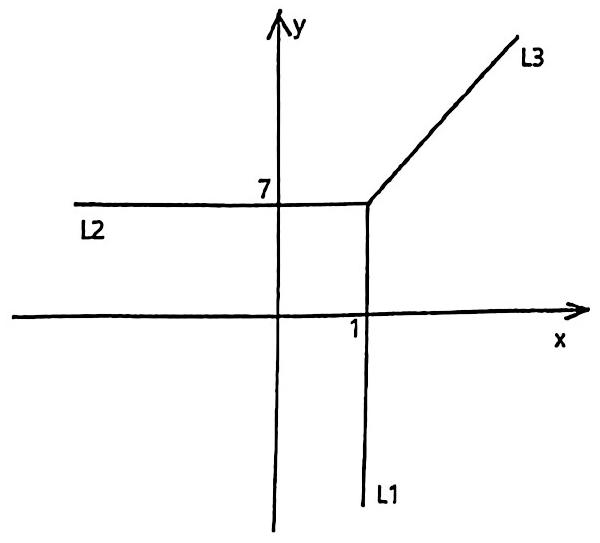
7. Let $S$ be the set of points $(x,y)$ in the coordinate plane such that two of the three quantities $3$, $x+2$, and $y-4$ are equal and the third of the three quantities is no greater than this common value. Which of the following is a correct description of $S$?
(A) a single point(B) two intersecting lines(C) three lines whose pairwise intersections are three distinct points(D) a triangle(E) three rays with a common endpoint
Solution
Three cases for which pair is equal:
(1) $3=x+2$ and $y-4\le3$: the ray $x=1,\ y\le7$ going
down.
(2) $3=y-4$ and $x+2\le3$: the ray $y=7,\ x\le1$ going
left.
(3) $x+2=y-4$ and $3\le x+2$: the ray $y=x+6,\ x\ge1$ going
up-right.
All three rays start at the same point $(1,7)$.
Answer: E
2015 AMC 10B #13 · AMC 10
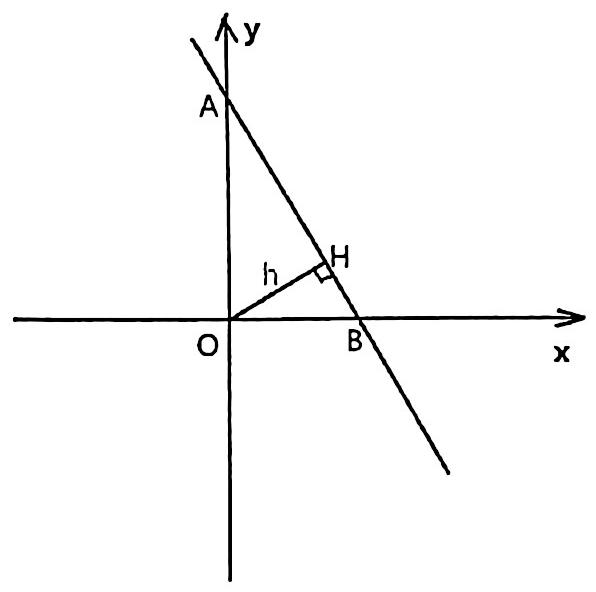
8. The line $12x+5y=60$ forms a triangle with the coordinate axes. What is the sum of the lengths of the altitudes of this triangle?
Solution
Intercepts: $x=5$ gives $B(5,0)$; $y=12$ gives $A(0,12)$ — a right triangle with legs $5$, $12$ and hypotenuse $13$.
Two altitudes
are the legs: $12$ (onto $OB$) and $5$ (onto $OA$).
For the third, compute the area two ways: $AO\cdot BO=AB\cdot h\Rightarrow 60=13h\Rightarrow h=\tfrac{60}{13}$.
Sum $=5+12+\tfrac{60}{13}=\tfrac{281}{13}$.
Answer: $\tfrac{281}{13}$
2014 AMC 10A #14 · AMC 10
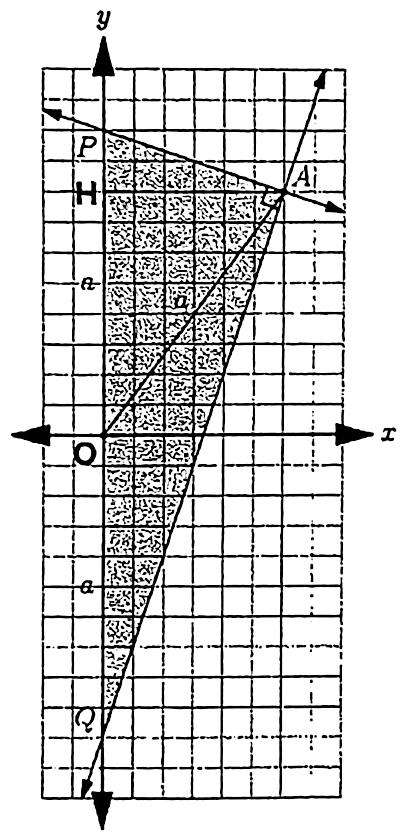
9. The $y$-intercepts, $P$ and $Q$, of two perpendicular lines intersecting at the point $A(6,8)$ have a sum of zero. What is the area of $\triangle APQ$?
(A) 45(B) 48(C) 54(D) 60(E) 72
Solution
$P$ and $Q$ sit on the $y$-axis with $y$-coordinates summing to $0$ — so the origin $O$ is the
midpoint of $\overline{PQ}$.
The lines are perpendicular at $A$, so $\triangle APQ$ has a right angle at $A$, and the median to the hypotenuse is half the hypotenuse: $PQ=2\,AO$.
$AO=\sqrt{6^2+8^2}=10$ (a $6$-$8$-$10$ triple), so $PQ=20$.
The height from $A$ to the $y$-axis is just $x_A=6$.
Area $=\tfrac12\cdot20\cdot6=60$.
Answer: D
2015 AMC 10A #17 · AMC 10
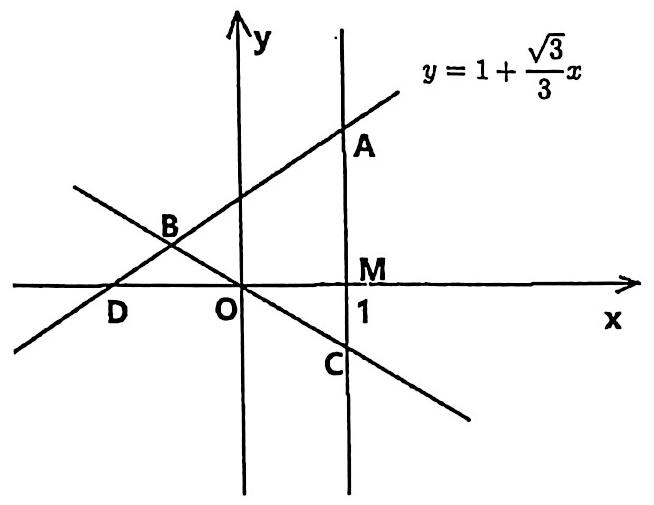
10. A line that passes through the origin intersects both the line $x=1$ and the line $y=1+\dfrac{\sqrt3}{3}x$. The three lines create an equilateral triangle. What is the perimeter of the triangle?
(A) $2\sqrt6$(B) $2+2\sqrt3$(C) $6$(D) $3+2\sqrt3$(E) $6+\frac{\sqrt3}{3}$
Solution
Slope $\tfrac{\sqrt3}{3}$ means the given line rises at $30^\circ$; the equilateral triangle stands on the vertical line $x=1$, so its side $\overline{AC}$ is vertical.
$D$ is the given line's $x$-intercept: $0=1+\tfrac{\sqrt3}{3}x\Rightarrow x=-\sqrt3$, and $M=(1,0)$, so $DM=1+\sqrt3$.
In right $\triangle ADM$ with $\angle ADM=30^\circ$: $AM=\dfrac{DM}{\sqrt3}=\dfrac{1+\sqrt3}{\sqrt3}=1+\dfrac{\sqrt3}{3}$.
The mirror line through the origin makes $-30^\circ$: in right $\triangle OMC$, $CM=\dfrac{OM}{\sqrt3}=\dfrac{\sqrt3}{3}$.
Side $AC=AM+MC=1+\dfrac{2\sqrt3}{3}$, so the perimeter is $3\left(1+\tfrac{2\sqrt3}{3}\right)=3+2\sqrt3$.
Answer: D
2003 AMC 10A #22 · AMC 10
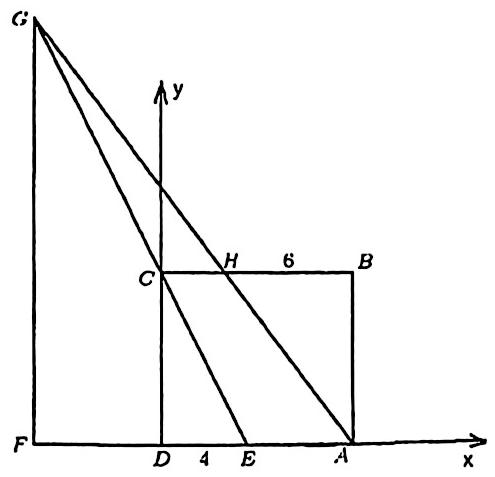
11. In rectangle $ABCD$, we have $AB=8$, $BC=9$, $H$ is on $\overline{BC}$ with $BH=6$, $E$ is on $\overline{AD}$ with $DE=4$, line $EC$ intersects line $AH$ at $G$, and $F$ is on line $AD$ with $\overline{GF}\perp\overline{AF}$. Find the length of $GF$.
(A) 16(B) 20(C) 24(D) 28(E) 30
Solution
You could chase similar triangles — instead, build coordinates: origin at $D$, with $\overline{DA}$ along the $x$-axis and $\overline{DC}$ along the $y$-axis.
Then $C(0,8)$, $E(4,0)$, $A(9,0)$, $H(3,8)$.
Line $EC$: slope $\tfrac{0-8}{4-0}=-2$, so $y=-2(x-4)$. Line $AH$: slope $\tfrac{8-0}{3-9}=-\tfrac43$, so $y=-\tfrac43(x-9)$.
Set equal: $-2x+8=-\tfrac43x+12\Rightarrow -\tfrac23x=4\Rightarrow x=-6$, $y=20$.
$GF$ is the vertical drop from $G$ to line $AD$ (the $x$-axis): $GF=20$.
Answer: B
🆕 Fresh from the latest exams
The same ideas, exactly as they appeared on the most recent tests.
2024 AMC 8 #10
12. In January 1980 the Mauna Loa Observatory recorded carbon dioxide $(CO_2)$ levels of $338$ ppm (parts per million). Over the years the average $CO_2$ reading has increased by about $1.515$ ppm each year. What is the expected $CO_2$ level in ppm in January 2030? Round your answer to the nearest integer.
(A) 399(B) 414(C) 420(D) 444(E) 459
Solution
Steady growth is a line: $y=1.515x+338$ with $x$ = years since 1980.
At $x=50$: $\;338+1.515\cdot50=338+75.75=413.75\approx414$.
Answer: B
2024 AMC 8 #11
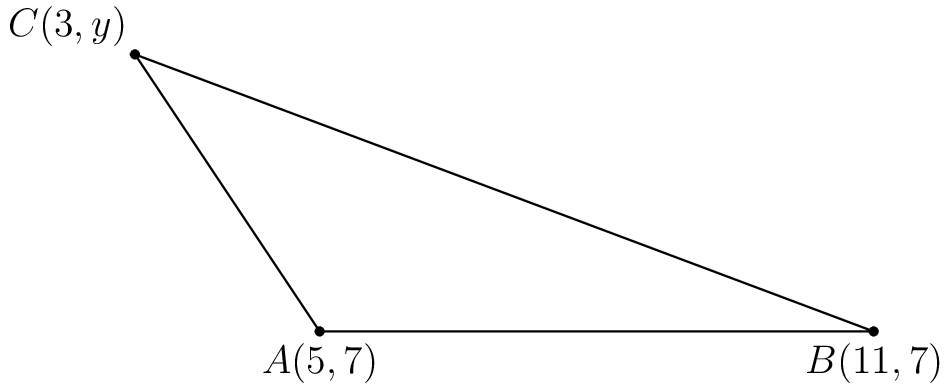
13. The coordinates of $\triangle ABC$ are $A(5,7)$, $B(11,7)$, and $C(3,y)$, with $y>7$. The area of $\triangle ABC$ is $12$. What is the value of $y$?
(A) 8(B) 9(C) 10(D) 11(E) 12
Solution
$\overline{AB}$ is horizontal (both $y$-coordinates are $7$) with length $11-5=6$ — a perfect base.
The height is how far $C$ sits above that line: $y-7$.
So $\tfrac12\cdot6\cdot(y-7)=12\Rightarrow y-7=4\Rightarrow y=11$.
Answer: D
2024 AMC 8 #23
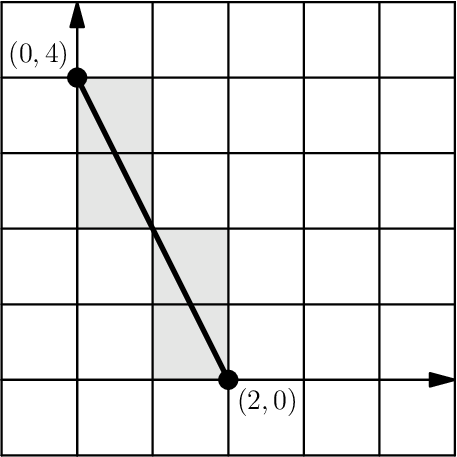
14. Rodrigo has a very large sheet of graph paper. First he draws a line segment connecting point $(0,4)$ to point $(2,0)$ and colors the $4$ cells whose interiors intersect the segment, as shown below. Next Rodrigo draws a line segment connecting point $(2000,3000)$ to point $(5000,8000)$. How many cells will he color this time?
(A) 6000(B) 6500(C) 7000(D) 7500(E) 8000
Solution
The run is $\Delta x=5000-2000=3000$ and the rise is $\Delta y=8000-3000=5000$, so the slope is $\tfrac53$.
Count cells the way the pencil meets them: after the first cell, a new cell starts each time the segment crosses an interior grid line — $\Delta x-1$ vertical ones and $\Delta y-1$ horizontal ones — except at an interior lattice point, where both crossings coincide and only one new cell starts ($\gcd(\Delta x,\Delta y)-1$ such points).
So: $1+(\Delta x-1)+(\Delta y-1)-(\gcd-1)=\Delta x+\Delta y-\gcd(\Delta x,\Delta y)$.
Check on the picture: $2+4-\gcd(2,4)=2+4-2=4$ ✓.
Here: $3000+5000-\gcd(3000,5000)=3000+5000-1000=7000$.
Answer: C
⭐ Challenge (AMC 10 level)
2014 AMC 10A #18 · tilted square
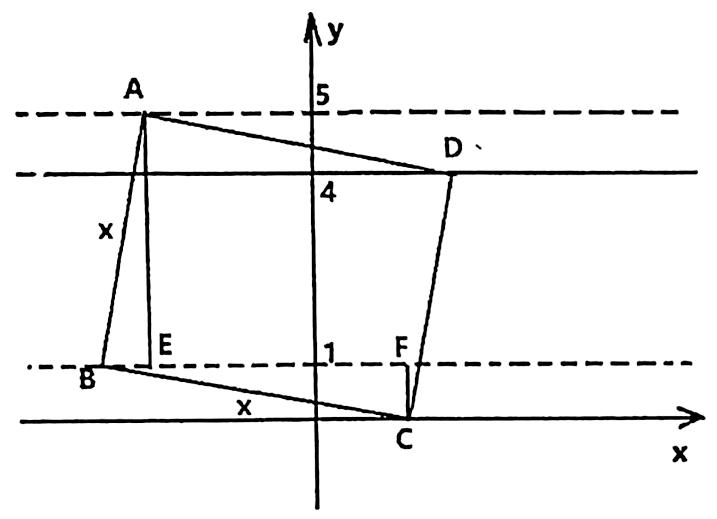
C1. A square in the coordinate plane has vertices whose $y$-coordinates are $0$, $1$, $4$, and $5$. What is the area of the square?
(A) 16(B) 17(C) 25(D) 26(E) 27
Solution
Think of the four horizontal lines $y=0,1,4,5$. Drop perpendiculars: through $A$ draw $AE\perp BF$ and through $C$ draw $CF\perp BF$.
$\angle ABE+\angle CBF=90^\circ=\angle CBF+\angle BCF$, so $\angle ABE=\angle BCF$, and $AB=BC$ gives $\triangle ABE\cong\triangle BCF$.
So the side of the square is the hypotenuse of a right triangle with legs $4$ (from $y=0$ to $y=4$) and $1$ (from $y=4$ to $y=5$):
$s^2=4^2+1^2=17$ — and $s^2$
is the area.
Answer: B
2013 AMC 10A #18 · equal-area cut
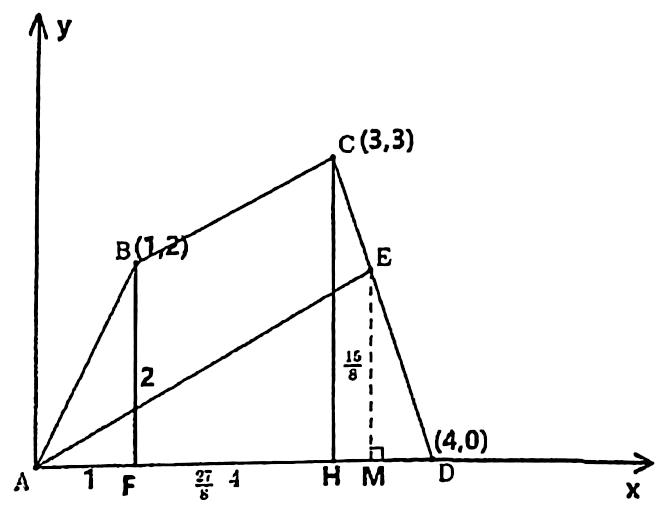
C2. Let points $A=(0,0)$, $B=(1,2)$, $C=(3,3)$, and $D=(4,0)$. Quadrilateral $ABCD$ is cut into two pieces of equal area by a line passing through $A$. This line intersects $\overline{CD}$ at the point $\left(\dfrac pq,\dfrac rs\right)$, where these fractions are in lowest terms. What is $p+q+r+s$?
(A) 54(B) 58(C) 62(D) 70(E) 75
Solution
First the total area, by slicing along verticals: $S_{ABCD}=1+\tfrac{(2+3)}{2}\cdot2+\tfrac32=\tfrac{15}{2}$, so each piece is $\tfrac{15}{4}$.
The cut $\overline{AE}$ (with $E$ on $\overline{CD}$) makes $\triangle AED$ with base $AD=4$:
$\tfrac12\cdot4\cdot y_E=\tfrac{15}{4}\Rightarrow y_E=\tfrac{15}{8}$.
Line $CD$ drops from $(3,3)$ to $(4,0)$ — slope $-3$. At height $\tfrac{15}{8}$: $x_E=4-\tfrac{15/8}{3}=4-\tfrac58=\tfrac{27}{8}$.
So $E=\left(\tfrac{27}{8},\tfrac{15}{8}\right)$ and $p+q+r+s=27+8+15+8=58$.
Answer: B
🗝 Answer key
| Example | 1 | 2 | 3 | 4 | 5 |
|---|
| B | C | E | C | C |
|---|
| Practice | 1 | 2 | 3 | 4 | 5 | 6 | 7 | 8 | 9 | 10 | 11 | 12 | 13 | 14 |
|---|
| $y=-\tfrac12x+2$ | $y=-2x-2$ | E | A | E | A | E | $\tfrac{281}{13}$ | D | D | B | B | D | C |
|---|
| Challenge | C1 | C2 |
|---|
| B | B |
|---|
Sources: prep-course Lecture 06 (video + board notes + 18 worked examples, translated to English) and official AMC 8 / AMC 10 problems from the local bank
(kb/content/banks/) and course handouts. Answers verified against official answer keys where available.